Economy
Lefties! throw off your tired affection to Microsoft or Apple!

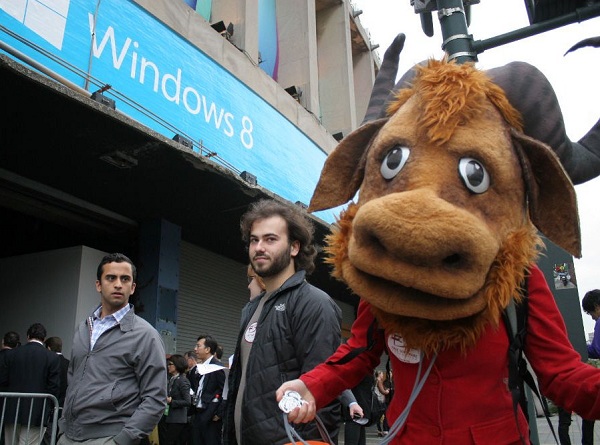

I am often disappointed and bemused by the use of propriety software by members of the ‘progressive’ community. In a world of No Logo, of occupy movements, of an outburst of angry and the desire for freedom, too many are stuck using the software of large corporations whose main concern is profit.
Back in the day we all had vinyl records, but somewhere along the line came the CD player. With this we lost the warmth of colour in recorded music. In return we got ease of storage and a smaller size. But even the benefits of the CD format are dubious, as we were told that the main benefit we would get is the the CD will never scratch, will never be damaged. I think that any of us who own CDs will see the fallacy of this claim.
And now we are moving to the MP3 format, losing even more of the warmth and colour of music as the tunes are forced into a compressed format.
In all this time, with the eroding away of the quality of music have we seen a lowering of the price for music? Has all this been done for the benefits of the large music companies or for the consumer? I will leave the questions as an exercise for the reader.
And of course like all things IT the creation of the MPH3 format led to a series of patent battles. The winning format may or may not have been the best technical solution, think of the VHS & BETA format wars.
So it is with software and operating systems. Too many are just happy to go along with the flood and not think too much about what software they use. Many think there are not even any options for them to use alternative software.
But there are many alternatives to use. The first one that jumps to mind is Linux, but also there is the BSD project. Linux has made great strides since my first attempts to use it way back in the 90s. Installation and use of the distributions are as easy and straight forward as any Windows or Apple machine. Indeed both Microsoft and Apple are happy to use Free Software in their systems.
However there is much confusion about free software and what it stands for. Think free as in speech, not free as in beer.
Many years ago some programmers at the MIT artificial intelligence laboratory had a problem with a printer. Being some of the best programmers in the world at the time, they thought it best to ‘patch’ the printer driver and so carry on with their work. But sadly the producer of the printer would not release the code and so they were forced to come up with another solution. I can not remember what the outcome of this particular issue was, most likely they bought a new printer. However one of the programmers, Richard Stallman, saw this as a serious and ongoing issue. Having spent time in the MIT computer labs he was used to the idea of people making software and sharing it within the university/workplace, with friends and acquaintances. It is exactly this sort of collaborative effort that computers and the internet make possible. It is precisely this sort of collaboration that the large software and hardware manufacturers oppose. Unless of course if attempts at ‘freedom’ give them a competitive edge.
There is also a fair bit of purposeful confusion and mischief making surrounding the idea of free software. The source of the truth can be found on the Free Software Foundation (FSF) website, and can be easily accessed by anyone interested in such things. Free software is again concerned with personal freedom and equally important with personal development. It is not, regardless of what some will say, concerned with free as in price (although much free software can in fact be downloaded at no cost.) There is nothing that disallows programmers and entrepreneurs from charging for software, nor for support. Many companies, the first one that springs to mind in the Ubuntu Linux distribution, have used Free Software as a successful business model.
Ubuntu is a great starting point for a Linux tyro, simple to install and fully featured with Office suites, a replacement for photoshop called the GIMP that will be more than sufficient for most peoples needs, as well as all the networking tools one could ever need. Ubuntu is an African term, arising from the indigenous philosophy and it means, in the short form ‘Humanity to others’ or in a longer form ‘I am what I am because of who we all are.’ Or in a cheeky geeky joke it may mean ‘I can’t configure Debian.’
Indeed the Free Software world is full of silly puns and jokes like this. GNU the project started by Stallman is a recursive abbreviation meaning Gun’s Not Unix. The scripting language perl is often called the pathologically eclectic rubbish lister. The SUSE distribution, made by a German company and now in partnership with Novell boots up with the slogan ‘have a lot of fun…’
And to me this shows the greatest aspect of Free Software; one is in a position to learn and have fun while using a computer. Maybe I am old fashioned, but I see computers and the network as one of the greatest achievements of the modern world. Some of best minds over several generations have worked to create this great liberating tool. I think it is incumbent on users to be try to use computers to extend themselves, to make themselves learn and get out of their comfort zone.
Small business will be able to use Linux and save themselves some money, as compared to Windows or Apple there are versions of Linux that will install and run happily on older, out of date hardware. A perfect solution for hosting an intranet, or a database.
I am under no illusions, Linux is not for everyone. There are some applications that will not have free alternatives. For the professional artist only photoshop will do, same with Auto CAD. But for most people and businesses and for most uses the Linux alternative is a valid option to at least investigate.
How useful is Linux in the real world? While it is hard to get good statistics, as most of the information is gathered by adding up licences, even Microsoft CEO Steve Ballmer admits that some 60% of web servers use Linux. But of course as Linux is freely available and can be used with no licensing hoops to jump through the figure may very well be higher. When the NSA wanted to create a more secure OS they used Linux as a base, and have since released the very uptight SELinux (Security enhanced Linux.) NASA uses Linux in many applications. For large powerful enterprises like these there is a great benefit to being able to access and modify the Operating System code at no extra cost to the company! IBM has great interest in Linux and uses it extensively. IBM has supported Linux since 1999 and has over 600 developers extending this free operating system as well as over 500 applications.
I will end this little rant, by going back to my original thought and request that progressives in particular should take a closer look at Linux. Lefties! throw off your tired affection to Microsoft or Apple!
Get off the treadmill of large multi nationals forcing you to work in the way that is most convenient for them and work in the way you want.
There is nothing to fear, and only a new world to conquer. Indeed to only problems one may have is finding the right distribution to use, as there are literally hundreds of options to chose from. If you need a web server, or a quick and dirty rescue disk, maybe you want to do music or film editing, or scientific work, look around and one can find a distribution to fit your needs. (To gain an idea look at the Distrowatch website.) To get started one only has to google Linux Live CD, from here one can find a distribution that can then but burnt onto a CD or a USB stick. Reboot the computer and then one will be able to try out Linux. This will make no changes to the hard drive, but will allow one to explore and hopefully have a lot of fun. Alternately pop into your local news agent and you will find many of the computer magazines will have a free CD to use.
And I will leave with a quote from the Free Software Foundation, describing what is meant by free software and the four freedoms we should demand from software. A deeper discussion can be found on the website www.gnu.org.
A program is free software if the program’s users have the four essential freedoms:
The freedom to run the program, for any purpose (freedom 0).
The freedom to study how the program works, and change it so it does your computing as you wish (freedom 1). Access to the source code is a precondition for this.
The freedom to redistribute copies so you can help your neighbour (freedom 2).
The freedom to distribute copies of your modified versions to others (freedom 3).
By doing this you can give the whole community a chance to benefit from your changes. Access to the source code is a precondition for this.
PS As I feel the need to eat my own dog food, this article was written using the EMACS editor on a laptop running Ubuntu 9.