Economy
Changing of the Guard among Tasmania’s forestry moguls

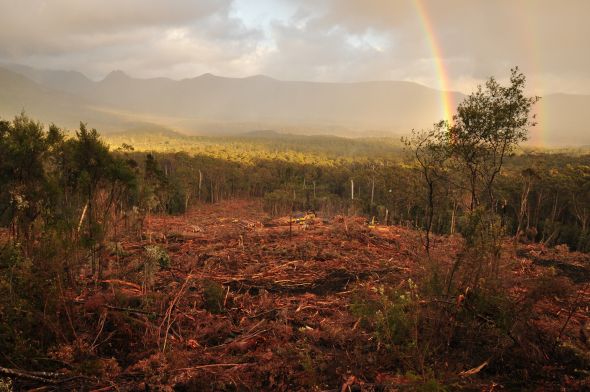

In December 2011 Neville Smith Forest Products bought back a mill processing high quality Tasmanian Oak products (mountain and alpine ash, and messmate) from Gunns. The sawmill at Mowbray, Launceston was owned by the Neville Smith family until it was bought by Gunns.
Neville Smith Timber was founded by James’ grandfather in 1924 and grew to be one of Australia’s most prominent hardwood processing businesses. The mill was sold to ITC in 2004, who in turn sold to Gunns in 2009; now it’s back with the family company.
Reference: http://www.smh.com.au/business/tasmanian-forestry-family-returns-to-business-20111204-1odd3.html#ixzz28UkxL4cL
Today [Friday 5 October 2012] the Tasmanian Company which is investing heavily in the forestry industry creating job opportunities announced the purchase of a new Tasmanian asset. A new market has emerged for wood from Tasmania’s timber plantations; Neville Smith Forest Products has purchased the former Forest Enterprises Smart Fibre plant at Bell Bay and will process woodchips from plantations. The plant has been idle for the past 6 months and has the capacity to process around 350,000 tonnes of woodchip a year and has port access.
Chairman of Neville Smith Products, James Neville Smith says the capacity of the facility means they can process more than residue from their own sawmills.
James Neville Smith: Oh absolutely … our sawmill will generate – sawmill residues – as every sawmill does. But not to the extent that could keep a facility like Smart Fibre open, for that volume alone. No, there will … we will need volumes from other mills and other forest owners. It’s a, ahh… magnificent facility. But fundamentally it’s an access port to get the woodchip estate, or the plantation estates off the island. And I think right now that’s been a big problem for the whole industry. And ahhm… this is just the first step in terms of rectifying that problem.
Sally Dakis: Was your interest in the processing plant accelerated with the demise of Gunns or it going into administration? Did that change anything for you?
James Neville Smith: No… (pause)… nope. That didn’t make any difference. I mean, you know, for us the demise of Gunns is a tragedy like it is… like it should be recognised for, you know, the rest of the Tasmanian community. I mean it’s a long-standing company that … you know lost their way and where they got themselves in a position of too much debt and were forced to make some decisions that were, I think… were detrimental to the industry. But that… that’s past, you know, we’ve all gotta move on. And, ahh … I think the industry needs to regroup. And, ahhm… Tasmania, as a whole, needs to regroup and consider the impact of, ahhm … of the loss of Gunns; and the loss of the jobs and the loss… the money flowing through the community.
Sally Dakis: What do you see your role? Do you see that Neville Smith Forest Products would actually purchase plantation wood to put through the Smart Fibre plant?
James Neville Smith: Ahhm … quite possibly; more than likely. We’ll enter into all sorts … types of arrangements with various forest owners to ensure, ahh … the plant is utilised to get the woodchips off the island.
Sally Dakis: How significant a role might it play, given its capacity to process woodchips and the size of Tasmania’s plantation estate?
James Neville Smith: Well, Tasmania’s got a large plantation estate as you’re aware and over the next decade there going to be a lot of wood that’s going to go through facilities such as Smart Fibre. There are other facilities in the State that can handle the volume … and, you know, woodchips is a commodity type product obviously. And, ahhm… logistics is important. So obviously with Smart Fibre being in the North East, it’s going to be well located for the plantation estate in the North east. There are facilities that would be better suited; you know, to areas, ahhm… in North West of the State. Yeah, we see Smart Fibre as being a strategic asset for the plantation estate going forward.
Sally Dakis: How good a financial investment is the mill? At the moment the Stock Exchange declares that the price [paid for the mill] is a confidential price. But how good an investment is it for your company?
James Neville Smith: Probably a question better asked in a couple of years’ time, Sally. But we think it’s a good investment. We think it’s an important piece of the puzzle for what we’re going in Tasmania. Ahhm … you know, we have a positive view. We’re probably a bit contrarian down in Tassie; we have a positive view about how it looks for forestry. We think, you know, that the sustainable management of forestry … forestry assets – be it plantation or native – is part of the environmental solution, as opposed to the problem.
And, ahhm… I think over time, or I hope over time … because it’s critical to Tasmania’s economy, that that fact becomes reality in people’s minds.
Sally Dakis: Why do you think you’re company has been able to take that position, because ahh… essentially your company sold out of a lot of hardwood investments back in 2004; you’ve re-purchased a lot of the Gunns assets. Why go against the trend?
James Neville Smith: Well … (pause) … I mean, the trend was set by … I mean, a lot of the companies … a lot of the forestry sector, have gone through a lot of trouble because of the association with the managed investment scheme business. I mean, that’s what has brought a lot of these businesses down. And Gunns had a perfectly good operating business with sawmills and woodchip facilities and… they got, you know, they got too much debt; that was their fundamental problem. And, of course the markets went against them and the dollar and all those things that we are all aware of. But, look the forestry industry is an industry that we’re obviously aware of; we’re passionate about. We didn’t sell out because we didn’t like it, we sold out because, you know, we got offered a price… we decided to take it.
Look, the forest industry is a sustainable industry based on a sustainable resource. It employs people in Australia, ahhm … we utilise the wood. I mean, most of our products that we saw up and process here in Tasmania, is sold in Tasmania. Now, you know, if we stop that industry then well be importing similar types of timbers from places were forest management and sustainable practices that are far worse than anything that one could perceive was wrong with Tasmania. So, you know, we’ve got one of the best managed forests in the world in Tassie … as they do in Victoria and other parts of Australia. Ahhm … it’s just that the politics have got people thinking otherwise.
Sally Dakis: But aren’t you concerned about the politics. We’re seeing an industry going through a restructure; we’re seeing the Intergovernmental Agreement on shaky ground at the moment. That is going to have a bearing on the future of the industry, isn’t it? Are you not concerned by that … uncertainty?
James Neville Smith: Ahh … look, we’re concerned about it. We’ve been operating in the face of that perversity for decades. I mean, the reality is, as I said, this is a resource that is sustainable; that’s undeniable. Trees grow back. Now, we as a country have gotta make decisions: do we want to export we export our natural resources out of the ground, we don’t do any value-adding, we send it off to China and buy the steel back.
Now, in Australia we get the opportunity to utilise our natural resource, grow it back, andcontinue to utilise it. And in one generation or one life time you can see that regeneration coming through, like I’ve seen from my forebears. So, I am, ahhm … absolutely committed and I believe the lion’s share of the environmental movement are committed to the proposition of sustainable management of forestry. In fact, FSC certification which is heralded as the, ahhm … benchmark of certification in the forestry sector was actually based on native forest sustainable management practices. That’s were it all came out of North America and Europe – all through the Western World, native forest sustainable management is a proud industry within the community. Why’s it’s not in Tasmania, I’ve got no idea, but I believe it will be one day.
[Neville Smith Products will take over the plant on the first of December.]
Reference: http://www.abc.net.au/rural/tas/content/2012/10/s3604597.htm