Economy
Tasmania’s forestry saga – in limbo again!

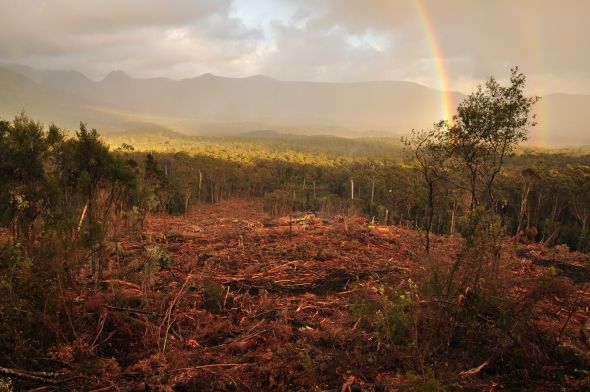

As everyone probably guessed, Forest Industries Association of Tasmania (FIAT) has staged its walk out. It has declared it will stay out of the negotiations over the minority Government’s decision to restructure Forestry Tasmania proposed by Forests Minister Bryan Green and seconded by the Tasmanian Greens Leader, Nick McKim.
The on again-off again talks are again in limbo for a month. The forest industry signatories have staged their well-semaphored walk out for maximum effect and impact.
Today acting Premier Bryan Green announced he would push for the establishment of a new statutory authority to take control of Tasmania’s production forests. Labor’s minority government partner – the Tasmanian Greens – had been arguing for the forests to be transferred to a government department.
“The industry had been concerned about ensuring that there is not ministerial control over the management of forests in Tasmania,” Mr Green said.
“I agree with that. We’re putting in place a process to ensure effectively a body is developed to allow that to happen, it is independent from ministerial control. What I’m looking to do is ensure that we get an outcome that everybody can be happy with.”
FIAT threatened to walk away from the negotiations if the Greens got their way. FIAT’s CEO, Mr Terry Edwards claims the Minister reneged on an assurance he gave on restructuring within Forestry Tasmania. He says the State Government had previously given commitments that production forests would remain with Forestry Tasmania.
[b]Change[/b] is tough and there’s still plenty of muscle in this old logger!
So the standoff continues.
• Environment groups’ statement on FIAT
Environment groups say the Forest Industry Association of Tasmania’s decision to suspend its involvement from the forests peace talks risks jobs, further undermines investment confidence in the industry and delays delivery of the important $100 million regional development funding.
“Most Tasmanians are sick of the game playing that has dogged the forest debate over the years, particularly as the industry continues to bleed jobs. It is absolutely in the interests of the forestry industry to deliver a secure investment and market environment by finalising these negotiations quickly,” said Dr Phill Pullinger from Environment Tasmania.
“FIAT has cited opposition to the overdue reform to the financially crippled Forestry Tasmania as its reason for walking away from the peace talks. Yet all interested parties know the Forestry Tasmania model is profoundly broken and loses Tasmanians millions of dollars a year. FIAT should work with Government and stakeholders to find a solution, rather than walking out again,” said Lyndon Schneiders of The Wilderness Society.
“Tasmanians expect the forests agreement signatories to act in a mature and responsible manner and to do what is right for the community,” said Don Henry of Australian Conservation Foundation. “For this reason, we will not walk away from the talks. We will continue to work hard with the majority of the forestry industry signatories to finalise a negotiated forests agreement as quickly as possible.”
The ENGO signatories remain committed to the forests agreement and intend to participate in and conclude negotiations during coming weeks to protect important native forests and find an agreed wood supply for the industry.
• FORESTRY TASMANIA RESTRUCTURE
Nick McKim MP
Greens Leader
Wednesday, 12 September 2012
The Tasmanian Greens today said that they were prepared to consider a new independent statutory body to manage Tasmania’s production native forest estate.
Greens Leader Nick McKim MP said that he would be attending the upcoming Forestry Sub-Committee of Cabinet to discuss giving direction to the Forestry Tasmania Transition Oversight Committee.
“The Greens are open to exploring the concept of a properly structured statutory body, but of course we won’t give support until we see more detail around how it might be structured,” Mr McKim said.
“We expect that detail to be developed as part of the work of the Forestry Tasmania Transition Oversight Committee under the direction of the Forestry Sub-committee of Cabinet.”
“We are happy to support further work to be done on what a new independent statutory body might look like, but we remain firmly of the view that Forestry Tasmania should not remain in control of the native forest estate.”
“The only responsible course of action is to not block further work being done on this question for consideration by the Cabinet Sub-Committee.”
“We are open to considering this approach in order to progress the separation of the commercial and non-commercial functions of Forestry Tasmania as recommended by URS and as agreed by Cabinet.
• BRW: With Gunns on its knees, what hope for Tasmania’s economy
• ABC The Business: Gunns left fighting for its life
Updated Mon Sep 3, 2012 10:29pm AESTThe Business – Tracey Kirkland
Tasmanian timber company Gunns is entering its sixth month in a trading halt, with a $900m loss for the year and a debt to the banks of more than $500 million.
Tickey Fullerton – Tasmanian Timber Company Gunns is fighting for its life. The future of the operation lies with the banks who are owed more that $500 million. With few assets left, analysts say the future looks bleak for the once thriving company. This report from Tracey Kirkland
Tracey Kirkland – Tall timber, at its peak Gunns was a $4 a share company boasting an annual profit of more than $100 million. Its fall has been long and hard.
Robert Eastment – Gunns have gone from being a largest woodchip exporter, certainly in the southern hemisphere… ahhm… potentially there for a while, the largest in the world. They have now obviously gone from there to virtually nothing.
Tracey Kirkland – Employee numbers have been slashed by a half to just 600 and its share price is sitting at just 16 cents. The Company has been in a trading halt since March and has asked for an extension. In the dying moments of reporting season last week, the Comp-any announced an annual loss of $904 million and an asset devaluation of more than a billion dollars. So how could things go so horribly wrong?
Matthew Torenius – The collapse of the MIS schemes within Australia has been a big negative on the Company’s cash flow. We’ve seen an increase in the supply of woodchips into the Asian region. We’ve seen an increase in the Australian dollar which has hurt not only Gunns, but obviously a number of other manufacturers in Australia. And look, it’s fair to say that also…the… some ill-timed acquisitions
Tracey Kirkland – What’s left is a massive debit; banks are owed $559 million, most of which is due in December [2012]. That means a real risk of falling into administration and soon.
Matthew Torenius – Really it all rests on now, a ‘white knight investor’ ahh… coming in and putting more equity into the firm. But whether they decide to take equity; they may well decide to buy the debt and then look at restricting the Company from there.
Tracey Kirkland – The insolvency firms are circling.
Matthew Torenius – The sort of Companies that tend to… and ahh… investors that tend to look at these situations are those that are interested in investing in distressed debt. ‘Vulture’ type hedge funds that tend to come in and be able to buy assets at a… at a substantially discounted value. There has been some speculation that there are some private equity firms – both here and overseas – looking at the Company.
Tracey Kirkland – With timber mill assets in South Australia, plantations in Tasmania, as well as the controversial pulp mill project, Gunns is currently valued at around $24 million. Several Asian investors have expressed interest in a joint venture, but even that seems to be losing traction.
Robert Eastment – You need a resource. You need a wood supply, you need the mill and then you need a market in which to sell it. You know, you can’t have two – you can’t have a mill… and a market to sell your wood if you can’t get the wood coming in. So it’s very much an integrated process… ahhhmmm… and you know, as we move forward, Gunns is probably becoming less integrated and therefore it’s harder to sell [the joint venture option].
Tracey Kirkland – The Company’s real value lies in the potential of its plantations. But that’s also been reduced with the spiralling [downward] price of woodchips.
Robert Eastment – Will the woodchip market turn around? Yes, it probably will… over time. It… it won’t continue… I don’t think, to go down.
Tracey Kirkland – But whether that gives Gunns enough time to avoid the chop, looks more and more doubtful.
From here:
http://www.abc.net.au/news/2012-09-03/gunns-running-out-of-ammo/4241110?section=tas