Tamar Devil
Tamar Devil
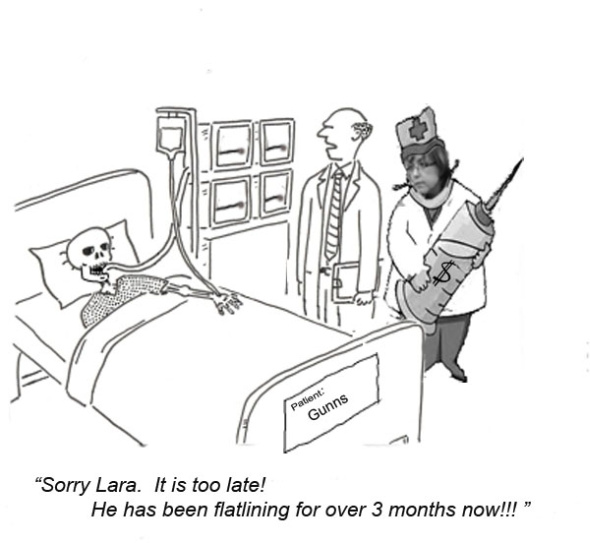
As onlookers await news from the constant bedside ritual and the decision to switch off the machine – by bankers – looks imminent, Gunns pulp mill may at last become a failed dream. The reverie of former government ministers and former CEO John Gay, is also likely to become a former vision.
A lack of social licence, never a consideration for Gunns, has turned the heads of investors and would-be saviours alike, leaving the ailing Gunnosaur in a state of cachexia. Starvation, the only option left, will likely cause the former giant to go with a whimper, rather than a bang.
The creators of this illusion, based on delusion, have grossly underestimated social licence. And the great work of TT readers and contributors, linked together with the thousands who have marched and campaigned against this mill, is testament to that fact.
In China, estimates of between 50,000 and 100,000 people have done likewise and taken on riot police. The paper giant Oji, planned to put a wastewater outfall pipe into the sea from Oji’s fine paper mill at Nantong. According to the Chinese news agency, Xinhuan ‘reports indicate that the demonstrators were afraid that the dumping of industrial wastewater into the sea would have harmful effects on the environment, notably on fish farming.’ According to Xinhuan, ‘the massive and in part violent protest did not calm down before the local government announced that it would cancel the wastewater project.’
Photos of the riot: http://cryptome.org/2012-info/qidong/qidong-protest.htm
The Japanese paper manufacturer, the same company that had its orders cancelled by Xerox in 2007, due to its use of Tasmanian native forest woodchips, has been producing paper at the rate of 400,000 tons per year at the plant since 2010. A news release on Oji’s website said the company is concerned about the demonstrations in China and that allegations of cancer causing chemicals in its wastewater were totally unfounded. It claims the wastewater has been thoroughly treated to meet China’s strict wastewater standards.
Oji News Release: http://www.ojipaper.co.jp/english/news/2012/release_20120730.html
One can’t help feeling this story has been told a little closer to home. Echoes of ‘world’s best practice’ resonate through the text of this article and one can draw little comfort from the fact that lies are not just told in Tasmania.
There is comfort, however, in knowing that social licence is vital for any project of this nature today and that can be in part attributed to the people of Tasmania who gave of themselves to prevent this injustice. God bless all Tasmanians who stand up for their rights and may this vile pulp mill finally rest in peace.
David Leigh is (an up-to-date bio is on its way)

Bryan Green
• It isn’t easy, but I’m Bryan ahh… Green
David Obendorf:
Bryan Green has clearly had a Road to Damascus Experience… apart from his blind faith in ‘a pulp mill’ in the Tamar Valley, he is now singing from the Greens’ song-book. All the timber tragedies over the last 7-8 years that Kim Booth has whipped him over in the Parliament, Bryan Green – yes, very Green – now accepts as if they were his own revelations.
And he brought in the song-book to leave with ABC local radio’s Leon Compton, so that Bryan could quote the figures and sing his beautiful conversion theme song and stay on roundtable message.
Unbelievable stuff! Kim Booth, it looks like you can almost give up you’re day job … Bryan is a convert to the woes of the forestry industry. Black is really black after all … and ahh … ahh …Green is well … quite green indeed.
For me, seeing the words politicians use make a difference – their speedy talk is so cheap and fleeting.
If you can’t be bothered wading through the transcript and there are some gems here, listen to the audio from the ABC website:
http://blogs.abc.net.au/tasmania/2012/07/mornings-on-demand-tuesday-3172012.html?site=hobart&program=hobart_mornings
Leon Compton’s State-wide Mornings 31 July 2012
Leon Compton: So, in a few days the final deadline for the agreement in the forestry peace process will be up. The parties inside the room – that’s environment groups and industry aren’t making promises necessarily that a deal could be won. But, they are hopeful. Outside the room, many are wondering what the deal might mean for them; a deal at what cost? And what will be gained?
Bryan Green, the Minister or Local Government, Planning, Primary Industry here in Tasmania also the Deputy Premier. Minister, good morning.
Bryan Green: Good morning Leon.
Leon Compton: And thanks for coming in. Last week industry and environment groups said that the needed a fortnight to model new areas for protection and to work out what that would mean for timber supply. While that modelling happens it seemed that you had a job to do in heading off to Canberra and talking about money. What specifically was your role? And is it at the moment?
Bryan Green: Ahh well, of course we did go the Canberra the next day [Tuesday, 24 July] given that the IGA was ahh, ahh an agreement signed by the Premier and Prime Minister. And of course we went to Canberra to brief the Prime Minister and ahh, the Minister for the Environment on the progress that had been made to this point. And, look . I think ahhm, you’re right ahhm … in suggesting that they, the signatories wanted more time, mainly to model the resource, Leon, mainly as opposed to the reserve to see whether the position that they come forward … or intending to come forward with could be sustained from the point a view to a resource that could be made available into the future. Which, certainly from my point of view, is the key to any agreement.
Leon Compton: Umm… there is concern that there might not be the sort of resource available under this deal, that ahh, people like speciality timbers groups … people like Ta Ann … private foresters are hoping for.
Bryan Green: Well, I mean that’s front and centre from our point of view. And the conservation outcomes will – in the end – be important as well if we are to get a peaceful resolution to a debate that’s been ongoing for 30 years.
But I think ahh … last night [Brighton public debate] ahhm, you know, I attended a, a debate … attended a, a debate with respect to forestry. And from my point of view, it was quite useful in giving me at least the opportunity to … to talk about the reasons that we’re actually in the position … or the people that we’ve helped through this difficult time in the forest industry … have been put in that position, ahh, ahh, you know, as a result of markets and ahh … other issues beyond obviously their control. So,…
Leon Compton: Sure, you talk about the high Australian dollar; cyclical conditions locally. But the reality is last night, you see on the news services a sawmiller who says, ‘My problem is none of those things, it’s just that I can’t find the timber from the forest at the moment. Where’s the supply?
Bryan Green: (pause} Well Leon, ya, ya talk about you know … that high Australian dollar, that it’s cyclical. But if you look at … and I’ll leave the document with you that actually gives you the facts on how the industry has changed over the last 7 or 8 years, not just the last year. You know, it’s been put to us ahhm … and put to me, on a daily basis that this IGA process that we talking about – in terms of trying to get an agreement in the forests – has in fact been the cause of the problem. But what I was able to highlight, I hope, not, not to everybody’s satisfaction obviously … because, ‘cos it’s a very emotive issue. Ahh, that … ahh, that in fact there has been a change in the industry incrementally over a, over a 7 or 8 year period, which has culminated in a position where many people were left badly exposed … ahh, their businesses badly exposed; which would have led to a devastation. Now to do nothing in the face of the facts associated with this downturn in the industry would have been negligible… ahh… ahh… negligent thing to do. We, we had to respond to those difficulties.
And, and effectively that’s what’s drawn the parties around the table ahh … not the other way round. You know, Will Hodgman – last night – was suggesting this was some ploy to keep ahh … the … Labor government in power. Well, I, I don’t think that Terry Edwards or Hans Drielsma ahh … those people representing the contractors are … are interested in keeping us in power. What they are looking for is a long-lasting agreement that allows for resource security and at the same time provides for an opportunity for the industry to consolidate and expand – particularly around the plantations.
Leon Compton: Is it still the same deal that the parties started negotiating on two years ago though? I mean there are questions about where Triabunna sits in all this; what about guaranteed wood supply for a company like Ta Ann which employs, what about 140 people around the state. And what about the issue of residues and what will happen to [wood] chip in Tasmania and the capacity to do something with that. It feels, to many people, that what’s being agreed and finalised at the moment might not bear a lot of resemblance to where things started. Which was, of course, approval for a pulp mill.
Bryan Green: Ummm. Well the pulp mill from our point of view is ahh… still, something that we’re aspiring to see built in Tasmania. And of course, I remind listeners that ahh … effectively the pulp mill is ready to go.
Leon Compton: But support for that going to come out of this deal? Is there anything in the deal the Greens have offered, the Greens have offered … the environment groups have offered to suggest that they will go quiet on it, offer some support for it. I means, that’s where this started, isn’t it?
Bryan Green: Well, I think if you … if you think about it Leon, I was just making the point that. Ahh… all of the planning approvals – both State and federal – have been given for the pulp mill; it’s ready to go. And the site has been effectively ahhm… ahhm… cleared, levelled..ahhm, it’s ready to build. And that was done over … ahh … about a 12 month period … with, with … little or no protests right through. So… umm, I, I think that there’s some localised concerns in the Tamar Valley about the pulp mill but, but overall, I think most people understand that is is a plantation-based mill. It doesn’t have an effect on native forests, going forward. Ahhm … and, and that is still … ahhm … front and centre. And, and …
Leon Compton: Is there any mention of it [the pulp mill] in this deal… that’s being negotiated at the moment? Or is that a memory?
Bryan Green: Well certainly … it’s part of ahhh … our … the IGA process that was … It’s part of the IGA that a pulp mill is – in the end – the downstream processing opportunity we need for our plantations going forward.
Now, you talked about the sawmiller last night … ahhh. That was upset and ahhh … Will Hodgman was down there yesterday. He … he’s a country sawmiller, he does have a … a Crown contract … ahhm … and the country sawmillers ARE around the table, arguing for a volume to ahh …to go forward with. And I would support that position … ahh … of course I would … ahh … that doesn’t mean the IGA process – as it stands at the moment – or the downturn that exists is reason that, that the … that those people are upset with respect to their individual contracts. Ahhm … they, they haven’t got a Crown ahh..ahh contract, as it stands at the moment.
Leon Compton: Ok, I just want to get this point clear. This process started … the IGA process started with talk of tacit support for a pulp mill or a ‘social licence’ for it. That’s still in this deal?
Bryan Green: well, we haven’t got the final deal. But … what I … all I can tell you is … Leon, from the government’s perspective, deal or no deal, the pulp mill is ahh … ready to go. Ahh… we just need Gunns or … a, a company to build it.
Leon Compton: Let’s talk about the ‘durability clauses’ that will ensure that environmentalists andg overnment stick to whatever deal is done. So, what do they look like, at the moment from inside that room?
Bryan Green: Well, ahh …you know … once again, they’re the discussions that ahh … ahh … they will the, the parties are having. But revolve around us achieving certification for the product. Ahh … ahh … ahh … you know … ahh … ahh … an agreement that we would be an advocate … or the ENGOs would be an advocate for the sustainability of the industry … ahh… in Tasmania. And I think, you know, most people are suggesting … who are opposing to this whole process, that you know, there will be an end to native forest [logging] as a result. But I know that ahh … ENGOs at the highest level understand full-well that the … the industry is sustainable and we do have to have a volume of native forest going forward to supply our … our sawmills and our high quality ahh … ahh … furniture-makers who are utilising those speciality timbers. That … you know, that is part of it. And I think, you know, having those parties around the table has in the end allowed people to understand each other’s position much better than they did when they were ahh … sniping at one another at a distance. So…
Leon Compton: What about their capacity to convince others outside the room, who still might breach the terms of the agreement? Ahh … can you … there’s been a suggestion that the durability clauses might involve a progressive trading of land into protection. In other words, you go down for a period of time … if it isn’t protests, some more land goes into protection. No protest after another year, more land into protection. Is that something that’s being considered as part of this durability?
Bryan Green: Well, it’s not possible ahh … to … ahhm … protect the … all of the land in … in one go anyway. The whole tenure argument is something we’ve always said as a government is … is something for the government to decide upon. You know Will Hodgman would have people believe that … that the people who are around the table … that he is, in fact condemning … people that I have the highest respect for. Particularly, you know, given the dedication they’ve shown to try to resolve this matter. Ahhm …ahh … in the end they are not the arbiters of this, it’s the Parliament that becomes the arbiter. In the end it’s the Parliament that makes the decisions as to whether this deal flies or not … because it requires legislation. I’ve got legislation still on the table now … ready to go that can facilitate an agreement if one comes forward. You know … it’s not … it’s not as say, you know, ‘This is an unrepresentative group of people making decisions for Tasmania’. Of course the Parliament – in the end – will of course make the decision.
Leon Compton: How do you get it past the Legislative Council, who have expressed ongoing, constant and, and deep suspicion of this process?
Bryan Green: Well the agreement will either stand up or it won’t Leon. And, you know, the industry, I would expect, would be an advocate for the … for this agreement. Ahh … I know that in talking to industry; the Ta Anns of the world, that they are desperate to get an agreement. They, they want to see an end to this ahhm … ahhm … debate that’s been ongoing for many, many years. And of course, you know, you referred to their volume; their volume and the specifications of the wood that they will use on into the future is an important part of the discussion that we’re having.
Leon Compton: Might they have to become a smaller company? Might they get less [timber] to work with out of this deal?
Bryan Green: Well, that wold certainly not be my… my hope. And … and they are operating now, they continue to operate. What I have asked ahh … ahh Forestry Tasmania and the group to look at is the specifications of the material [timber] that goes into ahh … Ta Ann. And it’s my hope that the volumes and the equipment required to ensure that they can continue to produce that high-quality material – that the Japanese market love incidentally – ahh … ahh … will ahh … will ahh … operate at volumes that will sustain that business and allow them to make money. [10.55]
Leon Compton: Deputy Premier, Bryan Green our guest this morning on you local ABC around Tasmania 9.13 am. Just briefly where is the report… or how long until you release the report into the ongoing structure of Forestry Tasmania? You’ve got it; you’ve been looking at it for a while … where is it?
Bryan Green: Umm … it’s ahh. It’s part of a cabinet process now ahh … Leon. And ahh … consideration has been given to ahh … the document itself and ahh … the Premier ahh … and I will be taking a Minute to cabinet in the not too distant future.
Leon Compton: And what did it say? Or can you give some inkling of what it might mean to the structure of Forestry Tasmania into the future?
Bryan Green: Well, we’ve …we’ve already indicated that … and ahh … I think te first URS report was made public, that, that the ongoing sustainability of Forestry Tasmania in the current market conditions is tough! That’s why we’ve made a provision for ahh… $110 million in the forward estimates so as to ensure that they can continue to operate ahh … appropriately. That … that revolves around ensuring now though, the … the commercial side of the forest business has the ability to be … ahhm … able to rise and fall with the markets as indicated by URS [report] on into the future. The problem that we’ve had in the past has been effectively a supply-driven industry as opposed to market-driven industry. Ahhm … it’s always about supply, as opposed to exactly what the markets want. And that’s why we’ve gone through these ‘doom-bust’ cycles in the past.
Leon Compton: Will this… will you restructure Forestry to end that?
Bryan Green: Ahh well … we, we have a responsibility when you’ve got a business that’s losing money at the moment. To make sure that we do our best to ensure that it makes money into the future. And part of the whole arrangement that we’re looking to … ahh … looking to as a future … arise … revolves around wood supply zones that will ensure Forestry Tasmania can market its product in a way that ahh … the world wants. [12.51]
[20.08]
Leon Compton: Well, let’s say good morning to the Leader of the Opposition who like our previous guest was at Brighton last evening and having a debate about forestry and other things is Will Hodgman, good morning to you and thank you for the chat this morning so.
Will Hodgman: Pleasure.
Leon Compton: So . . . is it . . . you continue to argue that the deal on forestry is a ploy to keep the Labor Party in power, after discussions last night anything happened to change your mind?
Will Hodgman: No. You’ve got to remember that this deal was struck just a couple of weeks after the 2010 state election, nothing had been put before the people of Tasmania when they voted. It was just a few weeks after the election that then David, premier David Bartlett, said he wanted to commence a roundtable process, involve the forest minister Bryan Green, bring in Nick McKim and start a discussion about how we could move to change the structure of forestry in Tasmania, and that’s over two years ago, [with] various considerations on a number of extensions, [and] more uncertainty for the forest industry.
This deal has been all about ensuring the Labor-Green government can survive, and that’s irrefutable. I mean everyone can see this was a political deal and it’s not in the best interests of the forest industry. And that’s why we oppose it, and last night showed how many people from industry actually disagreed with what’s being proposed. How many people feel disenfranchised from this process, that their voice isn’t being properly heard …
Leon Compton: How do you explain the fact that there are so many people in industry still in the room on this? While on the one hand a sawmiller says,‘we just need supply’, sawmilling representatives are in these negotiations as they continue.
Will Hodgman: Well, you’ve got to ask those people at the roundtable because the vast majority of participants in last night’s debate expressed their concerns at the process. That they don’t feel their view is being properly heard, that they have been excluded from important parts of this process. There were people who have missed out on the compensation payments for example. There were sawmillers who say our issues… we just can’t get enough wood. You lock it up, we’ll never get it, we’ll go out of business. That’s what the sawmillers I visited yesterday told us. [22.09]
Leon Compton: How do you explain though that sawmilling representatives are still in the room making this deal possible without their signature, without all of the signatures of those that started this process, it can’t be completed, so why are they still in it?
Will Hodgman: Well, you’d have to ask them, or perhaps Bryan Green, because he is associated with this process, but anyone who attended last night would have heard there are plenty of people in the forest industry who are not supportive of the process, certainly are not supportive of the deal as is proposed, and are wondering why the Labor government is selling their industry down the river, when the only conclusion you can draw is that it is to keep their coalition partners the Greens happy.
Leon Compton: I’ll ask you one more time though, if all that is true, how do you explain that sawmilling representatives, that unions, that the larger part of industry is represented in this deal still, and it requires all of their signatures for it to go ahead according to the initial terms in which it started?
Will Hodgman: Yeah, and I’ll say the same thing again Leon, you’ll have to ask them. There are plenty of people who they are purporting to represent who are unhappy, and last night was an opportunity – and that only came about because I challenged the premier to a debate months ago and she refused to front and tell the Tasmanian people – especially those affected by her policy – why they are pushing ahead with this, but there were plenty there last night who told the forestry minister, Bryan Green that they are not happy with the process, nor the deal as it stands.
Leon Compton: You asked for three debates with the government, are you hopeful there’ll be more?
Will Hodgman: Yes I am, and I’d think that Bryan [Green] would have taken from last night’s meeting that there are plenty of people who want to have their say. The debate was extended last night, and there were dozens of unanswered questions, so I would propose these debates continue, and we’ll be organising them. They’ll be at Smithton, they’ll be at Scottsdale, they’ll be at Triabunna, down the Huon Valley, so that … [if] the premier won’t front, I’d expect Bryan Green, or somebody from the Labor Party will so that this government can hear how this deal is affecting people’s lives.
I spoke to a ten-year-old girl last night whose father has been in north Queensland for the last 19 months because he can’t get work in Tasmania out of this deal. And that is just fracturing families right across the state. That was one example but she turned up lsat night to show the Minister, to this this Government the real impact of this deal on people’s lives.
Leon Compton: My guest is Will Hodgman, the Leader of the Opposition. Bryan Green is still here and ahh … I’ll introduce you to each other. In the hours since you took to a stage together … Bryan Green more debates around the state, will you play?
Bryan Green: No … because, because …. There (pause) … Unfortunately, Will will not stick to the facts and his whole diatribe just then ahhm … ahh … re-inforces exactly that. If, if you look at the process; he says the process was started ahh … by David Bartlett, but in fact it was the … the Statement of Principles that was formulated by ahh … the ENGOS, the industry, the unions, and contractors that was brought to State and federal Governments. It was then … the ahh … Prime Minister ahh … the Premier, myself and the [federal] Minister for the Environment had negotiations put forward ahh … an Intergovernmental Agreement to support the industry through the toughest time ahh … that they’d faced in living memory. Now that …
Leon Compton: Will Hodgman, your mic is still up … you can respond at any time.
Will Hodgman: Well just on that. The facts are … I’ve got a media release in my hand from David Bartlett, Premier dated 14 May 2010 just a few weeks after the election, where it says: ‘Premier David Bartlett has today announced plans for a high level strategic roundtable for the forest industry.’ It says later on [in the press release], ‘I’ll sit down with Mr McKim and forest Minister, Bryan Green asking them to suggest people who might participate in that roundtable.’ It goes on about the process, and what it’s for. I mean to suggest that this has been ahh … manufactured by industry at their request is totally and utterly false.
Bryan Green: It is … it is not false that …
Will Hodgman: When did the Labor Party … went at the last election … saying that we will commit to the Regional Forest Agreement and people voted on that. People last night at this meeting thought that to be true, and they trusted their politicians to deliver what has been … generations, decades of bi-partisan support. But after the election it all went out the window. And there’s one reason and one reason only, it was to secure the support of the Greens.
Bryan Green: That’s not true Leon. That is completely false to … to stand by and let people suffer in the way that they were as a result of the industry. In fact, the photo in the Mercury that’s taken today … ahhh … ahh … that’s used in the paper today, is actually a photo taken of me addressing Gunns workers out the front of Parliament House. Those people were desperate as a result of Gunns making a decision to get out of native forest; to build a pulp mill in Tasmania and to, to effectively … ahh … change the way that they operated. [26.53]
Leon Compton: Hang on, so let’s pull up for a moment and explore Will Hodgman’s point. I mean you can find $100 million over the three years to support Forestry Tasmania in a restructure. You found any amount of money to support the industry before. So again … why not champion a restructure of the industry … (interrupted) … and how is this process? …
Will Hodgman: And how is… 500,000 hectares
Leon Compton: Allow me to make the point Mr Hodgman … I’ll just fade you [Will Hodgman] down there for a moment…
Will Hodgman: You encouraged me to jump in and I apologise.
Leon Compton: I … I will I’ll get you back in a moment. I just don’t want to seem as if we’re running from the same side of the … of the fence. Can you … can you, Bryan Green, explain, why it is when there is so much money available – that is so central to this process – more forest, I mean are preserved, protected, locked up. Why not just restructure the industry if that’s what it needs?
Bryan Green: Well, we have restricted the industry. If you go back to the Tasmanian Forest Agreement there was $100-odd million made available for intensive management; there was $45 million made available to … to ahh … spent on sawmills. That money was to spend as … Britton’s Brothers, McKay sawmills … an enormous amount of restructuring went on in the industry.
The problem we got at the moment Leon is not the sawmilling industry in terms of them being able to sell their product. And … and … the people that were there last night [at the Brighton debate] like Rick Watson from the Huon. They know that they can get their supply. It’s about what happens to the residual … or the residues as a result of their operation that’s caused a problem. We were exporting 6,000,000 tonnes of woodchips from Tasmania ahhh … back in the mid-2000s Leon. That has ahhm … crashed, for various reasons, ahhm … over time. But [it] really crashed in recent times as a result of the high exchange rate; us trying to export a low value commodity [woodchips] a long way across the water ahh … and not making any money out of it.
You know, remember that through the Gunns, ahhm … transition process, against what Will Hodgman was saying, we provided them [Gunns] with $23 million and provided ahh … ahh … Forestry Tasmania with $11 million that was owed to them, by Gunns, that was participating in that market. There’s been a huge… problem that we had to address. And address it, we did.
Leon Compton: Will Hodgman, jump in as you will.
Will Hodgman: So, no one disputes the fact that those displaced from the industry (interrupted)… they deserve support… they deserve support.
Bryan Green: But so… you’d just abandon them, There a dollar in your 13-point plan AND you said you lock up 150,000 hectares…’
Will Hodgman: You know what you’ve done. You’ve given Gunns Ltd $23 million to exit the native forest industry at their choosing … it was a commercial decision that they made. Yet in your wisdom AND supported by the Greens, $23 million … (interrupted) … that could have gone, that could have gone forest industries… went to Gunns Ltd. That’s the first thing.
Bryan Green: So you don’t support the pulp mill now? You don’t support the pulp mill?
Will Hodgman: Of course we do.[29.37]
And for those felt in the industry. Is your solution to provide them with support, security and a career for the future; to lock up over 500,000 hectares of forest? I mean, how on earth is that going to allow this industry to grow with certainty; to realise its potential. You lock it up forever, you take away the work, for people such as the Pages [surname] who we talked to yesterday. They’re gone, they’ve been told that.
Bryan Green: They don’t have … they dont have a Crown contract now. At least be honest about that. At least be honest about that.
And … and the discussions around the table have got nothing to do with Pages’ situation, and you know that!
Will Hodgman: No, the fact is they can’t get access to wood for their community because it is placed under a moratorium under this deal … that is locking up …that is exactly true.
Bryan Green: That is, that’s not true! They’ve never had … they’ve not got a Crown contract. And part of the discussion, and Leon makes a good point, the country sawmillers are around the table right now. They’re the people trying to actually establish some volume for their … for their constituents.
And, and, and the point that you make saying: ‘locking it up for ever’ …. Ahh … will ‘effectively end the industry forever’. What the industry are … are trying to do is … as a result of this process is establish a volume that will see them ahh … umm … be able to operate in a sustainable way on into the future.
If you just look at what has been harvested in recent times from the point of view of high quality sawlog – in 2009-2010 it was 203,000 cubic metres Leon … and, and, if, if you take into consideration just as Will Hodgman has done in his 13-point plan, that Gunns’ exit means that 168,000 cubic metres can be potentially retired. It means that we are in a good space – in terms of providing a volume for the industry to go forward with … on into perpetuity. And that will supply all of the sawmills, and of course Ta Ann, and provide minor species on into the future. And really it is about trying to end the debate that’s been going on for thirty years; so that we can continue to diversify our economy, Leon.
Leon Compton: Will Hodgman, for better or worse do you think, that if this deal is done; if peace is found, it will end the debate?
Will Hodgman: Well peace won’t be found. Ahh … this was supposed to deliver peace. And as I say, it’s a process that’s been going on for two years. And there are people up trees as we speak; there are people damaging our markets – Peg Putt, the symbolic leader of the Greens – continues to damage Tasmania’s forest industry. We’ve got two cabinet Ministers who are attacking the forest industry and the pulp mill – Bryan Green says the Government supports – on a regular basis. And he just doesn’t get, that that sends a terrible message to investors, to those who are working in the industry, that is, that it is still under siege. And the deal that was supposed to deliver the peace is far from it; let alone the other things it was supposed to deliver – the pulp mill, Triabunna chip mill was supposed to be re-opened, resource security – none of those things have been delivered by this Bill other than a continuation of this Labor-Green government.
I want to put a point of fact on the table as well. Bryan has just made comment about changing markets and of course, the Australian dollar is one issue that we do need to deal with. And again locking up the forest isn’t going to help us when the Australian dollar returns to a more favourable level and we want to use that resource.
Bryan Green: And how do you deal with that?
Will Hodgman: Secondly woodchip sales, and wood residue sales, that you [Bryan Green] talk about, may well have dropped in volume, but they’ve actually increased at a national level. Whilst we, out of Tasmania, exported about a third of Australia’s total exports, in that area, just three years ago. Now our share has dropped to about 10% of an increasing national level. And that means, you know … the markets haven’t collapsed Tasmania has just surrendered its share of the market to other states.
Bryan Green: That’s not true.
Leon Compton: Can I pick up on just one point? The issue of residue; it is critical with what happens – the least valuable product if you like – off the forests. Because there is so much of it. Jan Cameron bought Triabunna [formerly Gunns chip mill and port loading facility]; it means there’s no southern export point for woodchip into the international and national markets. In this deal, is there something going on that deals with this issue of residue. I mean you’ve got an inkling of what’s happening in there, Bryan Green. Is there a deal that will create a market or that will improve the market for residue?
Bryan Green: Oh, well, I think in the end we’re going to have to look at other options with respect to residues. [33.43]
Leon Compton: By that, do you mean bio-mass?
Bryan Green: Well, biomass has been suggested as an opportunity. Then there’s ahh … ahh … there’s a range of opportunities that umm … could potentially, ahh … provide for diversification when it comes to residues. Such as producing charcoal for instance …. (interrupted)
Will Hodgman: Will your government support it? Is your government for it? Do the Greens as well?
Bryan Green: Yes we would, producing charcoal would be a great opportunity in ahh … Tasmania, ahh … going forward umm … from our residues. There are … there are … maybe ethanol … there’s a whole range of opportunities that might exist on into the future. But getting those commercialised is not easy. We’ve been … (interrupted)…
Will Hodgman: Not with two Greens opposing it.
Bryan Green: … wanting to get on to ahhm … selling lots of woodchips. It’s hard to wean yourself off that [woodchip export sales]. Mr Hodgman makes the point how the rest of the country is going. What I’d remind him of – in terms of exporting woodchips – what I’d remind him of, is that the volumes that are leaving Victoria ahh … about 15% of that is native forest, the main …of the rest of it is from the Green Triangle, that’s plantation. Those plantations have come on. I, I would also remind him that the Managed Investment Schemes have all fallen over and they are all basically under administration, both there [Green Triangle] and in Western Australia. They are looking for a cash flow and as a result of that the prices for those high quality plantation woodchips are in fact lower than what they would be normally. Which makes it even more difficult for us to compete with our native forest [woodchips] which has less quality.
Leon Compton: Bryan…
Bryan Green: Leon, two seconds, let me finish. If you have a look … (interrupted) …
Will Hodgman: Tell us what you’re plan is for private forests … amongst those farmers?
Bryan Green: … if you… if you have a look at the … ahhm … ahh … the ahh … (pause) … China in terms of, of its ahh … growth. There has been significant growth in pulp production in China, and there been significant imports into China. But the majority of that has come from Vietnam and South East Asia. And even now are prices are 35% higher, than what they can import from ahhm …those countries. That presents an issue for us … [35.37]
Leon Compton: On, on private forestry … Will Hodgman your question for Bryan Green on private forestry … and there concerns that they stand to lose hundreds of millions of dollars in the private forest estate?
Bryan Green: … and with respect to famers…
Will Hodgman: Yes, I want to know what the Deputy Premiers plan is, in respect that important part of this industry, who again have been excluded from the roundtable debate, as we’ve heard over the last few days. And Tasmanian farmers have had $2 billion wiped off the value of their properties ahhm … in recent times. And this deal is not assisting them. What’s the government’s plan on that front? What is this deal going to deliver? [36.15]
Bryan Green: This ahhm … Look, number 1, the, the negotiations that are taking place are about public forests, that’s the first thing. Ahh … in terms of the effect on … (interrupted) …
Will Hodgman: But it affects them Bryan, as well! As well, it affects them as well.
Bryan Green: Well, somehow you’re suggesting that I’m shutting down native forest operations on private land.
Will Hodgman: No, you are not making provision for them, who are going to be affected out of the deal your Government is signing up to. That’s what’s happening.
Bryan Green: So … so … I’m … What provision are you talking about? Infrastructure? Say, to export their product?
Will Hodgman: Well, obviously that’s an important part of it. What’s happening … why isn’t Triabunna [woodchip mill] re-opening as the IGA said it would be?
Bryan Green: So … so … Artec is operating in the north … the north of the State. Ahh … ahh … their plantation resource from the north-west of the state is continuing to be exported. What … what are you saying in terms of what is the Government…supposed to do?
Will Hodgman: Why … why are private forester unhappy then, Bryan?
Bryan Green: Have you given any recognition to the fact that ahh … in 2003-2004 they … there was a 1,669,000 cubic metres exported ahhm … from private land; to where it is now – 427,000 cubic metres. Are you suggesting for one moment, that the Government has actually applied pressure to wind back that market for them? Of course we have not!
Will Hodgman: The TFGA have expressed legitimate concerns … about this deal, that they have been excluded from. And they want to know what the Government’s policy is to address it.
Bryan Green: What I’m saying to you is … what I’ll say to the TFGA is… I’ll, I’ll say to the TFGA – and you right at the moment – we are not shutting down native forest on private land. Of course we are not. We’ve got nothing to do with it, other than to ensure that their forest practices are appropriate. Look if the TFGA want to market their product overseas, and can sell it and get it back to the volumes they had in the past, I’d say: ‘Good … good on them.’
Leon Compton: But you’re buying out sawmills. I mean these are the people that are processing …You are buying out sawmillers are you … in offering then opportunities to exit the marketplace?
Will Hodgman: Yes
Bryan Green: We are not buying out sawmills! There is $15 million there for ahh … potential exits of ahh … some sawmills, if they want to. But at the end of the day Leon, the sawmills that are ahh … operated in Tasmania will continue to operate. And private forests are a very important part of that, going forward. [38.19]
Leon Compton: And again the residue issue comes up. Triabunna, where is it? I mean clearly it’s not going to open under its current stewardship. It’s not the point … you know … of providing markets for chip out of the south of the state. So, what … you know … what are you going o do about it?
Bryan Green: Well I’d just remind you, and Will Hodgman once again that the Triabunna woodchip mill was shut before it was sold. It was shut and it had been shut for months remember. It wasn’t shut because of some clandestine plan to sell it to the Greens so that it would never reopen. It was shut because Gunns markets had dried up. And I’ve got the information for you there, if you’d like to look at it, Leon … in terms of the decline.
And … and you see, and that been such … the hard part of this debate because it’s as if Mr Hodgman is coming from a here and now position and that nothing has happened. Just to put your head in the sand; don’t do anything and it’ll all come back. It is not the case … there’s been a big change in the market.
Will Hodgman: No. So, why did Lara Giddings … Why did Lara Giddings … sign documents stating that Triabunna would be re-opened?
Bryan Green: And, and you make this point about … you make this point about the debate … You know the last discussion you had … the last discussion that was had at Brighton – organised by the Liberals – Mr Gutwein fronted and so did the Premier, but you didn’t. I mean, I wouldn’t get too het-up about who’s fronting..
Will Hodgman: I was interstate Bryan, it was impossible for me to be there …
Bryan Green: Oh is that right? Just like … just like you … you weren’t there when Chandler was wanting to meet you … I mean, you’ve got a shocking record when it comes to these things….
Leon Compton: Ahh … Will Hodgman, I’d like you to finish us up with a final point you wanted to make.
Will Hodgman: Well just on that point, I wonder why it was then that the Premier of this state and the Prime Minister of this country signed up to a Statement of Principles that said that this deal would facilitate the re-opening of the Triabunna chip mill. I mean, it just shows what a sham this process is. That the Premier’s signature is worth nothing and that people have been ahh … brought into a process that is all about delivering things, that is far from being materialised. That’s why we saw so many people last night in Brighton, seriously upset about what’s happening; their, their totally exclusion about a debate about their families, their futures and their communities. And that is why Bryan, and you can talk about the last meeting in Brighton … if you’re so tough, you’re so prepared to defend you position. Come with me to every other community in Tasmania that has been directly affected. I’ll come up to Smithton; I’ll go up to Scottsdale; down the Huon Valley. Let’s go up to Triabunna – a town that has been decimated as a result of your government’s policies. And let’s continue this discussion.
Bryan Green: When you get to Smithton, have a look at the big dairy factory that’s being built right there where Gunns used to operate.
Will Hodgman: Do you realise how offensive that is to people who work in the forest industries … love it, support it and have worked for generations in it. And want to say in it … and your answer to them is to go off and pour lattés.
Bryan Green: Right next … right next … right next door to Britton Brothers sawmill. Tell the truth what you propose to lock up…
Leon Compton: Gentlemen, it’s now sounding like another day on the floor of Parliament of Tasmania. I’ll thank you both for being part of the discussion. [41.00]
• FORESTRY FLIP-FLOP BY LIBERAL LEADER CROWD PLEASER
Hodgman Doesn’t Need Premier’s Blessing to Debate Greens
Nick McKim MP
Greens Leader
Wednesday, 1 August 2012
The Tasmanian Greens today said that Will Hodgman’s claim that he needed the Premier’s permission to debate the Greens on forestry was more flakiness from a Liberal Leader prepared to change his party’s policies at the drop of a hat in order to please a crowd.
Greens leader Nick McKim MP said Mr Hodgman must explain the policy backflip on forests he made on the fly on Monday night before an audience of sympathetic forest workers, which was hastily updated on his website last night.
“Liberal Party voters who care about the environment should be disgusted that Will Hodgman has dumped even the token conservation measures contained in their forest policy,” Mr McKim said.
“Up until last night, the Liberals’ policy was to protect and preserve up to 150,000 hectares of high conservation value forests, including what their policy describes as ‘most of our remaining old growth forest’.”
“It exposes Will Hodgman as a flaky populist who is prepared to do or say anything, including abandon a long standing party policy, just to get a round of applause and a pat on the back.”
“It’s not surprising that Mr Hodgman doesn’t want to debate the Greens on forestry, because he doesn’t have a forestry policy to speak of except to blindly support the broken business model that drove the industry into this crisis.”
“If Mr Hodgman thinks that he needs a permission note from the Premier to debate the Greens on forestry, then that’s his choice, but if he changes his mind we’re ready to go.”
• THE FUTURE OF FORESTRY
Greens Call for Genuine Debate With Liberals
Kim Booth MP
Greens Forestry Spokesperson
Monday, 30 July 2012
The Tasmanian Greens today issued a challenge to the Liberal Leader Will Hodgman to justify his refusal to support the shift to a modern, profitable and environmentally sustainable timber industry.
Greens Forestry spokesperson and long time sawmiller, Kim Booth, today unveiled a series of engineered products made in Tasmania from eucalyptus nitens plantation timber, to illustrate the potential for a modern timber industry producing high-value products from an abundant timber resource.
“The only thing holding back the Tasmanian timber industry from a bright future is the wilful misinformation spread by the Liberal Party and some in the industry who refuse to support the shift to an industry that actually creates jobs,” Mr Booth said.
“Will Hodgman is living in the past. The market has gone one way, but Mr Hodman wants to take us back to the way things were done fifty years ago.”
“If the Liberals wants employment, skills, higher wages and better career paths in the timber industry then they should be encouraging the development of an industry based around high-value products from sustainably harvested sources.”
“I have commissioned the manufacture of a series of high quality timber products using plantation timber, including furniture items and cross linked beams, products for which there’s currently significant global demand.”
“Tasmania could and should be manufacturing its own plantation products such as cross linked lumber, laminated beams, floorings, linings and Ikea style flat-pack furniture for domestic and export destinations.”
“There is an enormous and growing market for new generation structural timber products, which are now replacing concrete and steel even in the construction of skyscrapers.”
“The smart money is on plantation timbers, and Tasmania’s nitens resource provides an exciting opportunity and a pathway to higher productivity.”
“The Greens are calling on Mr Hodgman to front up and have the conviction to defend his policies in a public debate, but it’s no surprise that he’s ducking for cover because he has no real solutions.”
“The Greens want a genuine debate, free from the kind of sloganeering and name calling that has defined the Liberal Party’s approach up until now.”