Economy
No Peace in The Forests. Ken Jeffreys: We could have won a gold medal …

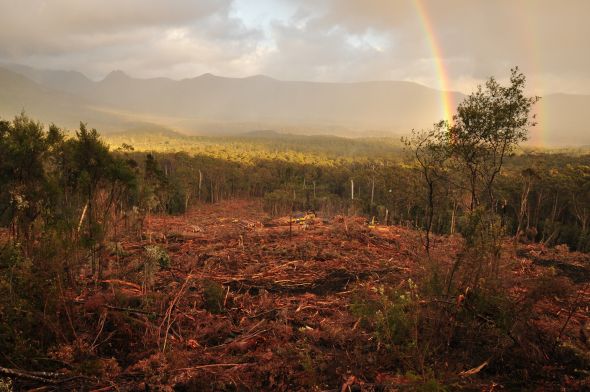
Pic: Emma Capp

No Peace in the Forests – 6 Aug 2012 Brad Markham
Conservationists and industry groups involved in long-running talks have failed to strike a deal for peace in Tasmania’s forests.
Transcript:
News Presenter Peter Gee: Tasmania is still without a peace deal. Key industry and environment groups have revealed that they have failed to reach an agreement by today’s deadline. The deputy premier and federal environment minister have been called in to help.
ABC Reporter, Brad Markham: It’s taken more than two years of talks – [Don Henry, ACF CEO present at announcement] – but Tasmania is still without a forest peace deal.
Terry Edwards [FIAT]: “To date, the signatory group have not been able to meet an agreement.” [Phill Pullinger looking on]
ABC Reporter, Brad Markham: Signatories to the peace talks were granted a second extension a fortnight ago. It was to enable their preferred agreement to be tested to see if it was workable.
[Footage of Hans Drielsma, Terry Edwards sitting across the table from Phill Pullinger, Vica Bayley and Don Henry]
Terry Edwards: “That modelling work hasn’t panned out quite the way we thought and it has produced a result that we didn’t foresee.”
ABC Reporter, Brad Markham: It is a major blow for key industry and environment groups involved in the negotiations.
Terry Edwards: “Certainly initially that ahh… dinted all of our confidence.
Tony Burke: “Had the modelling come out the way that they expected, today wold have been different.”
ABC Reporter, Brad Markham: Signatories are refusing to reveal the exact hurdles thrown up.
Terry Edwards: “The modelling showed up ahh… less wood resource than we had anticipated from a given reserves proposal.”
ABC Reporter, Brad Markham: The federal environment minister, Tony Burke and Deputy Premier, Bryan Green have been called in to help.
Phil Pullinger [ET]: Well there’s a, ahh… a constructive role that we [the signatories] think they can play… in playing a facilitation role between the groups and, as Terry [Edwards] said, a fresh set of eyes to look at things… look at a new set of options.”
Lara Giddings: “In one respect they are a long way away… and in another respect they are so close to an agreement, that it is so worthwhile in continuing to go through the process.”
ABC Reporter, Brad Markham: But the ministers’ role will be limited.
Terry Edwards: “We don’t believe that an imposed solution will create an environment that will be durable.”
Tony Burke: “There is no way the Commonwealth government, nor the Tasmanian government will deal with this, where we are negotiating and brokering an agreement.”
ABC Reporter, Brad Markham: The meeting is due to take place this Friday. Signatories have described it as a last hurrah [quote made by Terry Edwards]. And they say if a fresh set of eyes can’t help strike a deal, there isn’t one possible. Brad Markham ABC News.
• Environment groups worried about Forests Agreement failure to reach deadline
Still Wild Still Threatened and Huon Valley Environment Centre are expressing concern about the Tasmanian Forests Agreement failing to be reach a resolution yet.
“It’s worrying that an agreement has not been reached.
“We hope there will not be any concessions made on the full reserve ask and secure conservation outcomes.
“We are hopeful this process will provide significant conservation gains.
“At this final stage as agreement between the forestry industry and some environment groups is appearing difficult, we hope that the threatened forests with important conservation values are not left open for logging,” Huon Valley Environment Centre’s Jenny Weber said.
“With the government’s failure to implement a moratorium, every day that talks continue more and more of the high conservation value forest that is the subject of those talks is in fact being lost to logging.
“We remain hopeful that a resolution will be reached soon that will see an end to the destruction of these forests. It is critical for the conservation of Tasmania’s unique environment that the full verified area of world heritage and national heritage value forests receives formal legislated protection,” said Miranda Gibson spokesperson for Still Wild Still Threatened.
– Jenny Weber, Miranda Gibson
Still Wild Still Threatened is a grassroots community organisation campaigning for the immediate protection of Tasmania’s ancient forests and the creation of an equitable and environmentally sustainable forestry industry in Tasmania.
www.stillwildstillthreatened.org
stillwildstillthreatened@gmail.com
PO Box 295. South Hobart TAS 7004
• David Obendorf: TRANSCRIPT of a very telling interview Forstry Tasmsnia’s forest management – 7.30 Tasmania last Friday Ken Jeffries, Forestry Tasmania spokesperson: If sustainable yield calculations and resource modelling was an Olympic sport, I’m sure our blokes would be contending for the Gold Medal.
A former Gunns contractor calls for industry reform
7.30 Tasmania – August 03, 2012
A former Gunns contractor says Tasmania’s forest industry has to change.
Transcript:
Presenter Airlie Ward: There’s been plenty of mud thrown during Tasmania’s forestry debate by environmental groups and forestry representatives. Less has been heard about those who have lost their livelihoods.
As the much anticipated peace deal is expected to be finalised next week, 7.30 Tasmania spoke to a former Gunns contractor who after three decades in the industry says it has to change.
These days gathering the family fire wood is about the extent of Charlie Davis’ involvement in an industry that has been his livelihood for 31 years. like so many in the timber industry, Charlie Davis began as a teenager felling trees for his father. Over time he built up his own contracting business and ebd up working for Gunns. At one stage he had a quote to deliver them 200,000 tonnes a year.
Charlie Davis: We ended up with 28 working for us, when it was all going pretty well. And then sort of the problems started. The industry, you know you couldn’t sell things on an ongoing thing. You’d have week on week off
Airlie Ward: It was a sign of things to come.
Charlie Davis: April 12 months ago [2011] Gunns rang us up and told us to stop.
Airlie Ward: The bills kept on coming in though, and the intermittent work caused significant stress.
Charlie Davis: We just got sick of the pain. Michelle [his wife]… she was in tears all the ime. So I just come home one day and said, ‘We’ve gotta stop this.’ And that when I made the decision that we had to get out.
Airlie Ward: Gunns had made a decision to get out of logging native forest.
Charlie Davis: I don’t blame Gunns for getting out. I mean, they had to change direction because of the… the way the World markets were
Airlie Ward: Despite the fact it end his three decades of working in the timber industry, Mr Davis says it had to change the way it operated.
What was happening that was unsustainable?
Charlie Davis: Oooh, we was cuttin’ down too… we was clearfelling all… all the regrowth. Which, I mean, in a lot of peoples’ eyes, and in my eyes it should have been, you know, thinned out and grown on. It was… it was already half grown. And if you cut down all the young trees then you’re not going to have bigger sawlogs in the future. It’s obvious
Ken Jeffreys, Forestry Tasmania spokesperson: If sustainable yield calculations and resource modelling was an Olympic sport, I’m sure our blokes would be contending for the Gold Medal.
Airlie Ward: The industry down turn has led to a drawn out and fractious process. Some blame a loss of markets driven by environmental campaign; others the high Australian dollar.
Charlie Davis: We shoulda went back to more selective loggin’ and grew our regrowth trees on for sawlogs to supply our own saw mill here, rather than exporting the smaller logs overseas. And that’s you know… that’s the beginning of the end I reckon and there’s a lot of people who agree with that.
Airlie Ward: Regardless, it is in crisis and both sides of the debate have been locked in talks for the past 2 years trying to find a peace to the decades long war. After two extensions they are expected to deliver a solution to the government early next week.
Even if they reach agreement, it appears not everyone will be satisfied.
[Images of the Brighton debate on Monday 30 July; with Bryan Green addressing the audience.]
Man in audience: Listen to me for a minute, you arrogant bugger [directed at Bryan Green]
Airlie Ward: At a debate in southern Tasmania earlier this week the Resources Minister [Bryan Green] was given a hostile reception.
Another man in audience: Yeah, you know that ‘cos you’s are bendin’ over backwards for those greenies. We want a new government mate, ‘cos we want the place to get goin’.
Airlie Ward: Bryan Green struggled to be heard.
Bryan Green: I’m not shuttin’ it down, You asked the question and I’ll try to answer it.
Airlie Ward: As the Liberal leader [Will Hodgman] played o the crowd.
Will Hodgman: Not one more stick of native, productive forest should be locked up.
Airlie Ward: The same day as the debate, the Tasmanian Liberals changed their forest policy abandoning plans to protect up to 150,000 hectares of native forest.
Charlie Davis: It’s never gonna return. I mean, we just gotta face the change. We… we have to move on.
Airlie Ward: Charlie Davis say’s people should not be hankering over a return to past practices.
Charlie Davis: I don’t think we would of had the issues with the Green movement if we’d selective logged and managed the forests in a more sustainable way.
Airlie Ward: And who do you blame for… for not logging in a sustainable way?
Charlie Davis: Well I reckon it’s a lot to do with Forestry Tasmania. They should’ve managed it in a… in a better way. And they should never have been allowed to interfere with the market.
Airlie Ward: How is it that Forestry Tasmania interfered with the market?
Charlie Davis: Oh well, they… they was searching for markets themselves. And I mean, and thety had control of the timber. So if you’ve got control of the timber and you search for markets, then you’re not supplying the markets that you’ve got here. So that’s interfering.
Ken Jeffreys, Forestry Tasmania spokesperson: This is one of the furphies that gets around. Ahh… Forestry Tasmania does export some wood to ahh… to Asia. And if we hadn’t done that we would not have had Ta Ann in this state.
Airlie Ward: The Government Business Enterprise has been copping it from all sides. At a recent Parliamentary hearing Forestry Tasmania chief, Bob Gordon said it has taken a heavy toll.
Bob Gordon: I know our staff are feeling… (pause)… ahhm… battered and… somewhat unloved.
Airlie Ward: Although he believes there is a future for Tasmania’s native timber industry, Charlie Davis won’t be in it.
Charlie Davis: We… we have to sell the home and, and… to, to cover that… (pause)… and ended up losing most… ohh, we had to… we lost most of the gear. I had to give all that back… to the banks. And that’s, you know… one thing that we struggle with now. You can’t get your credit rating back.
Airlie Ward: Other gear was sold at a massive loss.
Charlie Davis: Ah well, we had a 525-CAT log-skidder that cost us $130,000 and we ended up sellin’ it for thirteen and a half [$13,500].
Michelle Davis: It was hard emotionally draining. It was hard seeing the kids not understand quite what… where we were at with things.
Airlie Ward: Now 12 months after losing their Gunns contract and deciding to quit the industry, Mr Davis and his wife, Michelle got an exit package.
Charlie Davis: We’ve set ourselves up now… like, with debts cleared. And, and enough sorta … to get a start on our processing premises and get that up and running.
Airlie Ward: The couple are about to process game meat for human consumption. Charlie Davis heads out of a night to shoot wallabies which are then refrigerated on site.
Charlie Davis: We got approve from the Council… from the West Tamar Council (smiling and nodding) and so everything should start to happen shortly.
Airlie Ward: [Talking to the three Davis children] Are you happier now?
Davis children, Laura: Yeah, it was hard to see mum crying and upset a lot about everything. And it was hard to not see dad much, because he was working all the time.
Airlie Ward: While it was the cause of significant heart-ache. Michelle Davis hopes the future of the timber industry is brighter one than she’s left.
Michelle Davis: The resource is there. It just needs to be managed a hell of a lot better than it had been. Ahhm… so, hopefully, hopefully things will come right and they’ll sort it all out and there will be an industry.
Airlie Ward: The Premier was handed the second stage into Forestry Tasmania a few weeks ago. It’s been a closely guarded secret and is yet to be made public. 7.30 Tasmania understands it recommends a significant down-sizing of the Government Business, including getting rid of the Board and reducing the management structure. It is believed the review suggests putting the operations side of the business – which is the land and trees management –back into a government department, leaving Forestry Tasmania to look after the commercial and marketing side of things.
It is understood the move will cost $35 million, the same figure as the budget allocation set aside to keep the ailing business afloat.
http://www.abc.net.au/news/2012-08-03/a-former-gunns-contractor-calls-for-industry-reform/4176194?section=tas