Economy
Forestry Tasmania must face reality. Obendorf: The Last Elephant

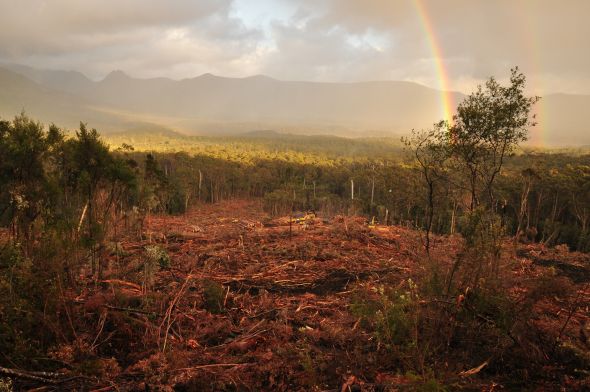
Photo: Emma Capp

Imagine if a company lost money selling something that it never paid for. Now imagine that company was owned by a state government.
In an environment in which state governments and oppositions are either crying poor or crying waste you might imagine that such expensive mismanagement would create a bit of political heat.
But the usual rules of politics don’t seem to apply to this particular government business enterprise. It might be because we are talking about such a long history of public support. It might be because we are talking about the logging industry. But whatever the explanation, the fact remains that Forestry Tasmania, which is 100 per cent owned by the Tasmanian taxpayer, has lost nearly half a billion dollars in the past two years.
In 2010 the management of Forestry Tasmania lost $306 million. Admittedly, they managed to turn things around a bit in 2011, chopping through just $129 million of taxpayers’ funds. That’s nearly $1,000 for every man woman and child in the state.
It gets worse though. A closer look at Forestry Tasmania’s annual reports reveals that it has a large, and steadily growing, unfunded liability for employee superannuation. In 2011, the deficit stood at $122 million, up from $99 million in 2008.
Over on the mainland a lot is said about industry assistance in general and support for the car industry in particular. In federal parliament, political and ideological battles rage over support for ‘free trade’ or ‘old fashioned protectionism’. But not, it seems, in Tasmania.
Those looking for a more polite and subtle debate about industry assistance need only take a short flight across Bass Straight to a land where the ALP, Liberals and Greens all support big government outlays to support industries that employ small numbers of people.
Not only do they like old fashioned protection, they like to do it the old fashioned way. Rather than offer matching grants for firms that make new investments in capital or skills the Tasmanians simply underwrite the losses of their log supply business in order to prop up wood chip mills that would go broke if they had to pay the full cost of their raw materials. Of course it isn’t just the Tasmanian government posting cheques to Forestry Tasmania; the Commonwealth has tipped nearly $100 million in since 2006 as well.
But free marketeers should take heart, as it seems that Jeff Kennett is keen to restore some normalcy to the Australian political spectrum. In a recent speech the former Victorian Premier declared that he was working on a revival plan for Tasmania.
Surely the great privatiser will be brave enough to take on Forestry Tasmania’s record loss making management? Surely the proud fiscal conservative is aghast at the cost to taxpayers of recent losses and the long run impact of those enormous unfunded liabilities?
Just as propping up the forestry industry in Tasmania has created an unusually broad political coalition in Tasmania, ending these destructive and inefficient subsidies should attract unusually broad support for Mr Kennett if he is up to the challenge. He could simultaneously deliver for the free marketeers and the environmentalists.
Tasmania is currently on the wrong side of the two speed economy. The high exchange rate associated with the mining boom is the fell swoop that is finishing off the export woodchip market. Luckily for Tasmania’s residents, the political pain of this transition will be much greater than the economic pain as while the industry accounts for the majority of political debate in the apple isle, it only employs around one per cent of the workforce.
Despite the willingness of the Tasmanian parliament to pour hundreds of millions of dollars into forestry the global market for wood chips and the global market for currency have combined to create the pressure for change that protestors have failed to achieve.
The question facing Tasmania today provides a glimpse at the questions that regional economies around Australia will soon be facing, namely, with an exchange rate above parity with the US dollar what local industries can survive and which new industries might thrive with well-designed support?
Dr Richard Denniss is the Executive Director of The Australia Institute, a Canberra based think tank. www.tai.org.au
An edited version of this OpEd was published in the Australian Financial Review LINK: http://www.afr.com/p/opinion/forestry_tasmania_must_face_reality_xQihIz0RSI3oRcoC10p8vN
John Lawrence, on Tasmanian Times, HERE
First published: 2012-08-20 03:08 AM
• Wood supply to Tan Ann – the last elephant in Tasmania’s forests
David Obendorf
In late August 2010 the draft Forest Principles were leaked to the ABC Centre in Hobart and to the Mercury newspaper. Several of the drafted Principles were highly controversial to one or other side.
The final Principles Agreement was passed to Messrs David Bartlett, Bryan Green, Kim Booth and Nick McKim with media present on 14 October 2010.


ABC pics
Principle 1 – General Wood Supply: Provide a sustainable resource supply profile for the industry based on an agreed minimum quantity and quality requirement for industry. This will be underpinned by legislation.
Principle 2- Native Forest Wood Supply: Subject to the provisions of the transition, as legislated native forests are handed back, ensure that these entitlements are not allocated nor licensed to new players.
Principle 3 – High Conservation Value Forests: Immediately protect, maintain and enhance High Conservation Value Forests identified by the ENGOs on public land.
Principle 4 – Transition: Transition the commodity (non-speciality) forest industry out of public native forests into suitable plantations through a negotiated plan and timeline.
Principle 5 – Industry: Create a strong sustainable timber industry including the development of a range of plantation based timber processing facilities including a pulp mill. There will need to be stakeholder consultation and engagement with the proponent, ENGOs and the community.
Principle 7 – Plantations: Support sustainable and socially acceptable plantations including agreed reforms and new agro-forestry outcomes, including pursuing certification.
In the week prior to the signing of the State of Forest Principles Agreement between the 7 Forestry organisations and the 3 ENGOs, the then Premier David Bartlett sent a very prompt reply letter to the CEO of the Forest Industries Association of Tasmania, Mr Terry Edwards. Mr Edwards was one of the lead industry negotiatiors at the table drafting the Principle Agreement.
The Premier’s letter here:
http://www.themercury.com.au/images/uploads/images/uploads/letter.pdf
Mr Edwards had sent his letter only the day before [7 October] ‘asking for clarification and assurances in relation to a number of matters central to the Agreement.’
Mr Edwards received the Premier’s reply by return mail:
The Government agrees that the Statement of Principles should not be construed in any manner that would require any party (including Forestry Tasmania) to breach any existing contract or statutory obligation, and that the High Conservation Value [forests] clause should be read in conjunction with Forestry Tasmania’s contractual obligations to its customers. I am advised that these sentiments are reflected in the amended Statement of Principles.
I have sought advice from my colleague, Resources Minister Bryan Green, regarding your [Terry Edwards] request for Forestry Tasmania to begin negotiations with existing customers to extend their contracts through to 2027. The minister has advised me that there would be sufficient resources to satisfy all existing high-quality sawlog volumes through to the same date. I am pleased to confirm that FT has indicated a willingness to commence those negotiations and has provided the assurance concerning long-term supply in written advice to the minister. I have attached for your information, a copy of correspondence from FT to Minister Green.
The major ‘customers’ of Forestry Tasmania David Bartlett referred to, at that time, were Gunns Ltd and Ta Ann Tasmania.
The Statement of Forest Principles evolved in the Bill Kelty facilitated negotiation on the Tasmanian Intergovernmental Agreement signed in August 2011.
That heads of government agreement signed by Julia Gillard and Lara Giddings on behalf of their respective Governments set minimum annual wood supply allocations for high quality sawlog; peeler logs (for veneers) and specialty timbers.
IGA stipulated ‘wood supply for the remaining industry will be guaranteed at least 155 000 cubic metres per year of high quality sawlog, by regulation; 265,000 cubic metres per year of peeler billets, and a speciality timber supply, noting that the industry claim is 12,500 cubic metres per year, subject to verification.’
IGA agreed that ‘contracts for native wood supply that are in existence at the time of this Agreement will be honoured. The Governments recognise the importance of this commitment for the successful implementation of the whole Agreement, particularly in relation to the guaranteed supply of peeler billets [to Ta Ann Tasmania] under theircurrent contract, including the option to extend that contract. In providing this commitment, the Governments also have a clear expectation that Signatories to the Statement of Principles will continue to respect those contracts and the associated need for guaranteed supply to meet them.’
With Gunns Ltd surrendering its two wood supply contracts for pulpwood and sawlog, the largest holder of a wood supply contract from public land was Ta Ann Tasmania. In October 2011 $37.95 million was paid – $25.3 million paid to Gunns and $12.65 million to Forestry Tasmania – in order to extinguish legal rights associated with Gunns Limited’s major native forest wood supply contracts. The annual volume of wood supply Gunns was to receive in its 20-year pulpwood supply contract and its sawlog contract [WS917 & WS918] is unclear.
The contacts were signed in 2007 [to 2027] when Gunns Ltd intended to use up to 1,500,000 tonnes of native forest pulp wood in its Tamar pulp mill; FT would increase their native forest allocation 100,000 cubic metres per annum if the Gunns built and operated a rotary peeled veneer mill in Tasmania.
The Tasmanian Regional Forest Agreement (1997) provides for Forestry Tasmania to make available 300,000 cubic metres of high quality hardwood sawlog annually to 2017.
Neither Gunns Ltd nor Forestry Tasmania has ever revealed the wood volumes that were supplied to the company under its 20 year contracts. An expert witness commissioned by Gunns Ltd, Robert de Fegley in his submission to the draft Integrated Impact Statement for the proposed pulp mill stated: ‘I have not been provided with copies of any wood supply contracts … Gunns and Forest Tasmania have informed me that the conditions of their supply contracts are commercial-in-confidence.’
The contracts to supply 265,000 cubic metres of peeler logs to Ta Ann Tasmania each year to 2027 is the last big, bad elephant left in our native forests.
Are there any courageous pachyderm hunters in Tasmania?