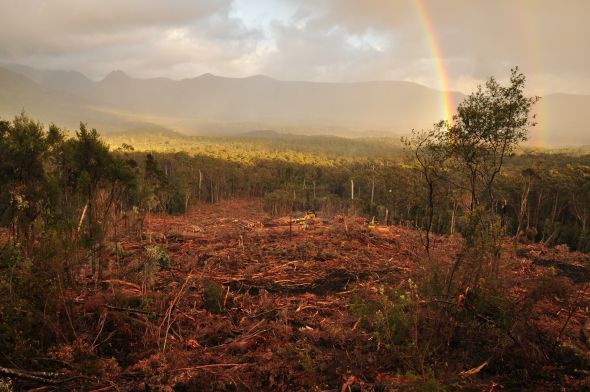
The Tasmanian Conservation Trust stated today that a final deal resulting from the Tasmanian Forests Intergovernmental Agreement (IGA) must deliver the 572,000 ha of proposed reserves and the upgrading of the biodiversity provisions of the Forest Practices Code to ensure a complete forest conservation outcome is achieved.
The TCT Director Peter McGlone stated that: “Most priority areas for forest biodiversity in Tasmania are found outside of existing and proposed reserves and its conservation depends on the establishment of a significantly strengthened Forest Practices Code in line with the 2007-2010 review recommendations.
“The current Forest Practices Code is seriously out of date and the state government must stop holding up the implementation of these long over due improvements and commit to doing so as part of the final IGA deal.
The TCT stated that the IVG reports confirm its fear that, if the IGA reserves are created without an appropriate reduction in Forestry Tasmania’s wood supply commitments, there will be a significant intensification of logging in unreserved public and private forests with potentially disastrous impacts on forest biodiversity.
“Any suggestion to trade off biodiversity conservation, by not upgrading the Code, to make it easier for stakeholders to negotiate an outcome which delivers reserves, while maintaining current wood supply, needs to be rejected by IGA stakeholders and governments,” Mr McGlone continued.
“The only way to get a sustainable future for the forest industry, that delivers both reserves and best-practice management, is to reduce the size of the industry i.e. halving the current size of Forestry Tasmania’s contractual commitments of both sawlogs and peeler logs. The size of the industry must be reduced to match resource availability, based on today’s native forest regrowth resource and not on unfunded dreams of future plantations.”
After reviewing the reports released last week by Jonathon West, the TCT also stated that the IVG reports clearly show that proposed reserves justify being protected but also demonstrate that reservation alone is not sufficient to protect forest biodiversity.
“The 572,000ha of proposed reserves will deliver impressive and nearly complete protection for wilderness, world heritage and some other values but represents only a small step forward for protection of threatened species habitats and other forest biodiversity,” Mr McGlone stated.
The IVG reports also provide compelling evidence that many important elements of biodiversity in Tasmania cannot be effectively conserved in the formal reserve system on public land.
Mr McGlone concluded by saying: “Many of our most threatened species and forest communities are found entirely or primarily on private land or have habitats which are widespread and scattered (e.g. swift parrot) and cannot be effectively or fully conserved in formal reserves. Some forest biodiversity found in small and isolated reserves is also threatened without complementary management outside the reserves.”
TCT Position:
The elements of a genuine commitment to a sustainable forest industry need to include:
A. RESERVATION:
A.1. Delivering current reserve proposals – Establish the validated 572,000 ha of reserves on public land (recognising that about half the commercial resource is located within these areas).
A.2. RFA reservation commitments – Recognise that Regional Forests Agreement reservation commitments, mostly on private land, remain outstanding and still need to be delivered.
B. BIODIVERSITY CONSERVATION:
B.1. Forest Practices Code – Upgrade the biodiversity provisions of the Forest Practices Code as per review recommendations (recognising that ‘headroom’ discounts of wood resource availability would need to increase from about 5-10% to about 30-40%)
B.2. Support for private landholders – Provide information and financial support for landholders to facilitate adoption of best-practice management plans, including 30-40% ‘headroom’ discounts on regrowth logging opportunities.
C. INSTITUTIONAL REFORM:
C.1. Forestry Tasmania – Disestablish Forestry Tasmania by institutionally separating public forest management for the public interest from commercial harvesting of available regrowth wood resources for industry. Experience has proven that a rogue GBE with both purposes cannot be relied upon to make prudent decisions either commercially or in the public interest – sensible institutional reform must be part of the package.
C.2. Parks and Reserves Authority – Upgrade and properly resource parks and reserve management by creating a Tasmanian Parks and Reserves Authority, statutorily independent of the government of the day, with a clear and unencumbered mandate to protect and present the values of reserved areas – taking seriously the management of 50% of the State that would be formally reserved is way overdue.
C.3. Speciality timbers and honey – Establish an independent speciality forest products working circle (recognising that doing so would impact on both reservation ambitions and industrial regrowth availability).
D. CLIMATE CHANGE:
D.1. Income from carbon – Get approval for a carbon accounting methodology that allows the State government to capture the once-off windfall gain associated with the reduction in greenhouse gas emissions associated with halving the size of the industry (in response to increased reservation and Code ‘headroom’ discounting) – payable to Treasury to be put in a Conservation Fund to support the newly reformed Parks and Reserves Authority and private landholders implementing best-practice management plans.
D.2. Future forest contracts – Ensure that contractual commitments over public regrowth forests outside reserves allow for carbon benefits attributable to delaying or abandoning logging plans to be taken should commercial circumstances warrant it (i.e., no entering into yet more wood supply contracts that pre-empt alternative use decision-making – this can be done be regular auctioning of available timber rather than long term contractual commitment).
E. TAMAR VALLEY PULP MILL
E.1. Tamar Valley Pulp Mill – Abandon support for the discredited Gunns pulp mill proposal and abandon any linkage between that proposal and changes to native forest protection or management.