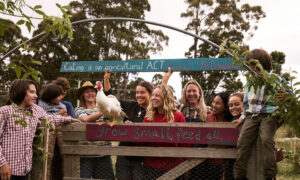
Professor West’s IVG Chairmans Report includes a nine (9) point outline towards a solution of the forestry wars in Tasmania and a roadmap towards an IGA solution.
So how and where does the proposal for a blackwood growers co-operative fit into this Plan?
Point two of the Plan appears to put the blackwood co-operative proposal right in the main game.
2. Begin to plan now to build a plantation-based industry.
Already several key industry participants, in particular Gunns and some leading sawmillers, have begun such planning. Government should provide an overarching framework for this transition, which avoids shifting all the risk from Forestry Tasmania to the private industry, and helps manage that risk.
In fact blackwood has advantages over many of its plantation rivals. It is already Australia’s premium timber species with major market creditbility. It can and is already being grown successfully in profitable, commercial plantations in New Zealand. It is ideal as a farm-forestry based enterprise which a) will help diversify farm incomes, b) help re-build and broaden community support for the battered forest industry, c) expand the supply of blackwood timber to meet growing future demand for premium quality timbers, and d) develop the unrealised commercial potential of this great Tasmanian icon.
No planning required. The only thing that needs to happen is for the co-op to be included as an outcome from the IGA, to get IGA funding, and to continue to engage with the rural community and start planting blackwoods immediately. What could be simpler?
But then point five of the Plan appears to kill the prospect for a blackwood co-operative as an outcome from the IGA, by lumping blackwood in with the other special species that can only ever be grown and managed as part of commercial native forestry. This fails to recognise that blackwood is very different to the likes of myrtle, sassafras, and celery-top pine. All of the latter species are very slow growing and will never be grown in plantations.
5. Establish special-species zones in which clear-felling is not permitted but selective harvesting on a sustainable basis is allowed.
Tasmania’s special-species wood-based manufacturing industry—including boat-building, furniture, presentation timbers, and craftwood—is a vital part of our economy, one of which all Tasmanians are proud. A secure future for this sector depends upon continued access to a relatively tiny amount of the rare and unusual timbers that this industry employs. These include blackwood, celery-top pine, myrtle, and lesser varieties such as sassafras. The zones from which these woods are drawn should be granted a status that protects them from wholesale clearing, but ensures that those timbers continue to be available.
Blackwood on the other hand can be grown in profitable, commercial plantations to produce high quality timber. While the future supply of all the other special species is fixed or declining, the future supply of blackwood can be expanded to meet growing world demand for quality timber.
But Professor West and the IVG seem to have scotched the idea, with the dogma that all special species timber will only ever be produced from long-rotation native forest management. This will be a lost opportunity for the forest industry, for the farming community, and for Brand Tasmania.
In a few years time Australia will be importing most of its blackwood timber from New Zealand. It will be much cheaper to produce and export to Australia than the small volumes that will come from native forest harvesting here in Tasmania post-IGA. New Zealand farmers will be enjoying the benefits of growing profitable plantation blackwood to meet those expanding world markets for quality timber.
Do we really want this scenario to happen?
• Pip Courtney, Landline: Worthless woodlots plouged back in
PIP COURTNEY, PRESENTER: It’s not so long ago that many agribusiness investors regarded blue gum timber plantations as the new black.
Aided by juicy tax incentives they ploughed billions of dollars into wood lots on some of the country’s most productive farmland.
Three years ago the two largest companies running plantation schemes crashed under mountains of debt.
Now, many of those virtually worthless woodlots are coming down, so the land can be returned to farming.
TIM LEE, REPORT: From the West Australian wheatbelt to the basalt plains of western Victoria, a massive land reclamation effort is in full swing.
CHARLES PITHIE, FARMING CONTRACTOR: These two particular bulldozers have been going for almost a year now, clearing country.
They’ve probably have another three years to go just to clear the 6,000 hectares that are in our portfolio.
TIM LEE: It’s complicated and costly and involves tens of thousands of hectares, much of it prime farmland.
Land that many expected would yield a bountiful and profitable crop.
The crop was blue gum, or eucalyptus globulus to give it its botanical name.
The world’s most widely grown eucalypt for woodchips, used to make high grade paper.
Butch Packard is clearing his farm for the second time in 30 years.
Only this time instead of virgin bush, he’s removing 337 hectares of second rotation blue gums.
For many the name blue gum now has bitter connotations.
Investors who lost many thousands of dollars in fanciful, highly speculative schemes, and the land holders who are now paying dearly to rid blue gums from their paddocks.
In many cases the promised returns vanished quite literally in a cloud of dust.
This machine’s run on a 360 horsepower tracker and we use every bit of that horsepower.
CHARLES PITHIE: Spins this drum with the teeth on it and we’re cutting down the stump to 50mm below the ground level, which reduces the risk of it coming back again but also leaves the maximum amount of root matter back in the ground so that it can break down and micro organisms can get back in the soil and start doing their things, which will improve the soil structure over time.
Read the rest on Landline here
Tasmanian Times analyst John Lawrence was one of the first in Australia to question the viability of MIS schemes, so energetically promoted by then Minister for Forests, Tasmanian Eric Abetz. The Lawrence analysis, here