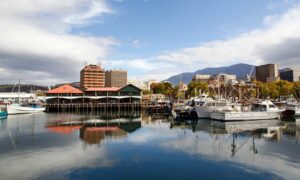
The draft Hobart Capital City Plan 2011-2040, dated November 2011, has only recently been released for comment for a very short period of time (ending Friday 2 March 2012).
If the document circulated on line is an indication of the final version, we don’t have to hold our breath. And that for 29 years!
While fixing a long-term vision and general direction is welcome and needed, an actual plan for a period this long seems a nonsense.
While a few points have been made very well (for example the need for a (too?) modest increase in settlement density to counteract “urban sprawl” – or the clear determination to do away with the silo approach to everything) many of the other points and proposals for action seem a mere continuation of the tried and failed approaches to getting a grip on Hobart’s unsatisfying development culture.
Many motherhood statements (for instance in the Vision on page 25) are good, even excellent, but far too little has been formulated in the area of implementation. Yes, timelines and responsible departments have been named and neatly inserted in a grid plan (tick!), but the all-important aspect of design quality and sheer “know-how-to-do-it-properly” is glaringly absent.
This is an opportunity missed to catch up with world best practice regarding urban liveability – a theme ever increasing in importance as the world, including Tasmania, becomes ever more urbanised with people needing to be able to step out of their homes into a liveable environment. The culture in Hobart has up to now consistently sabotaged directions to learning how to do things properly.
Let’s use one of the more glaring examples in Hobart, to illustrate just how important a fully experienced hand is when it comes to transform lofty plans into successful reality and how easy it is to loose the baby, the bath water, the pram and the nanny if the implementation is not up to scratch.
Take street tree planting over the last 5 or so years. There is supposed to be a Hobart street tree plan (no-one has been able to give it to us) and we can safely assume that the motherhood statements contained therein are wonderful, because public poetry always is. But the reality on the ground looks like this:


No clear sight line, obstructing pedestrians and alighting drivers, no canopies expected to form, unsuitable species, vandalism pre-programmed, public irritation, waste of money and good will – totally unprofessional
Hundreds and hundreds of completely inadequate “trees” have been put into narrow footpaths all around Hobart, gravely obstructing pedestrian movements, sight lines and parked cars.
The motherhood statement in the Hobart Capital City Plan may sound as lovely as it can get, but if the outcome looks like the pictures above instead of the pictures below, the whole exercise is not only useless, but outright counterproductive.


Tree canopies, avenue trees, shaded car parks and traffic calming measures immediately create a sense of place and relieve stress. They significantly improve the micro climate and reduce heat sinks. In Tasmania such trees need to be deciduous, “engineered” at knowledgeable nurseries (of which there is only one in the State) and be planted out into specially mixed substrata to reliably fulfil the very high demand on trees in public places.
Not using proven liveability design principles from highly successful cities of the world is counterproductive, because the Hobart population is confronted with an imbecilic interpretation of a street tree plan. The council does not even obey it’s own regulations, which demand that overhanging vegetation must be cut back to a height of 2.5 meters above ground. Another rule prescribes that “Crime Prevention Through Environmental Design” (CPTED) should be adhered to. This means that a street tree has to have a clean trunk height of minimum 2.5 meters. And on goes the list.
Enough details – back to the principles!
By acting unprofessionally, as in the above example, the already entrenched Tasmanian aversion against trees and other proper urban liveability planning initiatives is further solidified and the much-needed cultural change has further moved towards never-never land.
This example illustrates that dealing with design and implementation details cannot be left to the lower echelons in the planning hierarchy or to the men in fluoro vests.
Equally, authors of lofty documents also may not ignore the design and implementation details and regard them as below their status (as they unfailingly do). If the matter of liveability design tools is not addressed in detail and firmly bolted onto any future plan, nothing will ever be translated into reality no matter how well presented, voluminous and expensive the plans are.
Now to the level of importance that detailed urban design has to occupy.
Designing for liveability belongs into the category of essential infrastructure.
Deep breath…!
That means that elements such as street trees must be treated as infrastructure and funded accordingly. Planning for such infrastructure has to be taken seriously and executed according to sound knowledge of true best practice (not the Tasmanian spin doctor version). It cannot be left –briefly returning to our example – to a single council officer who is let loose with a few ten thousand dollars yearly and decides to stick plants in the middle of ever more footpaths, violating every liveability principle under the sun on a daily basis.
Liveability
The term liveability has finally been given some oxygen in this master plan. That’s good. But only if the meaning and weight of these words is fully understood, manoeuvred into the infrastructure department and taken away from the “optional embellishment” mindset.
Making an urban environment liveable should be the central aim of any urban plan. Shaping a city’s open space (that includes street and roads) in such a way that it becomes a place for people to really live in and not just travel through in a motorised private vehicle as fast a possible, is what makes the difference to a city’s economic, social and environmental wellbeing.
Cities that make liveability the imperative cornerstone develop instruments such as a comprehensive mobility plan (note the difference to a mere traffic plan!) calm traffic, make the place pedestrian and bicycle friendly, build up public transport, aim for a tree canopy cover of up to 40%. Such cities regularly rank at the top of the most desirable cities world-wide. Once they have achieved this position, they become magnets for companies to set up shop and for people to live in. It would be no different for Hobart if it decided to make this commitment – the sooner the better.
Integrated liveability infrastructure design – or lack thereof – reflects the economic, social and educational level of a city. It is the face that shows success or failure. It mirrors the level of political and administrative interaction or dysfunction, the state of public health, the state of mental and physical agility and mobility. It shows the level of quality and standards pursued, and demonstrates the knowledge – or ignorance – of the political representatives, professional implementers along with the impotence or strength of the population.
In other words the presence or absence of a strongly developed liveability infrastructure is a powerful indicator for the viability of a modern, comfortable and successful city.
The presence (or absence) of a liveability infrastructure is immediately recognisable to the professional eye, but also unconsciously experienced by the local population and visitors. The latter very much like to explore their destination by walking everywhere.
A properly designed liveability infrastructure is no more expensive than the higgledy-piggledy trial and error approach practiced to this point. It can therefore be installed at a pace throughout the entire urban built up area from centre to periphery, creating wellbeing and optimism as it proceeds.
The key word is “integrated” and it is to be understood as co-operation between executive departments or linking of the various design elements to a sane, healthy and attractive entity. Systematic integration creates new quality standards, based on new knowledge. Creates new jobs and responsibilities. Creates a need for training within new infrastructure projects (which is attractive for school leavers). Creates a mentality of comprehensive development. Creates a society that lives up to new, higher standards. It breaks through the political pressure of discretion and replaces it with surety and co-operation.
Integration needs to be the modus operandi for all projects.
So, adopting a plan for comprehensive liveability infrastructure as the foundation for all other planning goals should be the starting point – the number one project in this Capital City Plan, around which all other projects are then developed, based on the initial surge of consciousness and practical know-how.
Compiling a list of design elements and associated technical implementation and maintenance guidelines must be part and parcel of this approach.
Realise this game-changing “Uber-project” first, and most of the follow-on matters will fall into place much easier.
A possible way of integrating all that into the draft Hobart Capital City Plan 2011-2040 is to add a “Liveability Capital” page to the “Opportunities” section of the plan (p 16). The plan would thus deal with
• Liveability Capital
• University City
• Creative Society
• Cultural Capital
• Antarctic and Southern Ocean Gateway
in this order.
If a Hobart Capital City Plan is not expressly based on such a solid foundation it’s more than likely that we shall see no more than the current incoherent, random, developer driven outcomes that have made Hobart one of the uglier and more uncomfortable cities of the developed world. And that doesn’t do Hobart’s wonderful geographical location justice.
Or Download as Doc:
Brenner_submission_to_Hbt_plan.doc
Hobart, 6 March 2012