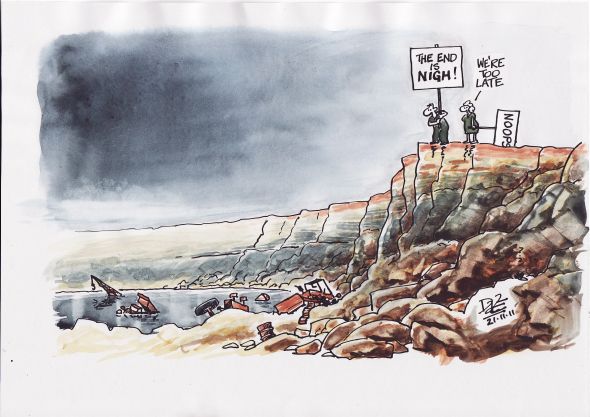
My very favorite piece of punditry about the Keystone XL pipeline appeared the day after President Obama sent it back for more review, perhaps killing it off altogether.
It came from the pen of a senior fellow of the Council on Foreign Relations named Michael Levi, who had spent the last few months endlessly opining about why the pipeline should be approved. Proven conclusively wrong, his sour-grapes op-ed explained that, in fact, environmentalists had damaged the cause of clean energy because they’d joined with Nebraska ranchers “who simply did not want a pipeline running through their backyards” to defeat the plan. By embracing such NIMBYism, he lamented, we’d made it easier to block transmission lines from solar power plants in the desert and other green infrastructure.
The argument is absurd on its face — one should embrace the dirtiest energy on the planet so that someday down the road we’ll be able to build some green stuff? It’s like saying you should guzzle bacon grease for breakfast to make sure your throat is open so you can eat sprouts for lunch. But more importantly, it’s a slur on the people who fought this fight, in Nebraska and elsewhere — it imagines that people out there beyond the Council on Foreign Relations are somehow unable to think generously about the world.
Take those Nebraska ranchers, for instance: They were absolutely vital to the pipeline victory. By turning red Nebraska green on this issue, they gave the administration the cover it needed to act. It was a real feat to force the state’s governor and Republican senator to come out against the pipeline, something only powerful organizing could have accomplished. And of course they were protective of their place — they stood up for the Sand Hills and for the Ogallala Aquifer, and why should they not? But they also stood up for the planet.
Jane Kleeb, who organized Bold Nebraska into a fighting force, made it clear at every turn that the president needed not just to reroute the pipeline but to shut it down, and that climate change was one of the reasons; there was no rift in the ranks. For the sake of completeness, here are the names of a few of the people Levi was disparaging, some of the organizers who carried the day in the Midwest: Randy Thompson, Malinda Frevert, Ken Winston, Ben Gotschall, Cindy Myers, Susan Luebbe, Bruce Boettcher, Ernie Fellows, John Hansen, Graham Christensen, Linda Buoy, Linda Duckworth, Mary Pipher, Pippa Lawson White, Teri Taylor, Mitch Paine. My guess is that every single one of them understands that their work is connected to people around the globe already suffering the effects of a warming planet; people may start out protecting what’s close to them, only to find it’s connected to everyone else.
And the Nebraskans weren’t even actually the first people to raise the cry. That honor goes to indigenous people around the continent, beginning with tribes whose land has been wrecked by tar-sands development, but extending out to most of the bands on both sides of the border. The very first people I called when I wanted to start working on the pipeline were Tom Goldtooth, leader of the Indigenous Environmental Network, and his dynamic assistant Clayton Thomas-Muller. Over the next few months they introduced me to dozens of their colleagues: John Steele and Tom Poorbear and Debra White Plume of the Oglala Sioux Nation; Bill Erasmus, grand chief of the Dene Nation; and Melina Lubicon Massimo, a young Cree organizer who managed to bring everyone she talked with to tears — she’d lost family members to the cancers now proliferating across tar-sands country. Adam Thomas, Rob Cee, Sharon Lungo, Kandi Mossett, Simon Reece, Nellis Kennedy, Winona LaDuke, Healther Milton Lightning, Marty Cobenais, Ben Powless — it’s a long list, filled with people every bit as expert as Levi (such as Pat Spears, of the Intertribal Council on Utility Policy), but their vision not confined to think-tank hallways.
Many of these folks had seen family members get sick and die, so yes, technically, they were worried about their “backyard.” But every one of them spoke with great power of the earth they’d watched the rest of us wreck. You really think Native Americans care only about the particular plot of land on which they live, and that they somehow don’t understand the way things connect? Meeting at the Rosebud Sioux reservation in mid-September, native leaders from around the continent reached a “Mother Earth accord” that began with the reaffirmation of “our Indigenous view that the Earth is our true mother, our grandmother who gives birth to us and maintains all life,” and concluded that the U.S. and Canada should “reduce their reliance on oil, including tar sands, and invest in the research and development of cleaner, safer forms of sustainable energy and transportation solutions, including smart growth, fuel efficiency, next-generation biofuels and electric vehicles powered by solar and wind energy.” The second statement might emerge from a progressive think tank somewhere; the first goes deeper. These people were not describing their “backyard,” some suburban accessory for pleasant weekend living. They were talking about their home, and ours.
We won no final victories by beating this pipeline — there are no permanent victories in the environmental business. And we have much tougher battles ahead, not just to block things but to force the energy industry off fossil fuels and on to something else.
But that’s why it’s important to celebrate even partial wins: They help us build the resolve that we need to go forward. It makes me think it’s time for a new acronym to replace the absurd NIMBY, one that could be shared by the Nebraska ranchers and native activists and the college students and the green groups and the religious leaders and the labor organizers and the myriad Occupiers and all the others who came together to block this pipeline and hopefully do much more in the years ahead — people who are, thank God, too busy looking out for the future to be intimidated by realpolitik mandarins at outfits like the Council on Foreign Relations.
Everyone from Tim DeChristopher speaking from jail to Robert Redford speaking from YouTube made it clear that this is a more united opposition than the oil companies are used to dealing with. An opposition that takes strength from small victories, and which should be starting to worry the fossil-fuel industry just a little bit.
So I think we need a new name. Faced with projects like tar-sands oil which carry the possibility of deeply damaging the earth’s support systems, we should take to calling ourselves NOOPs: Not On Our Planet.
And if I weren’t a Methodist Sunday School teacher, I fear I’d be tempted to add an A to the end. If you’re an oil company executive willing to keep altering the chemical composition of the earth’s atmosphere, or a coal baron who thinks it’s okay to remove mountaintops, or a gas tycoon eager to pollute both water and air in search of some fracked riches — NOOPA! Find yourself a spaceship.
Bill McKibben is founder of 350.org and Schumann Distinguished Professor at Middlebury College in Vermont. He also serves on Grist’s Board of Directors.
Read the original, with full links, HERE

Geraldine Brooks, (Above, Pic: Randi Baird) the 2011 Boyer Lectures
Lecture 1: Our Only Home
Download Audio: HERE
In dictionaries, definitions of home are various. It is both ‘a place of origin, a starting position’ and ‘a goal or destination.’ It may also be ‘an environment offering security and happiness’ or ‘the place where something is discovered, founded, developed or promoted. A source.’
In these lectures, I will examine each of these definitions. I will revisit my ‘place of origin’ – an ordinary Australian suburban childhood of the sixties. I will ponder the way it led to a ‘goal or destination’: a career as a foreign correspondent and then as a novelist.
Tonight I want to discuss how my home in Australia was a place of discovery and a source of conviction about our responsibility to our only home, this fragile and beleagured planet.
Transcript:
I began to write these words on the island of Martha’s Vineyard, where I now live. It was a warm day in early July. Sunlight dappled the page, filtered through the leaves of an apple tree that was old before I was born.
Not far away, but unaware of me, a muskrat browsed in the grasses by the brook. Red winged blackbirds swooped across the water and a goldfinch, like a drop of distilled sunshine, darted through the glossy branches of an ilex.
The muskrat, the birds and the holly tree are natives here. I am not. Only my dog, a liver-and-tan Kelpie, is a fellow exotic. Ten years ago, I plucked him from a paddock in New South Wales and set him down in another hemisphere. He is insouciant about this, as befits his kind. He is the quintessential Aussie canine whose legendary toughness begat the expression, ‘That’d kill a brown dog.”
So while his warm flanks twitch in a doggie doze, it falls to me to reflect on what it means to live so far from our homeplace, so far, indeed, that the cold winds of July have been replaced by this soft and buttery summer air. I cannot explain to my Kelpie that the Indo-European root of that word, “home” is “haunt.” Nor can I explain to him how and why it is that I am haunted by absence and distance, by dissonance and difference, even if the alien corn that we will eat for dinner tonight is a sweeter variety than the starchy cobs of my Aussie childhood.
Nothing is as sweet in the end as country and parents, ever,
Even if, far away, you live in a fertile place.
Odysseus said that. Or rather, Homer did. I know next to nothing about Homer – who he was, how he lived – yet I feel he knows my heart. Separated by three thousand years, by gender and culture and geographic space, this ancient shadow is able to put words to the feelings that I have on a sunny day on a little island, as I think of the larger island that is my native home; that sits, like Ithaca, “low and away, the farthest out to sea,’ where the ribs of warm sandstone push up through thin, eucalyptus-scented soils.
Home. Haunt. I sit in my garden and look across to the house I have now; a house whose first beams were cut and shaped a century before the white history of Australia even began. When I run my hand over that rough-textured oak, I imagine the hand that planed it — the hand of a grist miller, himself an exotic transplant, the second or third in a line of English settlers who had come to this place drawn by the power of rushing water.
If any home is haunted, this one should be. In 1665, the very first miller, Benjamin Church, bought this land from the native people of the place, the Wampanoag. He dammed the wild brook they called the Tiasquam, and set his grindstones turning. In so doing, he destroyed the herring run that had fed the Wampanoag each spring, when the fish known as “the silver of the ocean” poured upstream to spawn.
Benjamin Church dammed the brook.
It is just one sentence in a long story. The story of human alteration in the natural world. It happened on the Tiasquam Brook in Martha’s Vineyard, as it happened in uncountable places. As it happens now, in the Amazon, in Africa, in Western Australia, Tasmania, the Alaskan Arctic and innumerable corners of the world. A choice, a change, and the planet that is our only home reels and buckles under the accumulated strain.
Often, this story has also compassed stories of dispossession, in which the needs of the newcomers and their industry disrupted the imperatives of the native people. As Benjamin Church built his mill in 1665, an English neighbor fenced pasture for his imported livestock, and the Wampanoag were no longer free to hunt the deer and waterfowl that sustained them. Another settler set his hard hooved beasts loose to trample the clam beds, and a band of Wampanoag went hungry that night.
War followed, as war always has followed such acts of dispossession. In 1675, the Wampanoag on the mainland rose up against the English colonists. Benjamin Church, grist miller no longer, became a captain in the English army.
His principal foe was the Wampanoag leader, Metacom. For six months, Metacom had the English on the run, destroying a dozen settlements. The colonial enterprise in New England teetered. It was Church, the former miller, who devised a way to turn the tide of battle. He enlisted Indians at odds with Metacom to teach the English their guerrilla tactics. On a humid summer day in 1676, Church led the force that trapped Metacom and shot him dead. He regarded Metacom’s dead body and declared him “a doleful, great, naked, dirty beast.” He ordered the corpse drawn and quartered and had the quarters hung from four trees. Church kept the head, which he sold in Plymouth, at a day of Thanksgiving, for thirty shillings. It was placed on a tall pole to overlook the feast.
Everyone knows the story of the first Plymouth Thanksgiving, in 1621. Metacom’s father, Massasoit, attended that one, offering help and friendship to the hapless, half starved English Puritans. Few know the story of the Plymouth Thanksgiving of 1676, presided over by Massaoit’s son’s decapitated, rotting head. We like that earlier story much better. Let’s not do black armband history. Pass the turkey. Let’s we forget.
But I can’t forget. Though Benjamin Church’s mill was torn down, this land bears his imprint. The Tiasquam brook remains dammed, the herring absent. And the grindstone is still here, set as a doorstep at the entrance to my house. Two meters in diameter, almost half a meter thick. When my foot lands on its notched ridges, words from Gerard Manly Hopkins’s poem echo in my head:
Generations have trod, have trod, have trod;
And all is seared with trade; bleared, smeared with toil;
and wears man’s smudge and shares man’s smell…
Benjamin Church’s mill was built a hundred years before the Industrial Revolution that dismayed Hopkins. But it industrialized this landscape. And now I live where he lived, in an American home on Indian land, haunted by ghosts who lived and died unaware that my land, my homeplace, even existed.
I did not mean to become part of this story, to know, so intimately, all this history so very far removed, and yet so sadly similar, to our own. Metacom has much in common, after all, with Pemulway in Sydney or Yagan in Perth, guerrilla resisters whose heads also ended up on display-Pemulway’s pickled in spirits and Yagan’s shrunken and smoked. But that’s black armband history, too, and as a schoolgirl in 1960s Sydney, I did not learn it. In those days, I could not have told you that the home I lived in stood upon Eora land, as does this hall in which we meet tonight. And I acknowledge the traditional owners of this place, and the continuing contribution of their descendants to the culture from which I am an accidental exile, a reluctant expatriate.
I am not part of that earlier Australian generation who set off on a deliberate search for fame and fortune in distant lands. My generation was the first that didn’t need to. By the 1980s, when I left home, our culture had grown deep and wide enough to encompass all but the most rarefied of ambitions. I meant to leave Australia for just a year – a standard student adventure. But way leads on to way. Like Odysseus, I went to war — although as a writer, not a warrior — and then found my homeward journey diverted by quests and siren songs. What was to have been my brief foreign fling has become, by unplanned stages, my life.
In dictionaries, definitions of home are various. It is both “a place of origin, a starting position” and “a goal or destination.” It may also be “an environment offering security and happiness” or “the place where something is discovered, founded, developed or promoted. A source.” In these lectures, I will examine each of these definitions. I will revisit my “place of origin”– an ordinary Australian suburban childhood of the sixties. I will ponder the way it led to a “goal or destination:” a career as a foreign correspondent and then as a novelist. Tonight I want to discuss how my home in Australia was a place of discovery and a source of conviction about our responsibility to our only home, this fragile and beleagured planet.
I have said that I live now on the banks of a little river that was dammed in 1665. When I first left Australia in 1982, a greater river, a larger dam, was very much on my mind. That river was the Franklin, in south west Tasmania. A river wild from source to mouth, already a precious rarity in the smeared, bleared post-industrial world. Yet a river whose wildness was in clear and present danger. Works were already proceeding for a dam that would flood a pristine wilderness to yield just 180 megawatts of power. The last thing I did before I left the country was to hole up in Bob Brown’s cottage in Liffey. Typewriter on knee, I helped him edit mounds of handwritten notes and shape them into the text for his book, Wild Rivers. We had little time: Bob was needed everywhere then, as the spearhead for a movement that encompassed political lobbying, legal maneuvering, advertising campaigns and the largest non-violent direct action Australia had ever seen. So we worked late, by candlelight and firelight, in that little off-the-grid cottage. Bob had decided that he couldn’t stay hooked up to electricity provided by the drowning of that already-lost gem, Lake Pedder.
I had started covering the Franklin controversy as a journalist in 1980. Somewhere along the line, not too far along the line, I must confess, I did the thing that journalists are not supposed to do. I became an activist. The river itself had turned me into one. In February of 1981 I rafted part of its length, on assignment for the Sydney Morning Herald, following Don Chipp, leader of the Australian Democrats. That river journey was, at the time, the hardest and scariest thing I had ever done. I was not what you would call an outdoorsy type. To paraphrase Woody Allen: I was two with nature.
Until I started covering environmental issues for the Herald, I’d never gone bushwalking or slept one night in a tent, much less steered my own small rubber raft over heaving white water. That first night on the river, having carried gear all day up and down a sheer, slippery, rain-lashed mountainside, I lay wet, aching and apprehensive, wondering what mad ambition had led me to sign up for this. The rains came down as only rains born by the Roaring 40s seem to know how to fall. Sometime in the middle of that long night, a plaintive male voice emanated from the nearby tent which Senator Chipp shared with his wife, Idun. “Jesus Christ, darling. Don’t wake me up to tell me you’re uncomfortable!” My misery, it seemed, had some distinguished company.
But that Franklin trip changed me, profoundly. As I believe wilderness experience changes everyone. Because it puts us in our place. The human place, which our species inhabited for most of its evolutionary life. The place that shaped our psyches, and made us who we are. The place where nature is big, and we are small. We have reversed this ratio only in the last couple of hundred years. An evolutionary nanosecond. The pace of our headlong rush from a wilderness existence through an agrarian life to urbanization is staggering and exponential. In the USA, in just two hundred years, the percentage of people living in cities has jumped from less than four percent to eighty percent. By 2006, half the world’s population lived in cities. Every week, a million more individuals move to join them. The bodies and the minds we inhabit were designed for a very different world from the one we now occupy. As far as we know, no organism has ever been part of the experiment in evolutionary biology which we as a species are now undertaking, adapted for one life yet living another. We are, in a way, already space travelers. We have left our home behind and ventured into an alien world. And we don’t yet know what effects this sudden hurtle into strangeness will ultimately have on the human body, the human psyche.
As the American writer and activist Bill McKibben has observed, we have ended nature. There is no longer any true wilderness left on Earth. The carbon we have pumped into the atmosphere has ensured that the hand of humanity now reaches into even the most pristine alpine crevice or remnant virgin forest. In his 1989 book, The End of Nature, McKibben argued that Earth’s altered climate gave the experience of being beside a river a different, lesser meaning. He wrote: “Instead of a world where rain had an independent and mysterious existence, the rain had become a subset of human activity. The rain bore a brand; it was a steer, not a deer.”
Today, twenty two years later, one of the easiest-to-grasp facts of climate change concerns its effect on rain. Warmer air simply holds more water vapor than cold. In dry places, like much of Australia, this means increasing evaporation and drought. In moist places, like New England, it means increasing downpours, more flooding. It means the tropics are expanding, pushing the dry subtropics further south, further north. As this happens, our rain bearing Westerlies are going to drop their water over open ocean rather than on our thirsty cities and farms. The Australian Water Services Association now tries to avoid the term “drought” which signifies a temporary condition. What used to be drought, it seems, is our new normal. Meanwhile, in New England, flooding on a new scale, an increasing frequency, gouges away roads, gashes up trees. Small, unprosperous communities ponder how they will find money to renew bridges and armour embankments against the next wild storm. And between us, between the suddenly wetter, suddenly drier lands, the great oceans creep higher, ever more corrosive because of the burden of acidifying carbon. Our great reefs dissolve, shellfish weaken, the links of a food chain strain to breaking point.
And who among us is making ready in any meaningful way, for the disasters that are coming? The defense departments of Britain and the United States, which are already gaming scenarios for the resource wars they expect to break out over scarce materials. It will be Metacom and Benjamin Church, once again, on a global scale. The dispossessors this time will be defined by wealth, not ethnicity. If you doubt the extent of scarcity, consider this. Municipal parks have begun removing public sculptures cast in metal and replacing them with plastic replicas, because of increasing theft to feed the appetite for commodities in China and India.
Beside the military, who else is making ready? The Newcastle Coal Infrastructure Group. In 2009 it raised, by several meters, the height of its massive new coal loader at the mouth of the Hunter River, after the CSIRO issued a report about predicted sea level rises. You’d laugh if you didn’t need to weep. I honestly don’t know what’s worse, BHP and its associates’ hard headed pragmatism, or Rick Perry, the Texas governor and presidential candidate who denies climate change and advocates massively expanding the carbon economy even as he prays for rain to end the epic Texas drought. Perry and his prayer remind me of the man in the old joke who constantly prays to God to let him win the lottery. After years of this, God, frustrated, finally replies: “Mate, help me out here. Buy a ticket.”
But few of us are buying tickets. Three years ago, I thought we had done so, when President Obama took office. He made a speech that promised his inauguration would mark the day “the rise of the oceans starts to slow and the planet begins to heal.” If only. Of all the disappointments of the past three years, highest on my personal list is Barack Obama’s silence-his failure to use his gifts of eloquence to explain our predicament and the necessity for urgent action. Instead, Obama greenlights Shell’s drilling in the Arctic, even as the toxins from BP’s blown out well swirl in the Gulf of Mexico. He fails to act against a tar sands pipeline that would run from Canada to the Gulf of Mexico and that has been described as the fuse on a carbon bomb. The US president cites the present condition of the economy as the reason for these terrible decisions. But if ” It’s the economy, stupid,” then how stupid is it to ignore a looming crisis that threatens the shape and, ultimately, the survival, of every economic activity we have. If we don’t stop burning down our only home to provide a few hours’ more light to party by, there will not be an economy as we know it. Wall Street will be under several meters of water and we will be at war with each other for the scant fruits of our heat-blasted, storm-lashed harvests.
When I was very young, I read John Wyndam’s post-apocalypse novel, The Chrysalids. In it, one of the characters keens for her devastated planet: “What did they do here? What can they have done to create such a frightful place? …There was the power of gods in the hands of children, we know: but were they mad children, all of them quite mad?”
In my own mind, I create a character like Wyndam’s, in the aftermath of the climate wars, eking out a mean existence in a harsh landscape, and trying to explain to her kids the mass insanity that led them there. “And you know, they flushed their toilets with drinking water. They made durable things, like plastic plates and cups, and they would use them only once and then throw them away. They thought it was normal for one person to drive around in a huge thing called an SUV. They used air conditioning, when it wasn’t even really that hot outside…” I imagine her kids rolling their eyes and thinking to themselves, ‘Mum. Always exaggerates. Nobody could ever have been that crazy.”
But how do you convince people, here and now, that these common behaviors are indeed crazy? Machiavelli observed that “(T)here is nothing more difficult nor more doubtful of success nor more dangerous to conduct than to make oneself a leader in introducing a new order of things. For the man who introduces it has for enemies all who do well out of the old order and has lukewarm supporters in all who will do well out of the new order…who do not put their trust in changes if they do not see them in actual practice.” Or, as Yeats put it more succinctly:
The best lack all conviction, the worst are full of passionate intensity.
This is the current political predicament, most especially in the United States. There is no nationally effective Green movement there. There is no energy policy. Barely even a breath of serious discussion. Climate change is an issue in the national political conversation only among Fox News bloviators who use climate scientists as pitas.
In the US, without leadership, the potential for any kind of concerted national action is bleak. So in the land of rugged individuals, it falls to individuals to act. In a funny little life irony, having fought against a hydro scheme on the Franklin, I have just completed an engineering study on how to use Benjamin Church’s 1665 dam for mini-hydro on the Tiasquam. We are designing a fish ladder at the dam, so that the herring can return after their long absence. We’re revegetating some wetlands with native shrubs for wildlife habitat, planting fruit trees and buying our meat and vegetables from local farms to lower the carbon footprint of our consumption.
I know it’s not much. And I know, that small as these actions are, I am uncommonly fortunate to be able to afford to take them. And yes, I am well aware that I just undid a big piece of it by flying here to give this lecture. But even if I can’t do everything, that’s no excuse for doing nothing. I will do what I can. And at this inflection point in human existence, I believe that what we can do, we must do. Perhaps an answer to Yeats’s despair lies in the words of the 18th century Rabbi Nachman of Bratslav. He said: “If you believe it is possible to destroy, then believe it is possible to repair.” The Jewish idea of Tikkun Olam, of each individual working to gather up and repair the shards of a fractured creation, is a metaphor that I think speaks eloquently to our present circumstance.
Here in Australia, while the need for individuals to act is great, the potential for concerted national action is greater. The Australian Greens have puts these issues at the front and center of the national policy debate. We have a government willing to enact carbon price legislation and an opposition that at least accepts the broad outlines of the crisis and its causes. But is it the best we can do? Not by a long way. Australia can punch above its weight on this issue, and not only because we are the largest per capita carbon emitter. Our continent covers a vast land mass and our territorial waters represent a significant and critical share of the world’s oceans. Time and chance have made us custodians of a huge and significant piece of the planet. Our national temperament has created a peaceful and prosperous society here.
We are, by any world yardstick, a rich society and a decent people. Right now, by some metrics, we are the richest people on the planet. Rich enough to expend some of that capital and decent enough to know it is the right thing to do, the right time to act. What we do here matters. What we do here could be a model for the world. It is depressing to hear politicians say that our sacrifices should be “in line” with what the US does. That’s a mighty low bar. Why should we align our ambitions with a nation that harbors justifiable fears of its own decline, that has created a national atmosphere increasingly hostile to science and reason, and that is locked in an arid political stasis? Please, let’s not line up there. What’s wrong with leading the way? Shouldn’t we aspire to set the line, to inspire, to become an example to the world, a byword for what a visionary country can be and do? We’ve played that role before, after all. We gave the world the secret ballot-the Australian ballot, as it was called-that did so much to raise living standards and improve conditions for workers worldwide. We were a leader in extending to women the right to vote. We were barely a nation when we set the bar for bravery and sacrifice by common soldiers in foreign wars. We grew up out of racism and misogyny and homophobia to become a mostly tolerant, successfully multicultural society in a world where, for too many countries, that seemingly modest ambition remains painfully out of reach.
We did these great things because we know that we are in it together. It is our core value as Australians. And at this moment in history, our core value happens to be the raw, aching truth of the human predicament. It may also be the only belief that can save us as a species. A species that will continue to find comfort and delight in the companionship of animals, the miracle of birds, the colors of corals and the majesty of forests. We are in it together, on this blue, spinning marble in the cold and silent void. And we must act on that belief, if we are going to be able to continue to live a good life here, in this beautiful and fragile country, on this lovely planet, our only home.
Related:
• The Age: Five years to act on climate
• The SMH: UN scientists forecast more severe droughts, cyclones and floods
• Science Daily: Rising air pollution worsens drought, flooding, new study finds
• CDIAC: Record High 2010 Global Carbon Dioxide Emissions
• Science Daily: Erratic, Extreme Day-To-Day Weather Puts Climate Change in New Light
• ScienceNews: Dirty air fosters precipitation extremes
SEA LEVEL RISE THREATENS SURF CLUBS: NEW REPORT
Paul O’Halloran MP
Greens Member for Braddon
The Tasmanian Greens today drew attention to the findings of a report commissioned by Surf Lifesaving Australia, which found that 9 out of 10 Tasmanian surf clubs are threatened by sea level rise.
Greens Member for Braddon Paul O’Halloran MP said the report entitled Impact of Extreme Weather Events and Climate Change on Surf Life Saving Services showed 63 per cent of Australia’s surf lifesaving clubs are threatened by climate change, including 89 per cent of clubs in Tasmania.
“The report conducted by Geo-Sciences Australia shows that the country’s hundreds of lifesaving clubs are falling into ‘zones of instability’ and are threatened by rising tides and harsher weather conditions,” Mr O’Halloran said.
“It provides a worrying snapshot of a real and present effect of climate change on the Australian way of life and one of our most famous figures, the surf lifesaver.”
“Responding to these threats will require surf clubs to come up with additional funds for rebuilding infrastructure, relocating clubs and paying for coastal vulnerability assessments.”
“These will be costly headaches for clubs, the majority of which already struggle to raise enough funds through public donations.”
“Australia’s 309 local surf lifesaving clubs help protect the lives of the 200 million people who visit our coasts every year, and provide enormous humanitarian, social and economic benefits to our coastal communities.”