Economy
The Media is not your friend. It is a marketing platform


Jonathan Green, writing on The Drum put it most eloquently: The Media is not there to help. It does not feel your pain
An eviscerating analysis of media reality – on this occasion in relation to the Christchurch earthquake which concluded with this observation: Used, you might say, and forgotten. Because that’s the sad truth in these things: that the media does not empathise. The media is not there to help. The media does not feel your pain.
How true it is. Yet countless people every day thrust themselves willingly into its gaping maw, to be consumed and spat out. To be the shiny object of the Meedja’s gaze … then peremptorily discarded.
Or, if they are in the media-politico club it all becomes so terribly in-house … think ABC’s Insiders … and insular, Canberra hide-bound.
A dose of reality in dealing with Meedja is always paramount. A story that starts out soft can be tabloidised into shock, horror, doubt, fear, riddle … as the most sensational angle to a yarn is desperately sought … or sometimes structured by the Backbench long before the journo ventures out.
And, then there is the immense power of corporate muscle and the timidity in face of it. Witness this report from last week’s Australian Financial Review (Oct 8), headed, Analyze this, if you’re game:
News Corporation has always been a little sensitive about what analysts and fund managers say.
Wendy Goldman’s 2001 book, The Murdoch Mission, recorded how the office of the chairman in New York interacted daily with analysts such as Jessica Reif Cohen.
In 2004, Deutsche Bank’s former media analyst, Mike Mangan, accused News of pressuring broking firms to publish positive research reports and said that as a young analyust he was “abused, insulted and sworn at” after downgrading his recomendation on News Corp from ‘buy’ to ‘hold’, and he knew two others who had similar experiences. He believed he was eventually replaced becuase of pressure from News.
So it’s understandable if AMP Capital decided it didn’t want to risk triggering bad press from Rupert Murdoch’s newspapers when it decided to pull a report to clients criticising corporate governance at News. But au contraire. In fact was was a policy decision to pull the report – AMP prefers to raise concerns directly with companies, a spokesman says.
Three years ago, AMP fund manager Jim Reid, a former journalist with The Australian expressed concerns a little too directly, suggesting that Murdoch was a “capital destroyer”.
He parted ways from AMP two weeks later by mutual agreement.
Harto’s (John Hartigan, News Ltd CEO) is not right … News Ltd does not own the Agenda: My contention is this – We have the opportunity to move from setting the agenda each morning….to actually owning the agenda. All day. Every day. We will own the Agenda. All day. Every day, HERE and, HERE: A Rage against the Dying of the Light.
But it has an immense all-pervasive influence, owning as it does some 70 per cent of print media; and exercising that power with capricious brute force as detailed in academic Robert Manne’s superb Quarterly Essay Bad News: Murdoch’s Australian and the Shaping of The Nation and, A pressing case for standing up to Rupert Murdoch’s bullying.
Lots of print ownership, yes, but fewer and few journos as the latest redundos from Mercury reveals: three more senior sub-editors have accepted News Ltd’s generous offer to go graze in the Top Paddock, including sub-editor Don Knowler whose bird column in Saturday Mercury has such a big readership (thank the Big-Eagle-in-the-Sky, the column will continue). And sub-editor and Books Editor for Sunday Tasmanian, Carlene Ellwood. The other sub is the office poet.
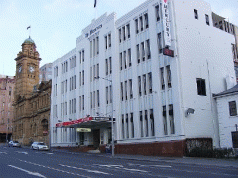
But wait, there’s more. Scuttlebut holds that Mercury will no longer headquarter at its wonderful art-deco Maquarie St edifice, but will move to the old Antarctic Centre in Salamanca; dangerous that, too accessible to a vast array of bars.
And the other bit of goss: current Editor Garry Bailey will exit soon to be replaced by Saturday magazine Editor Martine Haley, buttressed by an experienced journo from Brisbane.
• Earlier on TT: Rupert: My part in his (near) downfall
• Meanwhile, it helps to keep the boss on side (and also a lesson in how The Backbench HQ rewrites for what they want):
A freelance journalist for a British newspaper could find himself short of work after he tweeted offensive messages about his editor — all of which were automatically posted on the newspaper’s website via its Twitter feed.
Rob Crilly, Pakistan-based correspondent for the Telegraph, took to Twitter to vent his anger at an editorial decision made by the paper’s Foreign News Editor.
The journalist was angry about the way his story about Libya’s National Transitional Council was reworded.
“Neville Dean twisted my copy beyond all recognition,” Crilly posted.
“I said ntc [National Transitional Council] hadn’t decided policy. Neville Dean rewrote that new Libya govt had refused to work with western gov.”
But his tweets soon took a much nastier tone. Minutes later Crily tweeted “Neville Dean is a c—.”