Planning/Heritage
Is open space dispensable?

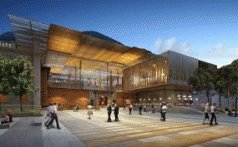

If we are to move towards higher density within some of our urban areas a consequence will be the reduction in areas of private open space attached to individual dwellings.
In Tasmania’s relatively small cities will we need to balance the loss of private open space with an increase in the size, quality or usefulness of public open spaces and if so, how might we achieve this?
Tasmanian Planner magazine put this question to:
Peter Poulet is an architect and artist who has worked in Australia and Japan, he is currently Tasmania’s State Architect as well as an Adjunct Professor to the University of Tasmania.
Gwenda Sheridan has worked for the past fifteen years in Tasmania as a consultant in heritage landscape research and planning. An interdisciplinary thinker this has resulted in tertiary teaching, and planning in statutory, environmental, and recreation areas. Gwenda is a member of PIA and of the International Committee on Monuments and Sites (ICOMOS).
Mary Massina has worked across the community, private and public sectors, as well as in key advisory roles at State and Federal political level. Mary is currently the Executive Director of the Tasmania Division of the Property Council of Australia and is actively involved in a number of key reforms such as local government, planning and water and sewerage.
What Peter Says
Private open space is precious to Australians, nevertheless I am of the opinion that one can have ‘too much of a good thing’ and hence not appreciate or understand what drives this need and how best to satisfy it. We all grow weary of ‘acres ‘of lawn to mow; begging the question, how desirable or sustainable is our way of settlement?
My thoughts on how a reduction in private open space can actually make for better settlements and dwellings stems from time spent in Japan. The notion that denser settlement actually helps people value their open spaces more is evidenced in traditional Japanese cities and towns where close habitation made for high quality private open spaces whilst maintaining harmonious communities.
“The open spaces inevitably generated among the closely built urban houses, while still performing the functions of lighting and ventilation, were sublimated into gardens that took on an air of solitary rural beauty…” 1
The tea garden of traditional Japan is small and is designed to be viewed from a tearoom or teahouse; it is intended to be an outlook for contemplation and focus, something we could all do with in our busy lives and a welcome attribute and contributor to the privacy and ambience of our homes.
There is also the capacity for our private open spaces to ‘borrow scenery’ or steal space from beyond their physical confines. By clever design and juxtaposition, space and outlook can be perceived as far greater and more expansive. However, “…smallness in itself is no obstacle to the use of borrowed scenery…By far the most common among the objects of capture are mountains and hills…To conceal irrelevant or undesirable features, trimming is needed, and for this purpose low clay walls…are commonly used …thick and luxuriant hedges…are quite appropriate…the process lies in the need to make an effective capture of the scenery actually wanted.” 2
Taking some of these ideas from the house and neighbourhood and applying them to our cities is illuminating. As an example, Hobart is a small city where its favourable attributes, the connections to and the borrowing of landscape features from beyond, give us a very different understanding of our ‘place in the world’, specifically the natural environment that surrounds us. The often accidentally encountered glimpses, views and vistas to places and landforms not part of this city are a strong and unique characteristic of our understanding of place which should be preserved. Where would we be without the daily references to Mount Wellington and the range and the grassy focus across the river of Droughty Point?
By planning our urban spaces with an acceptance and understanding of these multiple perspectives we are able to imbue our urban realm with perceptual qualities. Thus a unique and experiential dimension will inform our urban environment; this becomes a fluid, indefinite experience merging foreground, middle ground, distant and partial views.
I do not believe we need to enlarge our quantum of public space to compensate for the loss of private open space, however we do need to redefine our understanding of the urban realm to take into account the importance of the very characteristics determining the qualities of our urban spaces; movement, energy, light, sound, colour and discovery; that special experience of moving in and through a city discovering and reorientating it and yourself in an experiential environment. Moving though public space in Hobart is exciting as you reference points beyond the built centre and navigate by a subjective understanding of spaces.
The experiential and phenomenal power of our cities cannot be completely rationalised and must be lived. Our work is to amplify the ‘poetry’ of these urban encounters; to add richness and mystery to our public realm.
References:
1: Itoh, Teiji. ‘Space and Illusion in the Japanese Garden’. Weatherhill/Tankosha, New York /Kyoto. 1965. pg 68
2: Ibid., pg 32
What Gwenda Says
In Tasmania, city and urban lot sizes are being reduced by Greenfield subdivision or ‘infill’ in older suburbs where past lot sizes were larger. The Southern Tasmanian Regional Land Use Strategy informs us that urban lot sizes in Tasmania will be smaller in the next twenty years1. In Kingston, lot sizes have been reduced to 400m2 or thereabouts. Multi unit development is at 230m2 or less. Such changes in housing densities afford some indication of what the ‘new’ future landscape will look like, if progress down the current path is continued; the change having taken less than ten years.
The meaning of the current densification pattern.
At a landscape scale one perception is that considerable ‘losses’ hang off current changed planning density realities as they are being implemented. The loss relates to green open space, vegetation, gardens and trees and what this means.
Greenfield subdivision
Currently the practice in Greenfield urban subdivision is to raze what was there formerly. Out goes every blade of vegetation, tree, often topsoil, with it, biodiversity, birds and wildlife. Edward Relph2 spoke of this in the 1970s but it’s gotten worse; technology is quicker, bigger, and the end result more destructive. In 2005 Don Knowler3 noted five different habitat requirements for attracting birds to the garden. Requisites were tall trees, smaller shrubs, a water source, managing pets and a mix of native and exotic vegetation to give habitat, food, and shelter.
A vegetable garden and self sufficiency
In 2008 Tony Hall4 wrote on the disappearance of the back garden. The endemic disease of getting rid of gardens in older established suburbs (called ‘infill’) or of establishing totally inadequate ones in new subdivisions, Hall found was NOT the pattern overseas.5
In a carbon constrained world, with climate change, useable, quality green open space for growing one’s food must remain an option.
Heritage considerations and infill
Heritage Tasmania has no curtilage policy for its old historic houses and their living heritage surrounds. Many properties are not registered. The International Council on Monuments and Sites (ICOMOS) recently issued a draft document, for safeguarding and managing historic cities, towns and urban areas.6 It adopts a whole-of-town, or urban landscape scale approach, and uses historical, geographical (spatial), social and interventionist criteria to deal with change. It notes there must be a balance between public open space and the dense built environment.7
The Character of the Place
When densification occurs in a vacuum with no public or private green open space policy, the character of the place changes. It’s death by a thousand cuts, land parcel by land parcel. Patterns reflect spatial and historical elements with recognizable layers of landscape ‘fabric,’ (e.g. topographic, vegetative features, built form, perceptual associations and aesthetics). The ‘fusion’ and inter-connectivity of these characteristics, gives the place its distinctiveness, authenticity and significance values. Character of place is not being rigorously mandated for in scheme standards, nor is there future provision for this in evolving policy. It needs to combine heritage with planning.
The ‘anywhere’ urban landscape and aesthetics
Densification combined with current planning ‘products’ and inadequate green space provision, favours uniformity, lack of diversity and contrast. Exhibited are standardised colours, materials, structures, design and minimalism. Aggregated at the landscape scale, this produces the ‘anywhere’ landscape; there is nothing to soften the hard built form lines. Retired high profile lawyer/ planner John Mant raised the ‘anywhere,’ zone versus parcel format issue in 2006.8
The balance between green open space and built form
In Christopher Alexander’s research9 the percentage of green space should roughly balance the built form percentage to produce liveable neighbourhoods. Four interlocking elements to the neighbourhood, pedestrian space, gardens, car spaces and buildings are discussed.10
It is the geometry and pattern, the spatial interlock of these four elements which defines the kind of neighborhood it is, its human character, its working or not-working. Above all, its in the arrangement of these four and their interlock which defines the wholeness of a neighborhood.11
Our vision should be for neighbourhoods that exhibit wholeness.
Health and green space environments
Salutary scientifically based findings emerged in 2010 connecting green space provision to good health outcomes (or the reverse).12
…do people living in greener neighborhoods have better health outcomes when we take income and other advantages associated with greener neighborhoods into account? The answer is yes. Yes, the benefits of nature that have been intuited and written about through the ages have withstood rigorous scientific scrutiny.13
There are dire physical, mental, social, and highly dysfunctional health outcomes where green space is inadequate, (for example more aggression, property and violent crime, higher rates of childhood obesity, higher rates for 15 out of 24 categories of physician-diagnosed diseases, including cardiovascular diseases).
Parks and other green environments are an essential component of a healthy human habitat …the science tells us that they play a central role in human health and healthy human functioning.14
References:
1. ‘Southern Tasmanian Regional Land Use Strategy’. Table 3. Definitions of housing density in southern Tasmania. 94. See also p. 12. ‘However in 20 to 25 years the preferred housing stock is expected to be smaller houses on smaller allotments in close proximity to services and facilities.’
2. Edward Relph. ‘Place and placelessness’.
3. Don Knowler. ‘Sunday Tasmanian’. 10 July 2005.
4. See for example, Tony Hall. Where have all the gardens gone? ‘Australian Planner’. 45 (1). 2008.
5. Ibid 33.
6. ICOMOS. “The Valletta Principles for the Safeguarding and Management of Historic Cities, Towns and Urban Areas’. ICOMOS News. Vol 18 No. 1. July 2011.
7. Ibid.
8. See John Mant. ‘Australian Planner’ 43 (1) 2006. Formatting development controls. Other Mant articles appear online.
9. Christopher Alexander. www.patternlanguage.com ‘The Nature of Order’. Book 3. A Vision of a Living World. 2005. See Chapter 8. People in a Neighborhood Form a Collective Vision of their World.
10. These ideas are taken from Christopher Alexander. Book 3. ‘Vision of a Living World: From the Nature of Order’. Centre for Environmental Structure. 2002. Berkeley. California. For further details see www.patternlanguage.com. See Chapter 9. 288-310. Oxford University Press described the Alexander Nature of Order as possibly amongst the most influential books it has published in 500 years.
11. Ibid. 290.
12. Frances Kuo. ‘Parks and Other Green Environments: Essential Components of a Healthy Human Habitat’ was published in a 2010 research series for the National Recreation and Park Association.
13. Ibid.
14. See Executive Summary of this document. Online at http://www.nrpa.org/uploadedFiles/Explore_Parks_and_Recreation/Research/Ming%20%28Kuo%29%20Reserach%20Paper-Final-150dpi.pdf.
What Mary Says
Firstly, open space is not dispensable.
Secondly, with the move towards increased density and intensity within urban areas, it does not necessarily mean that in our cities we need to increase the size of public open space.
Thirdly, the existing public open space that we currently have, such as our parks, squares, malls, waterfronts, bike paths and foot paths for example can and should be dramatically improved in terms of quality and usefulness.
Arguably there isn’t a single person in Tasmania that would argue that open space is dispensable.
Our ability to walk around our cities, explore our parks, enjoy coffee at Salamanca Place or the Launceston Gorge, the ability to access our natural environment are all intrinsic to the uniqueness of our State and our cities.
But the proposition that we need more public open space to counterbalance the loss of private open space is highly questionable.
Despite the move towards increasing density and intensity within our major urban areas, we are not yet facing an explosion of growth.
We aren’t seeing existing residential blocks being carved into two lots as the norm.
Indeed according to ABS statistics released in June 2010, the population density of Tasmania was 7.5 people per square kilometre (sq km). The capital city statistical district of Greater Hobart had a population density of 160 people per sq km, much lower than Australian capital cities combined (370 people per sq km).
And even if we were, would it mean that more open public space needs to be created to offset the loss of private open space?
To answer that question, State and Local Governments would actually need to have the money to maintain and improve public open space and the community would need to embrace it.
As we know, the maintenance of public open space is at best nominal.
Arguably, government barely has the funding to maintain existing open spaces, let alone create and maintain new public open spaces. A perfect example of this is the current debate regarding the dredging of the Tamar River and while three tiers of government avoid taking responsibility, the Tamar River, an important public open space, has become virtually unusable for leisure purposes.
Another example is the entirely inadequate maintenance of the chairlift facility at the iconic tourism destination, the Nut at Stanley.
Furthermore, any discussions of creating new spaces such as the Battery Point Foreshore walkway proposal becomes mired in politics and even the ability to make a decision as to whether a cable car up Mt Wellington to increase access to existing public open space becomes a decade long farcical discussion.
Unfortunately the common thread in all of these examples and integral to quality existing and new public open space is local government.
One of the key issues that the Property Council is strongly arguing for, is local government reform. What does this have to do with public open space? A lot.
The Property Council commissioned Deloitte Access Economics to look at local government structural reform.
The August 2011 report found that up to 35 per cent efficiency gains or $110 million in the southern region alone could be saved if local government reform was handled efficiently.
Imagine what this would mean for public open space – better roads, better cycle paths, better parks and recreational areas all because local government would have the money to actually do something rather than bare minimum maintenance.
It truly isn’t rocket science, if you want higher quality public open space, the key reform such as local government reform, is the place to start.
Republished from, and with the permission of Tasmanian Planner.