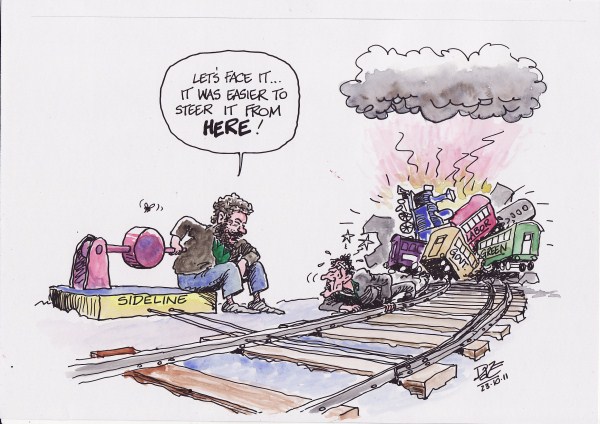
The results of the next state election are not going to be kind to the Greens Party. Nick McKim and Cassy O’Conner will be punished for their valiant efforts at actively participating in government, in the tradition of Tasmania’s Green alliances with the major parties.
What the Greens Party needs is a leader. Luckily there is one waiting – not so quietly – in the wings. Kim Booth is the man to take the Greens through their next chapter in state politics, and his uncompromised ideals will most likely win back disenfranchised voters who have seen their party almost crippled by a government in its final death throws.
The short-term future of the Greens isn’t rosy. Both support for the Tasmanian Greens Party and for Nick McKim as preferred premier have fallen by 9% since August 2010, according to an EMRS voting intentions poll taken in the middle of this year (HERE). 5% of this loss has been sustained since May of this year. Green voters, not unlike Australian Democrat voters before them, are idealistic people. Most vote for a watchdog in parliament; they vote for a party that is above politics that can effect change from the parliamentary sidelines.
Now that the Greens are sharing power, they risk compromising four decades of the moral high ground in favour of the mucky low ground that is the reality of government. Meg Lees took this risk with Howard and the GST; she never recovered her popularity and even after many leadership changes, the Democrats began their slow end.
Unlike the federal Greens, who only have to guarantee supply, the Tasmanian Greens are in coalition. The federal Greens don’t have to vote with Labor; the Tasmanian Greens have to make many more compromises.
The school-closing saga that pushed Nick McKim right to the edge is a prime example of a Greens party struggling to make strong decisions in government against their long-held beliefs. The proposal to close 20 smaller (dying) schools around Tasmania was sound vision. It made sense for Tasmanian students’ future. It was, on the broadest level, a way of guaranteeing Tasmania’s youth their most basic right of quality and diverse education. McKim should never have flatered on this issue. A teacher spread too thinly across multiple disciplines in a small, remote school can’t do the job as effectively as a specialised teacher in a bigger school. The politics around this issue ended up overriding sensible policy: the furious lobbying came from adults in various communities carried all the baggage of their own small-minded agendas. Ultimately this fight became about keeping schools open for adults, not for the kids. Greg Barns summed up the moral argument succinctly when he wrote ‘There is no right on the part of communities to have a school… There is however a right, and a human right no less, to everyone who lives in a community to have access to a quality education…’ (July 4, The Mercury).
This issue is so close to the core of Green policy vision for an education system that underpins an ‘open and progressive democracy…[which is] at the heart of achieving a clean, green and clever Tasmania’. What a shame the opportunity was lost to make real progress for Tasmania here.
On issues where Nick McKim has been tainted, Kim Booth has not. Kim Booth can re-energise the Green base. Kim Booth can get people excited about voting Green again. And better still: when his time comes after the next State election, he won’t have to worry about actually being in power.
Tasmania has a strange and unique demographic in many ways. There are no mass movements of people to our state resulting from sudden economic or industrial developments. As such, voting patterns don’t shift easily. There are no birth spikes here. We have limited population growth compared to other Australian states. The folks who voted green when ‘green’ was born on the banks of the Franklin River, are the folks who are voting Green today. Their kids are more than likely following suit. That is why it is important, for the future of the Greens in Tasmania in particular, to keep their core voters on side.
Kim Booth still embodies the original spirit of the Greens. His cries of moral outrage continue to ring loudly around the halls of parliament. Yet, unlike Tony Abbott however, whose hunger for federal power can be heard around the country, Booth is not a fervent popularist. No matter who he is fighting, his own party or the rest of the world, the one thing Green voters know for sure is that he is fighting. This is a prime Green quality.
The Greens have made progress while in government. Same sex marriage legislation and carbon tax issues would never have been brought to the table if it weren’t for some members of the Green party willing to take a risk and actually participate in government. Nick McKim’s work on prison reform and the oh-so-close forestry peace talks are other examples of the productive work the Greens have managed while in government. Kim Booth mustn’t forget this good work when his time comes to take his place as leader. The only thing Booth needs is a little more room for compromise.
Kim Booth must move to the next stage of his political career: become the patriarch that Green voters are longing for. He can be the leader the Greens need: a leader with the loudest moral standards and the politically maturity to be able to occasionally compromise.
Nick McKim might have the clean-cut image suited for mainstream politics, but Kim Booth has got the hairy passion.
Marion Abraham and Simon Laugher met at UTAS in 2009 whilst both studying political science. They have been longtime political junkies and now are working together to get their rants sorted into some kind of coherent writing. They write on a broad range of issues often related to Tasmanian politics. By combining Simon’s sleep-depriving appetite for news and Marion’s motivation to communicate political ideas, Simon and Marion write to share their educated political views through short, topical opinion pieces.