Income support payments must rise according to a new report recommending action to tackle the ‘poverty penalty’ currently being paid by low income Tasmanians.
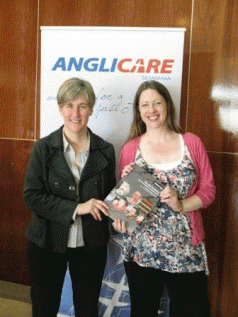
Anglicare’s research report The Price of Poverty showed that people on low incomes are paying relatively more for essential goods and services – in terms of money, time or health.
Around one third of Tasmanians are living on low incomes. The research found that electricity and housing costs now required an excessively high share of household income, leaving people unable to afford other essential goods. This has been described as a ‘catastrophic spending burden’.
‘The price for some of these essentials is now so high that households have to do something extreme to pay for it – such as ration food, choose cheaper and less nutritious foods, or ask for help from emergency relief services,’ said Anglicare’s Jo Flanagan. ‘Things like lack of transport make it hard for people to shop around or make bulk purchases. Living frugally is especially difficult in places with limited infrastructure.’
The report put forward a range of recommendations designed to:
• ensure adequate incomes
• ensure access to essential goods and services; and
• provide consumer protection
Anglicare is calling on the Australian Government to urgently increase income support payments to allow for an acceptable minimum standard of living. ‘The main issue facing people is that payments are not currently linked to increases in the cost of living’, said Ms Flanagan. ‘Social security income tests also need to be reformed to support people to engage in part-time and casual work. They currently face high marginal tax rates yet for some people this is the only work available and can act as a pathway to more secure employment.’
Other recommendations put forward in the report included:
• an income maximisation pilot project which would provide support and advice about entitlements such as Centrelink benefits, child care subsidies, child support, Workcover and concessions;
• appropriate funding for the implementation of the Tasmanian Food Security Strategy;
• funding to run the public housing system as a core government service;
• the introduction of a ‘social tariff’ to ensure all Tasmanians have access to adequate amounts of electricity at a price that does not impose hardship;
• further investment in public transport particularly to urban fringe and regional areas;
• a national policy framework to deliver essential phone and internet services at an affordable price;
• improvements to ensure better protection for APAYG customers;
• implementation of a ‘bill smoothing’ policy to allow Tasmanians to better cope with large bills for electricity and other essential services; and
• the development of appropriate product comparison information for telephone customers.
The research findings were based on interviews with 66 low income Tasmanians who provided details about their experiences of purchasing essential services.
Read more HERE
• COST OF LIVING A TOP PRIORITY
Tim Morris MP
Greens Cost of Living Spokesperson
The Tasmanian Greens today said the release of the Social Inclusion Commissioner’s Cost of Living Strategy remains as urgent today as when the Greens secured funding for it in the 2010-11 Budget.
Greens Cost of Living spokesperson Tim Morris MP backed the need for a whole-of-community response that included local, state and federal governments as well as the private and community sectors.
“Rising costs are clearly impacting on many Tasmanians, which is why the Greens put forward the initial proposal to fund the development of a Cost of Living Strategy, and successfully negotiated this outcome with Labor.”
“These issues can and will not be addressed by the State Government alone, but that doesn’t mean the Government is powerless to act.”
“The Commissioner reports to Parliament, and the Parliament must respond appropriately by recommending to government actions that it can take to assist those under most pressure from increases in the cost of living.”
“The best mechanism for the parliament to respond to recommendations from the Social Inclusion Commissioner is likely to be a Standing Committee of the Parliament.”
“The Greens are serious about addressing cost of living issues, including power prices, housing, water, and access to public transport, which is why we are eagerly awaiting the Professor David Adams’ final report.”
“What’s already apparent is that we must urgently reconsider funding priorities to address the immediate needs of the most socially disadvantaged communities – the basis of all good public policy.”
“There will be no easy answers, however the Commissioner’s report will be a critical tool to ensure that there is appropriate action, as well as a long-term plan to provide for a fair and equitable society.”