Economy
Live Export Shame Tasmania

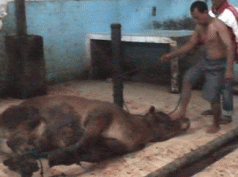

If you thought your Federal Member of Parliament was there to represent your views, think again. Reliable polling relating to how Australians feel about the live export trade indicates that 84% of us want the trade to end, yet only two members of the House of Representatives listened to us. They were Adam Bandt, Greens Member for Melbourne, and Andrew Wilkie, Independent Member for Denison in Tasmania.
Mr Wilkie and Mr Bandt, on August 18th, addressed an almost empty Chamber in the House of Representatives, speaking to their respective Bills to phase out live exports by 2014 (Mr Wilkie) and to abolish the trade (Mr Bandt). Your local Labor and Liberal Party representatives, in both instances, raced into the Chamber to vote the Bills down after each had finished speaking. They did not even have the courtesy to be present for the short speeches. Only one Senator, South Australian Independent Nick Xenophon has stayed true to our values, although it is Australian Greens policy that the live export trade should end.
Greens Senator Rachel Siewert triggered a Senate enquiry into the live export trade following the ‘Four Corners’ program ‘A Bloody Business’ on May 30. The Terms of Reference of this sham enquiry do not examine alternatives to the continued export of live animals to countries where they have absolutely no protection from the brutal treatment we have seen of cattle in Indonesia, Egypt and Israel, and sheep in the Middle East and Turkey, evidence we have seen on multiple respected documentary programs over recent years. The Department of Agriculture, Fisheries and Forestry (DAFF) also commissioned the Farmer Review, with similarly narrow terms of reference, and that enquiry received a large majority of submissions calling for an end to the trade.
This Senate Committee for Rural Affairs and Transport is chaired by farmer Bill Heffernan, who is legendary for his support of the live export trade, and multiple entries in Hansard reveal his bullying of anyone who disagrees with his position in the trade. Four Senators on the Committee only took up their positions on July 1 this year, and none has any credentials at all in animal welfare or economics, so it is certainly relevant that this enquiry has quite blatantly not even pretended to consider animal welfare at all. One, Senator Nash, is also a farmer, and constant interference by Senator Christopher Back, has deliberately de-railed the contributions of animal advocates. The animal advocacy movement was given just 1.5 hours of the Committee’s time, with the entire remainder being taken up by vested interests in the trade, producers, transporters and exporters.
Senator Back, who claims strong veterinary credentials but who appears not to have been involved in veterinary practice for more than 20 years, famously accused Animals Australia’s Lyn White of paying for the footage obtained in Indonesian slaughterhouses, and also claimed that one individual filmed was beaten up and that his wife and daughter had been raped. He has provided no documentary evidence to support his claims, and Animals Australia is now taking legal action to require him to apologise and retract his false statements. What seems likely to us is that the three-line handwritten statement he provided to the Senate enquiry is far more likely to have been paid for, either by Senator
Back himself or one of his associates, so powerful is his own vested interest in this trade. The three-line letter is conspicuously deficient in supporting his claims against Ms White and her colleagues, yet he was able to make his accusations under the protection of Parliamentary Privilege. The question therefore needs to be asked; why are these people able to use this technicality to effectively defame others and be protected by law in doing so?
Professor Ivan Caple, another self-professed veterinary expert, also was involved in this Committee’s deliberations. Professor Caple has a long history of involvement in the trade, and was a co-author of a report ‘Live Trade Animal Welfare Partnership 2009/10: Final report – Public Release – Indonesian point of slaughter improvements’. This report claims to have engaged an ‘independent’ panel, yet the four authors all have vested interests in the exploitation of these animals, and was, not surprisingly, commissioned by Meat and Livestock Australia. It observed the slaughter of just 29 cattle in just 11 slaughterhouses, apparently on pre-arranged visits.
http://www.daff.gov.au/__data/assets/pdf_file/0005/1886477/indonesia.pdf
This report claims that the welfare of cattle in Indonesia was ‘generally good’, then continues to detail serious welfare issues in feedlots, transports and slaughterhouses, which it claims can be addressed by ‘training’. That this training has not occurred in the two decades of the trade to Indonesia is an indication of the inability to, ineffectiveness and unwillingness of, MLA and LiveCorp to take any aspect of animal welfare seriously. It should also be noted that MLA/LiveCorp spends four times as much on marketing and promotion than it spends on animal welfare, and that some years ago, they had developed a ‘media strategy’ in the event that animal advocates were able to make public the atrocities committed against our animals in overseas countries.
The report notes compromises in all aspects of the Indonesian trade, but most specifically at slaughter, where it observed that 17% of the animals regained their feet after being thrown from the Mark 1 slaughterboxes, 18 cuts were used to sever the neck and arteries of some animals, incidences of tail breaking and eye gouging and ‘head slapping’, yet the report claims that ‘handling’ at the slaughterhouses is ‘generally acceptable’.
This is a transcript of the ABC’s interview with Professor Caple:
http://www.abc.net.au/4corners/content/2011/s3230575.htm
Additionally, according to Milanda Rout in the Australian on September 8, a Meat and Livestock Australia manual (no date reference) advises Indonesian slaughterman to pull cattle by their tails ‘to get them to move to slaughter’
‘”Two things can happen,” the document states. “Either the animal jumps out, tripping itself . . . or the animal will stand still. In this case the slaughterman should reach into the rear of the box, grasp the tail and pull the animal away from the box. The animal will then trip and fall”.
http://www.theaustralian.com.au/national-affairs/mla-abattoir-advice-breaks-welfare-code/story-fn59niix-1226131721528
This comes on top of advice from Australia’s Chief Veterinarian on August 24 that the Mark 1 slaughterboxes provided by MLA and Livecorp breach OIE standards, which in themselves are minimal standards only and well below standards in Australia. Hundreds of thousands of dollars in taxpayer funds has been provided for these slaughterboxes.
http://www.theaustralian.com.au/national-affairs/mla-abattoir-advice-breaks-welfare-code/story-fn59niix-1226131721528
The Senate Committee received over 430 submissions, the vast majority calling for an end to the live export trade, yet has taken evidence almost entirely from the vested interests in the trade. It has since become even more apparent that the live export industry continues to send animals to destinations where it does not even know the conditions faced by these animals, and nor does it care about them. Evidence recently acquired by Animals Australia in Turkey clearly shows fully conscious animals being shackled by a hind leg and stabbed in the throat until they eventually die. Other evidence of Australian cattle in Israel shows the animals covered in dirt and faeces, being beaten with spiked poles when they clearly have no room to move. There is not even a minimal attempt to comply with the most fundamental of OIE guidelines in any of the countries to which Australia sends its pitiful cargoes, yet still we load them onto third world, flag of convenience ships to this awful fate.
The depths to which exporters will sink was clearly evidenced by the recent exporters’ public relations disaster when the 31 year old former car transporter Al Messilah reportedly broke down and was forced to return to port in Adelaide. In the short period that the 67,000 sheep were on board, over 300 died. We will never know why or how, because, in time it took RSPCA SA to request permission to board the ship and were refused and were forced to obtain a warrant, the bodies of the animals were removed and incinerated, so no post mortems could be carried out. There is wide speculation that the ship in fact did not experience a significant breakdown, rather a virulent disease was present, which would have killed thousands more of the animals had they not been removed from the ship. Film evidence of the inside of the fully enclosed Al Messilah at this time showed animals tightly crammed, unable to move (or potentially reach feed and water) amongst the dead and dying.
This was attested to by Australia’s Chief Veterinarian, who immediately had the sheep placed in quarantine in a feedlot, mentioning exotic diseases they may have contracted on the ship such as screw worm fly and sheep pox. Local expert veterinarian Dr Peter Kerkenezov, who has worked on live export ships both as a ship’s master and a veterinarian, added that other diseases prevalent on these ships include salmonella and e-coli, and that exporters, and AQIS, are loading these animals contrary to state and territory animal welfare statutes, namely that they are knowingly exposing these animals to the risks of these and other diseases and other suffering.
This did not, however, deter Emanuel Exports or AQIS from loading 50,000 of the surviving sheep onto the Al Shuwaikh, a ship with an even worse history that the Al Messilah, shortly
afterwards, and the remaining unfortunate animals back on to the Al Messilah, which apparently recovered from its breakdown in record time. The sheep are destined for Qatar, where handling and slaughter practices are atrocious. Emanuel Exports is no stranger to the courts in respect of animal cruelty charges, having escaped conviction over the notorious Al Kuwait case on a constitutional technicality in 2008.
We have questioned AQIS in detail about the precautions it takes in relation to diseases on the ships, and have received the documentation it uses which it claims ensures that the ships are free from diseases. AQIS claimed that both it, and AMSA, inspects every vessel before every voyage, which we know to be untrue. The documentation provided is simply declarations from ship’s masters which require them to confirm that some disinfectant measures have been taken. Dr Kerkenezov’s advice is that to ensure that no infections, or bacteria, are present would require each ship being comprehensively swabbed and tested, and of course, this does not occur. It appears that AQIS, which has a clear conflict of interest in its attachment to DAFF, is content to let ship’s captains say that the vessel has been cleaned without carrying out proper testing itself.
DAFF, AMSA and AQIS are funded by our taxpayer dollars, as is your federal parliamentary representative. It is clear from what the live export industry has been able to get away with for decades that there is no proper diligence at all to protect Australian animals in the live export trade before they even leave Australia, much less on these terrible journeys or in importing countries.
Nine ALP backbenchers have expressed concerns about the trade, and it is reported that there never was a credible effort to end it, and nor will there be. Now it seems that the best our politicians are prepared to do is try and require pre-stunning of all Australian animals in importing countries, and the live export industry has said on multiple occasions that it will not happen. Moreover, ‘traceability’ is unworkable, and therefore the situation continues that we simply know what will go on happening to our animals.
So another two taxpayer funded enquiries mean that it will just be ‘business as usual’, and it is said that people get the government that they deserve. The government has only listened to the views of the select few who have made the loudest noise, the farmers who provide the animals and the exporters who send them to overseas hellholes. What it has all proved is that in spite of the solid body of evidence in multiple destinations of egregious and ongoing abuse of our animals over decades, our politicians remain entirely unmoved.
If you don’t want that government, please let your elected representative feel the backlash of your disapproval at the next election.
Many of you may have written to your elected representatives, and will have received the same standard ‘form’ letter because none of these people have any regard for these animals and apparently cannot put together an individual letter to you.
ALP politicians claim that they are compelled to vote with the government regardless of their consciences on this or any other issue, and failure to do so would result in expulsion from the party or a loss of pre-selection. Their consciences are clearly subsumed by their political self-interest. Given that the Gillard government is currently on a knife edge, it is unlikely that the ALP can afford to expel anyone.
Below is a summary of where your elected representatives stand on this appalling animal abuse:
HOUSE OF REPRESENTATIVES
Andrew Wilkie, Independent Member for Denison: Wants the trade ended, or at least phased out
Dick Adams, ALP, Lyons: Claims to want the trade to end, but rushed into the Chamber to vote down the two Bills proposing to end it or phase it out, therefore voted with the government to continue the trade.
Julie Collins, ALP Franklin: Votes with the government to continue the trade
Sid Sidebottom, ALP Braddon: Votes with the government to continue the trade
Geoff Lyons, ALP Bass: Votes with the government to continue the trade
SENATE
Greens Senators Bob Brown and Christine Milne: advocate for an end to the trade
ALP Senators Carol Brown, Helen Polley, Catryna Bylik, Nick Sherry, Lisa Singh and Anne Urquhart: vote with the government to continue the trade (note: Senator Urquhart, a former union official and process worker is on the Senate Committee chaired by Heffernan, and only entered the Senate on July 1. She has no credentials in animal welfare or economics)
Liberal Senators Eric Abetz, Richard Colbeck, David Bushby and Stephen Parry: vote with the Opposition to continue the trade.