Economy
We’re old and gray …


“We’re here, old and gray,
What’s more, we won’t go away
And we’re coming to get you anyway”
Furthermore, we vote and that should send a tremor up the spine of every politician in the state. Despite what the adherents of the first Church of St. Al Gore and his acolytes Br. Bob Brown and Sr. Christine Milne and others among the duped say, not all of us are taken in by claims of irrefutable evidence and proven science, even when the words cascade from the mouths of the Green Legion, let alone economists who have been putting charge of herding cats. Well this particular Cat is more than cool: he’s bloody frozen and why?
Okay, so he didn’t finish his course as a weather forecaster many years ago but he still knows more about weather than the clown that writes for The Mercury and refuses to take the ABC seriously because it has become like Soviet radio, it’s apparatchiks parrot the party line and don’t listen to alternatives.
When I was studying meteorology, the English winters were very cold and hard. So much so that like the Australian Prime Minister, I was forced to leave those shores in search of a warmer climate and at roughly the same time. Ms. Gillard went to South Australia and our experiences differed. I can’t say that Melbourne was any real improvement because four seasons in one day is enough for anyone and 20 years is a life sentence. What I can say without fear of contradiction is that all the senior forecasters in the UK were concerned about a new Ice Age in the late 1950s and early 1960s. They feared the cold Labrador current would block the Gulfstream and bring weather like Alaska’s to the north of England and Scotland. Many jokes were made about roasting oxen on the Thames as in the days of Samuel Pepys and in the Thames Valley, where I lived; there was snow on the ground in May, which was supposed to be spring if not early summer. On the day I left England for good, the temperature at London airport reached a staggering 84°F while back where I lived, in the Thames Valley, there was still snow on the ground and the air temperature was about 45°. The English have never been very good at keeping roads clear of snow but with gas readily available, central heating became more popular a good 10 years too late for me. However, I want to share with readers my experience of an introductory course given by the Chief Forecaster of time.
Like most arms of the English civil service, the Metrological Office was run on vertically integrated lines of management. The new starter had a desk with a drawer, a basic chair and if he was lucky, a square of carpet under the desk. A promotional or two later, and he would have a lock on one drawer in a two drawer desk; a chair with arms and slightly more carpet and so on up the line to where branch heads lived in relative luxury. In the London headquarters of the Met office, where I worked for a while and visited frequently the toilets were very basic and the paper in the cubicles went by the name of “Bronco” because it was rough on the rear end. By chance one day, I slipped into the toilets for the use of senior officers. What luxury: a carpeted floor, mirrors and hot and cold water and a luxury toilet seat made from mahogany or another dark exotic wood. The rare luxury toilet paper was what Australians would regard today as the norm -acceptable, soft and strong and wonder of wonders there was a bookshelf in the cubicle with plenty of room. Quite clearly, even when engaged in the most basic function, one had to be able to read The Times but then again, that was before the days of Rupert Murdoch. I never discovered whether the Gideons were able to slip their subversive literature known as the Bible into the rooms of repose: I suspect not.
The winters were long and hard and 1962-3 was a record breaker. The summer of 1962 had been quite pleasant enabling me to play cricket in the evening competitions until just after eight o’clock at night and you could certainly read a newspaper without light for another hour. September is absolutely the best month in England, where the foliage starts to turn in anticipation of winter and while some preferred spring, there was little hay fever about. Much to our surprise October was quite pleasant and I started to play tennis outdoors. November started to get colder and that was expected but sometime during that month, whoever controls the weather kicked the bottom out of the thermometer and temperatures plunged below 32°F, which in God’s own measurements as opposed to the metric system is the freezing point of water. And it stayed below that temperature by day and night for nearly 7 weeks; in fact until Christmas Eve.
On that day, it suddenly got perceptibly warmer and that meant one thing: snow. And did it snow! It was the worst for quite a number of years, especially in the Thames Valley where drifts of 15 feet were not uncommon and one of the finest sights in the country, according to some, the main road to London was cut by snow and then when cleared, covered in ice. Very few people managed to keep their feet and the elderly were encouraged to stay indoors, perchance to freeze inside. The worst phenomenon was so-called black ice because it was well-nigh invisible and as a motorcyclist, I can attest to the dangers involved. However, water in my carburetor ended my 3 miles to work and as there was no bus service because of the snow, I walked every day to and from, occasionally picked up by a sympathetic motorist. One day, I was really lucky because I was picked up hitchhiking by an Australian dentist in a Porsche 911, and he had never seen anything like it in his life. When walking to work, it was so cold that I wore my motorcycling gear, which included leather flying boots with fur lining and zips and I wore three pairs of socks, which barely kept my feet warm. Occasionally I would take refuge and relief with a small flask of brandy. If it wasn’t needed on the way to work it was certainly needed trudging home in the dark.
Then came a phenomenon known as frizzle or freezing rain. It was allegedly too warm for snow but the rain hit a surface and immediately covered it with clear ice. It was quite pleasant to taste and it looked wonderful on trees as a decoration but it was dangerous. Where I was living, in Ascot, the first thing to be done in the morning was to boil a kettle and pour the contents down the various sinks in the house to unblock the S bend. Then you could think about tea and listen to the weather forecast. On more dire occasions, a couple of kettles of water were required to heat the outside downpipe and remove the ice. That was the winter that broke me for various reasons, not the least being weather. Snow melted on the roof produced stalactites, which touched the ground; every footpath was like an ice rink and people could not afford to keep warm. I was told later the government played down the number of deaths by cold but in the building where I worked, it was modern and oil heated, at least initially. In fact it was more pleasant than being at home or even the pub until the oil ran out. We could stand in our offices and wear overcoats trying to work. I was working in the laboratory and the simulated cold room at -40°F sometimes felt better and warmer than walking home through wind-driven snow or sleet.
To give you some idea, we had about 300 people in the building and the rule was if you lived more than 5 miles away, allowances were made for absence. My trouble was being conscientious because I was being trained and wanted to qualify and so I trudged the frozen main road and because I was fit (I usually ran 9 miles most nights until winter set in) it wasn’t too bad although I probably looked ludicrous because I wore my crash helmet and visor with my motorcycling gear. And I still needed a scarf around my neck. The principal form of heating for housing was coal or coke (not the type to be snorted) and the effects of the weather on transport meant that deliveries weren’t made. We were lucky because we used wood (shock, horror) but even then, it was still cold. Those fortunate enough to own Volkswagens drove to work while others used skis because by and large, British cars would not start and a friend of mine with a German car – a DKW-Auto-Union (now known as Audi) became the first member of the wheels on the roof club when his car overturned at the roundabout at Bracknell.
Most if not all of those who skied to work were veterans of the far south. They carried their own ropes so that workmates could tow them uphill on the way home. Of course, the Antarctic hams or old hands maintained that it was nothing like Antarctica but one character with a genius for making noises managed to startle quite a few staff in the canteen with noises of batteries shorting out. In those days, there were no diesel generators or nuclear reactors under the ice and wet cell batteries were used. One poor fellow who suffered stopped taking his lunch in the canteen because the first time he heard the imitation of a shorting battery, he threw up with great violence. Anything that could burn would be used and it was not long before saws were taken to telegraph poles, which being seasoned with kerosene and creosote burned very well. Native forests and local plantations did not avoid the rapacious and capturing of wood and after the ground litter and downed trees had been cut up, people hacked into anything that was standing and would burn or they thought would burn.
When the oil ran out at work, the canteen staff went on strike. We were saved by the invention of “Cuppa Soup” which you can still find today. The only vaguely passable variety was pea and ham and with the rest, it was a case of “add pepper, paprika or some other spice to make it palatable.” Problems with the gas mains meant that Bunsen burners were out of the question and there was no easy way of getting hot water and so, the scientific genius came to the fore. This took the form of a small sheet of circuit board with the carbon rods from batteries inserted into two holes and wires soldered to the terminals. There was no messing around at the plug: the other end of the wires were bared and wedged in with matchsticks. Water boiled fairly quickly by this primitive arrangement. This was not good enough for my boss Dusty who was only vaguely eccentric by comparison with others. He managed to obtain the carbon rods that were used in searchlights – a good half-inch thick and about 6 inches long. His improvised device would heat a bucket to make real soup but once the Mark II appeared, it shorted out the mains. This did not bother Dusty, who went to the fuse box and replaced the fuses with 4-inch nails. I understand it burned out a considerable amount of lighting and wiring but at least we ate. You may think this was a fantasy but I was there and the last drink in the world you wanted was a cold beer.
So we struggled on in a parody of work and working with scientific instruments made of metal in very cold weather produced burns and it was difficult to work with gloves. Accordingly, I attended lectures on forecasting. I won’t give you the full spiel because no one would believe it but the chief forecaster or CFO as he was known invariably started the introductory lecture with what became known as tales of Earth (or Terra for readers of science fiction). Contrary to popular belief, he averred, the earth was not a perfect sphere: it was an oblate spheroid, which means flattened at the poles and slightly pear shaped because the southern hemisphere was weightier. I have to be honest and say I don’t understand how it could be heavier but I guess it had something to do with the mass of the Antarctic continent. He told us about the 23 1/2° inclination of the planet to the sun which gives us seasons and the orbit of the planet is elliptical and irregular, which also caused problems for forecasters. In addition, he would ramble on about various solar phenomena including sunspots, solar wind, gamma rays and even the effects of near Earth orbit objects, especially the moon.
As I mentioned earlier I did not finish the course but a friend did. A group of 30 were taken to a Nissen hut, a World War II left over with blacked out windows and there they spent the night. At 04:30, they were roused by instructors, like all good students and given the data to predict the weather for the ensuing day. As my friend Woody said, they had all the data and much more and there was a fair amount of confidence around until the blinds were lifted from the windows and outside was a perfect English pea soup fog. None of the 30 came anywhere near guessing that a temperature inversion occurred and I use the term guessing advisedly because it was largely a question of by guess and by God in the days before weather satellites. Incidentally, I worked on those including the first one UK–1 but that might have to keep for another day.
Because of the severity of the weather and the surprising amount of intellectual horsepower being relatively idle, it was inevitable that talk would turn to the Little Ice Age of the Middle Ages. Not too far away, the Thames had frozen at Windsor and the ice wasn’t thick but it would support the weight of a man. The generation ahead of mine could remember the blazing summers of the late 1930s and the beginning of World War II. One of the very few things I can’t remember about World War II is the weather: I had other things on my mind. When idle minds get together and mix with technicians who have spent time in Antarctica, the result was like most British weather forecasts, gloomy to say the least. The fear of an ice age was genuine but the CFO would have none of it: in a rousing speech to the massed, partly frozen audience, huddled together to keep warm, he went through all the problems of weather forecasting and finished with his battle cry: “climate is climate and weather happens.” Exit stage left with all the pomposity that a man of 5’4″ could manage. The chief had spoken! It is remarkable how some small man experience SMS, which is not to be confused with texting.
I chose to be fairly flippant in writing this because quite frankly I never bought the Gore thesis. Neither did many scientists and it cost them their jobs. The dominant paradigm was doom and gloom. On more than one occasion after many months of going through learned academic journals including those branded skeptics, I could see that both sides in what was then called global warming were backed by vested interests. Then when global warming morphed into climate change, the forces realigned and when people started to worry about excessive carbon dioxide and talk about AGW, that was quite enough for me. Firstly, if we can capture it, there’s money in carbon dioxide. Secondly, the scientific method as I understand it flew out of the window long ago. On a more serious note I have to wonder whatever happened to testing the null hypothesis. For reasons totally beyond my comprehension, a former prime minister stated that AGW was the greatest moral question of our time. Really? I would’ve thought the war and famine would be right up there with the real problems with floods and earthquakes close behind. As for coal mining being responsible, I prefer to remain silent.
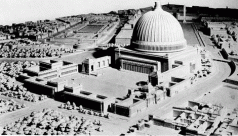
I maintain that the last few winters in Tasmania have felt colder and appeared to have lasted longer than when I first arrived. No doubt I will be accused of getting old and feeling the cold. That’s true and part of me harbors a secret desire to be the first Australian to freeze to death because of government indifference to the increased costs of heating. It makes no difference that we’ve done our part with solar panels and extra insulation – it still costs money to heat the house and keep it warm. Am I glad I don’t live in some of the public housing where I have heard the wind blows through the walls and under the floor. No one should brand me as a heretic just a scientifically trained rational skeptic. It’s quite irrelevant I expect but very large buildings have their own microclimates none more so than the former Bristol airship hangars and the zeppelin hangars in Germany. When the unlamented Albert Speer drew up plans for rebuilding Berlin and naming it Germania, the centrepiece was to be a huge domed building. In an alternative history novel written about a decade ago, the author describes the experiences of a couple of citizens being rained on in part of the interior. I only cite this as an instance because it shows that we can make climate. Personally, I hold to the view that we should reuse, recycle and make more durable products to prevent waste and in the near future, our old rubbish dumps will be producing methane gas, just as the Hobart tip fires the Royal Hobart Hospital. Over the years, I’ve seen computers and peripherals go to the rubbish dump for no other reason than obsolescence and with little thought to renovating them for those without. Furthermore, there have been no attempts to renovate/reuse them, nor reclaim precious elements from circuit boards and the like. You would be surprised to learn the value of some materials that could be reclaimed.

Part of the model of Albert Speer’s Germania.

In that sense I am a conservationist but I don’t go to the extremes that seem to me to be an excuse for raising extra revenue. Nor do I see that stopping coal mining will affect anything because the most hypocritical of all actions is to continue to export coal while condemning it and to export uranium while going through the same process. The first mistake was uncritical belief based on rhetoric, hyperbole and fiddling the fittest while the second was to denigrate those who have attempted to refute the doomsayers and the third and most deadly was to place energy policy in the hands of economists, those quasi-scientists of ill-repute. Heaven forbid that I should ever agree with Ziggy Switkowski on anything but the time has come to seriously consider nuclear power and before the greens and left start jumping up and down and screaming like enraged apes, it is possible to fuel nuclear reactors with thorium, the byproducts of which have a short half-life and cannot be weaponized. In the 1990s we led an ill-fated charge with new economics and now governments want us to test a new razor-blade with our necks.
I would hardly expect to be heard by anyone on this issue and I’m prepared for all the criticisms of the crazies and the well-meaning alike but I would like to say to those in power who hold our destiny in their hands and for some reason are carried away with their own omnipotence: go to the Climate Policy Network at http://cpn.zew.de/ – it’s in English and perhaps when you’ve read sufficiently, you might care to ponder a question put about another matter 400 years ago “I beseech you in the bowels of Christ think it possible you may be mistaken.”
This is not a question for one side only, just a plea for sanity, preferably before the next election(s). To complete this dismal tale, the parts of Britain where I lived along with Scotland and parts of Wales broke most of the records of the 1960s during this last winter. The pattern was the same: a cold, high-pressure area dominating the continent and a predominantly easterly airflow from Siberia.
Coming soon: The troubles with technology.