Economy
Why retail is struggling in Tasmania


Retail depends very largely on discretionary funding
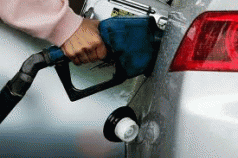
Amount spent on petrol in 1998 in Tasmania: $355 million dollars approximately
Amount spent on petrol in 2008 in Tasmania: $590 million dollars approximately
Likely spend on petrol in 2011 in Tasmania: $635 million dollars conservatively
Without the current high Australian dollar (i.e. Australian dollar reverted back to 85 cents in the USD) the cost of petrol for this year would be $762 million approximately.
We are now spending $280 million more per year than we were a decade ago
Every price rise drives fees charges and transport charges across the community.
It is why peak oil and a conservative doubling of prices must be prepared for.
Much of Hobart’s central City retail activity relies on individuals (consumers) having spare money to purchase what economists call discretionary items.
The increases in the cost of non-discretionary purchases (food, housing transport to work) creates a situation where individuals and households have less money available for discretionary spending.
In 1998 petrol was retailing at around the 70 cents per litre mark. Tasmania’s population was around 472,000. Tasmanians spent around $370,000,000 on 469,000,000 litres of petrol.
In 2008 petrol prices peaked briefly at $1.70 per litre before easing during the Global Financial Crisis. In 2011 petrol prices, supported by the high exchange rate for the Australian dollar have stabilised at around $1.45.
In 2008 the State population was around 503,300 and Tasmanian’s spent around $590,000,000 on 454,000,000 litres of petrol. (Note that Diesel and LPG consumption, whilst substantial, have been excluded from this for simplicity)
It is very probable (actual figures not yet released) that in 2011, Tasmanians will spend well in excess of $620,000,000 on petrol.
Alderman Cocker said “you don’t have to be a petroleum expert to recognise that since 1998 costs of food, housing and transport have all substantially increased much of it driven by oil which is the underpinning product”.
Whilst it is also true that real wages have also increased during that period (1998 ABS- Average weekly earnings $534; 2008 – $ 737) it would appear that overall household discretionary spending is down.
Alderman Cocker said “in small economies such as Tasmania, we cannot afford to simply keep sending hard earned dollars out of the state.
Whilst we live in a global economy, and our economy relies on exports of Tasmanian produced goods, we can also help ourselves by becoming more frugal in our use of petrol. We have the immediate ability to release a hundred million dollars into the Tasmanian economy next year by simply encouraging more people to walk, ride a bicycle, car pool or catch a bus”.