The Australian paleontologist and biologist Tim Flannery has earned his broad-brimmed field hat. Flannery is the discoverer of dozens of mammal and dinosaur species, extant and extinct, across Australia and Melanesia. In books like “The Future Eaters” (about the devastation wrought by the settlement of Australia) and “The Weather Makers” (about climate change), he has won accolades as a vivid chronicler of ecological history with an uncommonly broad sweep and an increasingly activist bent.
HERE ON EARTH
A Natural History of the Planet
By Tim Flannery
Illustrated. 316 pp. Atlantic Monthly Press. $25.
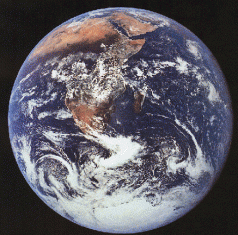
Now, in his fascinating, sometimes exasperating but ultimately valuable new book, “Here on Earth: A Natural History of the Planet,” Flannery moves to the widest possible view, swinging between a loving invocation of our home planet and its astonishing cloak of living things and a blistering portrayal of modern Homo sapiens as fuel- and chemical-addicted “Gaia-killers.” Our self-centered resource binge, he writes, is exacting irreparable damage to Earth’s biological patrimony, “undoing the work of ages.”
An overwhelming majority of scientists agree that humans have upended hosts of ecosystems and are exerting a growing and potentially calamitous influence on the climate. Some, perhaps in response to public indifference, have a tendency to push beyond the data in arguing for action. “Here on Earth” places Flannery in this group. I had a moment, about halfway in, when I was ready to give up in the face of overheated descriptions of environmental problems. But I stuck it out and was heartened to see Flannery abandon the rhetoric of shame and woe and turn to a more reasoned assessment of a young, intelligent species that finds itself in quite a predicament. After all, it’s not easy being the first life-form to become both a planet-scale force and — ever so slowly and uncomfortably — aware of that fact. That awareness is in its early stages and, as Flannery notes, “infancy is the most dangerous period of life.”
“Here on Earth” begins with the deepest biological context, as Flannery pits what he sees as the mechanistic, soulless conceptions of Charles Darwin against the more holistic, even hopeful, vision of Alfred Russel Wallace, the English naturalist who discovered evolution independently. Whereas Darwin “sought enlightenment by studying smaller and smaller pieces of life’s puzzle,” Flannery writes, Wallace “took on the whole,” envisioning a transcendent human future in which evolutionary fitness is determined by more than simply the ability to out-reproduce — or, according to the Social Darwinists, out-earn — one’s competitors. Flannery cites, too, Wallace’s denunciation of the “criminal apathy” behind the choking urban pollution of the late 19th century, which stunted and killed the poor in particular.
Tracking the rise and spread of the human species, Flannery …