Economy
The Question …


In response to the questions raised by Steve Biddulph earlier on TT HERE: The Question: In an economic crash, how do we keep our schools open ? How do we keep a health system of sorts functioning? How do we eat? Travel? Stay warm? When government goes bankrupt, how do we create a new system of self-care and management that does not rely on money from a well that has run dry? How do we build something that lasts? … Steve Biddulph
That the system will eventually crash goes without question. It is on artificial life support at the moment and the switch is about to be thrown. It is just the timing that is uncertain.
We have built ourselves a Tower of Babel with scant regard for the foundations. The world economies largely run on a system that generates no real wealth but depends upon trading in units of money instead of value. The stock exchanges across the world make some people very rich and ruin others, and they all gamble in the world’s largest casino. Overnight, more than three trillion Dollars changes hands in Forex alone and they can alter the financial position of whole nation’s currencies to create a small percentage gain for themselves.
The banks pare small percentages off every transaction made by their clients and grow rich in the process. Yet they do nothing that creates anything, except give loans that exacerbate the situation.
The governments artificially stimulate the economy and keep themselves in power by excessive borrowings, which subsequently devalue the real money of the nations and causes an inflationary cycle. They create debts that have to be serviced by ever increasing taxes and thereby lowering living standards. Currently America owes just over ten times the total world’s GNP in debts and is looking to increase this as a means of survival. There is no way in which they can service a debt of this magnitude without drastically devaluing their own currency, and this is the benchmark currency on which the whole world’s markets depends.
Given that the world’s population is increasing at a dramatic rate and the resources are dwindling to coincide with this, the future looks very bleak.
We narrowly escaped a complete meltdown during the recent sub-prime fiasco and the way out of that was to use every available reserve of cash to stimulate the economy. Those reserves no longer exist, and if this happens again, there is no longer a magic bullet available. The well has truly run dry.
The problem is at three levels, world, national and small/personal
On the upper level there is very little that can be done despite the dire consequences of not doing anything. It requires a total change of thinking and that is not likely to happen amongst entrenched politicians and leaders. It will be reactive AFTER the event, but no-one will or can take responsibility for disrupting world markets. Even President Obama has hit a political brick wall with the Tea Party and the Republicans. The White House thinking is firmly in control of the bankers and financiers; the very cause of the problem, and if America is in gridlock, what chance have the smaller nations? In the upper levels money is not related to anything of value. The gold standard was abandoned 90 years ago and the world has wobbled between boom and bust ever since. The waves are getting bigger!
There is one solution to this which could have a dramatic effect, but getting it past the moguls and bankers is virtually insurmountable. That would be to stop meddling with international finance and make currencies only valid in their country of origin. Trade between nations could be done via a world bank in a single international coinage – say, a World Dollar and this would have to be the ONLY international coinage. It would remove the problems that Europe is facing with the common currency where one or more participants defaults on payments or loses control of its own fiscal policy. Under the current Euro, all other involved nations find their own financial situation affected by the poor performance of one or more of its members. Under this system, they would revert to their own internal currency and trade in Euros or World Dollars between nations and a collapse of the international currency would be impossible. Problems would be localised inside national borders.
This would also stop all Forex and Forex trading, as other country’s money would have no value outside its borders. The value of the international currency would be fixed and stable. Basically, back to a gold standard situation where it is defined as a value of a basket of items, such as one barrel of oil (regardless of price) a bushel of wheat and an ounce of gold, etc.
All foreign debts and purchases would be paid for in this currency and the World Bank would see to it that their allocation be related to their GDP.
Perfect world!!
Nationally any major collapse will affect the greatest users of resources and the ability of the government to do much about it. City dwellers would be worst hit, which is, of course, the largest part of the population. Priorities would have to change in favour of food and survival essentials, but with a vast majority of people unemployed, the government has no income, but nevertheless, the people have a greater dependency on state hand-outs. The two are incompatible. The immediate solution favoured by most governments faced with this situation is to print money or declare a military dictatorship – or both. Germany between the wars and currently Zimbabwe are prime examples. The biggest problems come when there are no natural resources, or famine and drought hits. Darfur and Sudan being extremes. This also causes mass migrations, with on-going problems in the recipient countries. This is where nationalism kicks in and ugly situations arise. When people are thinking of their own survival, anyone lessening their chances is not welcome among them and the threat of starvation breeds predatory instincts
In Australia, we are incredibly dependent on large quantities of imported food and we have neglected our own food production. This has been driven by the economics of exporting raw materials and importing, rather than producing our own essentials. Fine while the world is on the crest of a wave; disastrous if the world economy crashes. What provision are our governments making now, especially when our food supply is a matter of pure business economics and is controlled by two very large monopolistic retailers?
Locally and personally we have more control over our situation. Tasmania is in an ideal situation to look after itself, having a very good growing climate and adequate land. It is unfortunate that the government priorities seem to be biased in favour of industrial crops, rather than food. There are already several self-sufficient communes and these are the best prepared for any possible disaster. The less reliant they are on others, the better their chances of survival. In America, the Amish are probably the best equipped, as they are completely self-sufficient, do not need money or oil and still do all their work and travel by horse-drawn vehicles. Israel established the Kibbutz system and again, it was a very successful community system that generated enough not only for their own needs, but allowed them to trade for all the other things they required. It was noted, however, that once the Kibbutz went beyond two hundred people, it began to falter and fail, largely due to the internal politics and power struggles. A common human failing.
In France, where I live, small rural towns have a system of local produce markets and allotments – areas of land hired out for vegetable and fruit growing to the inhabitants by the local Mairie, or council. They are very popular and highly productive. This system could ideally benefit all small towns and villages in Tasmania.
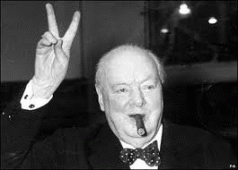
On a brighter note, we have been through this situation before, and survived, but it needs an inspirational leader to show the way. During the war, in Britain, one very famous man made a speech and inspired the nation. It started by proclaiming, “I can promise you nothing except blood, sweat, toil,and tears!”
The nation responded and welcomed a long period of exactly what he said! A sense of camaraderie was engendered, and everybody scrimped and saved and ‘dug for victory’, suffered under rationing and gave up all luxuries. It became a uniting cause and the people had regained a purpose in life. Despite atrocious circumstances, they survived.
Afterwards, this great man remarked, “It was their finest hour!”