Economy
Draft Agricultural Chemicals Regulations too weak


Peter McGlone, Director, Tasmanian Conservation Trust
Draft Agricultural Chemicals Regulations too weak
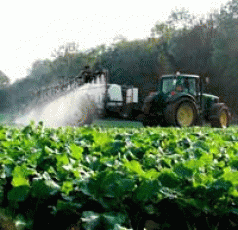
The public comment period for the draft ‘Agricultural and Veterinary Chemicals (Control of Use) Regulations 2011’ (Draft Agricultural Chemicals Regulations) closed yesterday and the Tasmanian Conservation Trust (TCT) has criticized the Department of Primary Industry, Parks, Water and Environment (DPIPWE) for failing to address the major problems with how these very dangerous and widely used chemicals are applied in Tasmania.
TCT Director Peter McGlone said today “the Department does not have rigorous science to guide the regulatory limits for these dangerous chemicals and has resorted to educated guesses or is led by the demands of industry.”
“Where the Department is uncertain it should apply the precautionary principle and stop the most dangerous chemicals from being used, make exclusion zones bigger and insist on lower contamination levels in water. It must also make research a bigger priority and require the use of technologies such as GPS to ensure safer chemical spraying.”
“Unless these serious concerns are addressed the result will be greater contamination of our water ways effecting both our drinking water and freshwater ecosystems,” Mr McGlone concluded.
The TCT’s major criticisms of the Draft Agricultural Chemicals Regulations are:
– Spraying near homes – Aerial spraying of agricultural chemicals will be allowed up to 100 metres from homes and workplaces although there is no evidence that this is a safe distance even in low wind conditions.
– Pilot error – Pilots are left to judge if they are a safe distance from homes and workplaces when GPS equipment should be mandatory.
– Triazines – The wide-spread community concern regarding the most dangerous agricultural chemicals, the triazines, has been acknowledged by the Department but they will not be banned or have any special controls over their use.
– Pollution levels in water – The maximum residue levels for agricultural chemicals permitted in water bodies have not been specifically determined for 42 of the 61 commonly used agricultural chemicals but instead has been based on educated guesses from what is known about other chemicals.
– Exclusion zones around water bodies – Any effective protection of streams, rivers and wetlands has been removed as the exclusion zone around all water bodies has been reduced from 10 metres (proposed in 2008) down to only 2 metres.
Dr Alison Bleaney, Jess Feehley, Dr Phill Pullinger
ENVIRONMENT TASMANIA, EDO TASMANIA AND THE TASMANIAN PUBLIC AND ENVIRONMENT HEALTH NETWORK
Proposed AgVet Regulations fail to protect water and public health
Environment Tasmania, EDO Tasmania and the Tasmanian Public and Environmental Health Network in their submission to Tasmania’s draft ‘control of use’ AgVet regulations, have called upon the state government to prioritise protecting the health of Tasmanians and its environment, and working to improve Tasmania’s ‘clean and green’
image when reviewing the submissions and the regulations. Only demonstrably safe AgVet chemicals and safe methods of application should be used in Tasmania. Aerial spraying of these chemicals is not a safe option in Tasmanian water catchments.
“The draft regulations still allow the spraying of triazines such as simazine, which have long been known to cause harmful effects and glyphosate herbicides which have been long linked to birth defects in humans and animals and other human health risks” said Dr Alison Bleaney of the Tasmanian Public and Environmental Health Network.
“More recently, the monitoring of fish hatcheries has raised significant concern as studies show that spray-drift from many agricultural chemicals can cause mortality, larval deformity and larval abnormalities across fish species. The new regulations must protect us from these environmental and human health risks” she said.
“The state and federal governments must start to seriously address chemical risks in order to protect our public and environmental health. It’s time to listen to scientists and only allow the use of chemicals that have been adequately tested and proven to be safe,” said Dr Phill Pullinger, Director of Environment Tasmania, “EU regulations based on this model led to the banning of 77 dangerous pesticides that are still currently used in Tasmania and we are being left behind,” said Dr Pullinger
“We remain deeply concerned that not enough has been done to ensure the primacy of safeguarding human and environmental health in the management of agricultural chemical use in Tasmania” concluded Jess Feehley from the Environment Defenders Office.
Environment Tasmania the Tasmanian Public and Environmental Health Network and the EDO Tasmania have joined national organisations including consumer group Choice, WWF and the National Toxics Network.
High profile advocates such as Australian scientist Tim Flannery and US environmental campaigner Erin Brockovich are also asking for safer chemical laws in Australia.