Economy
Window to Togatus (3)

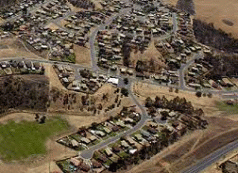

“Hey, do you know anyone in public housing?”
I asked several friends from university this question and got puzzled looks, a couple of “why?” and all ended with a “no, not really.”
I was looking for someone to interview, but in the process, I realised that we are not just divided from public housing tenants physically (the highest concentration of public housing is in the suburbs of Gagebrook, Bridgewater and Ravenswood) but also socially.
When I went out to meet some of the people that lived in these houses, I was kind of wary. I’d seen the news and couldn’t help feeling that maybe it wasn’t so safe. It turns out I was wrong – I was greeted warmly and got invited in for morning teas and functions. It felt like any other community meeting; maybe even friendlier.
So where did this social divide come from? If you are like me you probably don’t know anyone out in the public housing areas, and maybe like me, you have never really wondered why. Like me you might also be surprised to learn that there are a lot of people who say that this level of social division was increased by public housing policy.
“Housing policy in Tasmania has created social problems, no doubt about it,” says Pattie Chugg, Director of Shelter Tasmania, Tasmania’s peak housing body.
That is not the only problem the public housing system is facing. Housing Tasmania has several obstacles to overcome as it tries to change the way it provides housing. It has high debt levels, a waiting list and the services they offer are in high demand.
Problems with the System
There are two policies in particular responsible for creating most of the problems for the public housing system. The concentration of houses into large estates and the shift away from assisting lower working class families towards targeting “high needs” tenants.
“You’ve got a system that’s got lower rent returns; people with higher needs; a debt over its head that is not actually being replenished or really looked after; and slowly you are seeing cut and cut and cut and it’s all been created by government policy,” Ms. Chugg said.
The shift towards targeting high needs tenants has created problems with stigma and has put pressure on finances. If you don’t know anyone in public housing, this systemic issue could be part of the reason why.
“Those that are in public housing now, once upon a time, wouldn’t have been eligible at all – because public housing wasn’t set up to cater for people with mental health issues and ex-prisoners,” says the Director of Housing and Health at Flinders University, Dr. Kathy Arthurson.
It is important to note that the original model also had problems, however Ms. Chugg adds that it is the shift towards high-needs clients that has created issues with stigma.
“Targeting welfare recipients has had a huge impact on public housing. Often the stigmatisation and difficulties with public housing started in that era,” she said.
The fact that areas with high concentrations of public housing are often located far from the CBD also means that the tenants may have less access to jobs and services.
When I went out and spoke with some of the housing residents of the Broad-Acre areas in Gagebrook and Bridgewater, a lot of them say they feel that stigma is one of the main challenges about living in these areas.
Stigma has many negative effects, including an “us and them” attitude that can make it difficult to encourage business and employment opportunities in the areas, says Associate Professor of Sociology and Director of the AHURI Southern Research Centre.
Helen Manser, Coordinator of the Jordan River Community Services, seconds this concern.
“My big concern is the kids coming through. We hear a lot of negative comments from them and about them. So that’s really unfortunate that they are starting to call themselves bogans and (saying that) they are never going to be anything… the kids are really taking it on board.”
The Director of Housing Tasmania, Lynden Pennitcott says that he is aware that there is a problem with stigma for these areas. He is tasked with managing the government body on housing and has a portfolio of over 11 000 public houses in Tasmania.
“A lot of it really is about treating your neighbour – whether they are a public housing tenant, private rental tenant or a homeowner – as you would like to be treated yourself. I think that has a big role to play.”
Demand and Budget Concerns
There is a high demand for public housing services. At the moment the waiting list is over 3000 people long and people placed in the highest priority category can still expect to wait 20-22 weeks to be housed.
In Tasmania, 22 new people attempt to access homeless specific housing services each day, according to the Australian Institute of Health and Welfare. Over 70 per cent of those applicants are turned away. Nearly 89 per cent of these were turned down because of a lack of available accommodation.
The ability of Housing Tasmania to meet this demand is hindered by a debt that was obtained during the 70s and 80s, says Ms Chugg. The debt currently stands at $233 million. On top of this debt, Housing Tasmania also have an outstanding maintenance bill of $110 million.
“I have sympathy for Housing Tasmania in this regard, they have not had sufficient funds to carry out this service effectively,” says Prof. Jacobs.
Moving Towards a Brighter Future?
After establishing that creating large estates and targeting high needs tenants has created a problematic system, Housing Tasmania is looking to employ new strategies.
Their plan is to try and create a new tenure mix, which in practical terms means that they are trying to sell their properties to public housing tenants. At the same time they are also moving to work more with community housing providers.
“We are dealing with the legacy of the public housing estate. We now tend to have large concentration of disadvantage. One of the strategies that we are using to address that is to try and break-up those estates and manage down our ownership in those areas,” Mr Pennicott said.
“We are actively trying to sell properties, firstly to sitting tenants. If we can actually start to break-up some of those larger concentrations of public housing I think that they will very much start to address those issues of stigmatisation.”
He cites the example of Bridgewater, where Housing Tasmania originally owned approximately 60 per cent of houses in that area.
While he sees changing the tenure type as a positive step, Professor Jacobs says that on its own, it will not solve the problems in the public housing system.
“The real test isn’t so much who owns the property, but how much is being built. The only way that is going to happen is if the national government provides sufficient resources to the Community Housing sector to make that possible,” he said.
Prof. Jacobs added that he is sceptical that this will happen.
“The issue of lack of affordable housing is in a way symptomatic of the Government’s failure to invest in public housing. Now the reason they don’t invest in housing is, I think, by increasing supply of public housing it would mean that house prices overall would probably reduce. If you increase supply that has an impact on the cost of housing,” he said.
Mr. Pennicott said there had been new properties built using the stimulus money provided by the federal government.
“We have created 700 new affordable housing properties since 2008, a number of those have come into the affordable housing portfolio, but a number of those have also gone into the affordable housing sector managed by not-for-profit providers. We are looking at a total of 1200 new properties coming in before the end of 2012,” he said.
The Good News?
An obvious solution to the challenges facing public housing at the moment would be to increase the variety of people eligible, in the manner of many Scandinavian countries. It would help address the issue of stigma and social mix.
“The Government policy has created areas of disadvantage; there is no doubt about it. Really the way to break it up is to deconstruct that and pull it back out again,” Ms Chugg said.
The financial situation of Housing Tasmania makes that difficult. In the face of this Ms. Chugg says that the changes being made by Housing Tasmania to the system are positive.
She also points out that the public housing system is much better than the alternative.
“There is no minimal standards of rentals in Tasmania so people can end up in not very desirable dwellings, that maybe have bad plumbing or are cold…” she said.
“We’ve got cases of people that have lived in sheds… with dirt floors, with wiring that is coming out, with a child, with intermittent hot water. All of those places can get rented out and are rented out. We call those marginal tenancies and that is what people can get pushed into,” said Ms Chugg.
Getting people into secure, affordable housing in that situation is a success story. Without public housing people would be pushed into marginal tenancies. The stakes are high as Housing Tasmania tries to learn from the large estates and find a system that provides public housing in Tasmania without increasing social division.