History
Thinking About Anzac 2011

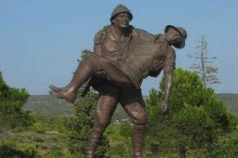

The latest ADF Academy scandal, followed by the highly publicised Etches – Wilkie story, and then by the news that the Academy is being taken to court by the national workplace safety regulator in relation to serious injuries sustained by a cadet in a training accident last year, all come so close to the Australian military’s (and for many other Australians as well) one day of the year, the most important date on the calendar for many serving ADF members and for many ex-servicemen and women, Anzac Day.
In the general scheme of things, such controversies in the past have had minimal impact on the commemoration of Anzac, and nor have they dented the standardised rituals which have now been in place since 1916. By the end of the 1920s Anzac Day was cemented in concrete as Australia’s national day, not only as a day of commemoration but of celebration as well. Australian identity was tied to the legend of Anzac, which enshrined the notion of a distinctive masculine stereotype as the symbol of a unique Australian national character.
But this is a very narrow perspective of Australia, and of Australian identities, for it is so exclusive that it even makes a mockery of the multiple identities within the armed forces themselves, including during World War I. Nevertheless, Anzac Day 2011 will continue in its time-honoured traditions, perhaps especially at some overseas localities like Gallipoli, where April 25 has become a place not only for commemoration and celebration, but for all kinds of pilgrimage, some genuine and some shallow, ignorant and just downright appalling.
Given all that, should we see the conjunction of the current ADF Academy exposes with Anzac Day 2011 as an awkward moment for the military to “tough it out” and get back to business as usual, or should we see it as an opportunity to get some things right, not only within the ADF itself, but within the way that we have straightjacketed the whole commemoration of Anzac into such a narrow and completely unrepresentative frame?
The problem that we are confronted with is that the legend bears no resemblance to the reality, and yet we continue to promote it and embellish it. I have interviewed and spoken with numerous men who were in the Second AIF, and who were prisoners of the Japanese, and I have also interviewed about 60 Tasmanians who served in Vietnam, and not one of them conforms to the stereotypical image we have decided we must have.
It is time for us, and for our military system, to be more humane – yes humane – in our understanding of the effects of war on members of the armed services and their families. An idealised digger image does nothing to foster that understanding in any way.
It is now exactly a century since the implementation of the recommendations of the leading British Imperial military officer, Lord Kitchener, were put into effect by the then federal Labor government of Andrew Fisher.
All sides of mainstream politics at the time, which included the ALP, were impeccably in awe of Kitchener and fell over backwards to implement his recommendations as holy writ as fast as possible. One of Kitchener’s key recommendations was to establish an officer training college similar to the US West Point academy, which led directly to the creation of Duntroon.
Another recommendation was to introduce compulsory military training for males between 12 to 26 years old, with the age groups being stratified as cadets (12 – 18 year olds), recruit trainees and soldiers (20 to 26 year olds).
The latter idea was a dismal failure, leading to the prosecution of nearly 28,000 Australian boys and men between 1911 and the beginning of World War I who refused to comply with compulsion. It also led to the imprisonment of nearly 6,000 men in military gaols. (For a more detailed treatment of these events see R. Ward, A Nation for a Continent, 1977, pp. 83-87)
On the face of it , it does seem odd that the ALP fully supported these measures, for the evidence suggests, in fact, that in the years leading up to federation of the Australian colonies in 1901, and in the decade before World War I, there was a strong suspicion that professional soldiers would always be used against the people. The use of troops during the great strikes of the 1890s by colonial governments to break up demonstrations and to provide an alternative labour force, held bitter memories.
Consider what Henry Lawson wrote at the time of the strikes, lines that were read to rags for years afterwards:
“We’ll make the tyrants feel the sting
O’ those that they would throttle;
They needn’t say the fault is ours
If blood should stain the wattle!”
So Labor’s support for compulsory military training needs some explanation. It is probably rooted in two considerations. The first is the belief that universal military service would guarantee that the army would be dominated by the working class, which would not ever allow itself to be used against its own people.
The assumptions underpinning such a belief are naïve at best. The second consideration was the fear of Asian invasion, especially within the context of the Japanese naval victory over Russia in 1905.
So what?
Well, the issues which we are now seeing confronting the ADF in 2011 contain threads which can be traced back in time, to the first decade of federation. Two key issues in Australian military history since then are to do with the victory of voluntarism over conscription and the establishment of an elitist approach to officer training.
Whatever the merits or not of Kitchener’s recommendations, compulsion was rejected by direct action by those who were being compelled. Direct action not by demonstration, but by evasion, non-compliance and civil disobedience on a scale which is difficult to find replicated at any time before or since in the history of Australia since 1901.
In one sense, it would seem amazing that this is not more widely known. In another sense, it even more amazing that the profound influence it has had on recruitment policies for Australian armed forces in the following century goes largely unacknowledged. It is also quite noteworthy that this model of “disorganised” grassroots opposition to government policy has evaded the attention of – well – everyone. Yet it is very difficult to find an example of some community opposition to government policy having such long-term national ramifications.
The other point to make about this opposition to compulsion is that it was ignored by both major political parties during World War I, resulting in the most bitter divisions within Australian society that have ever occurred. The defeat of the conscription referenda in 1916 and 1917 could have been foreseen from the community opposition to compulsory military training just a few years earlier, but the social damage caused by this issue would take a generation or more to be repaired, because it involved the question of young people dying in their thousands, of families being destroyed, and of a nation at war with itself.
The terrible irony is that although voluntarism eclipsed conscription at that time, it also produced a citizen army which did in fact – for a short time – mirror pretty much the whole of Australian society. It is possible to argue that the First AIF was about as representative of all sectors of the Australian community as it would have been if compulsory service had been implemented.
But the really important point to make is that the divisions created by the conscription issue flowed inexorably into post-war Australia. World War I destroyed forever any worthwhile public discussion about the inner workings of the military system in Australia, including such matters as military discipline, training methods, relations with civil society, repatriation processes and so. Divisions in Australian society between returned servicemen and those who didn’t serve overseas surfaced very quickly after World War I, as more than 250,000 demobilised diggers hit the job market. The mood of returned diggers is captured by the bitterness in this comment:
“… we’re just back from the shambles in France where whizzbangs are flying and comforts are few, and brave men are dying for bastards like you”.
Preference in employment for ex-diggers exacerbated conflict, and led to violence in some instances, as hostility between returned troops and those they labelled as “shirkers” occurred. The Melbourne Police strike of 1923 demonstrated the depth of social division, when 5,000 men, most of them ex-diggers, were recruited to break the strike, which resulted in the sacking of more than 600 police.
The RSL, which was dominated by ex-AIF officers, rapidly gained control of the Anzac Day ceremony, and soon became the most powerful lobby ever seen in Australian political history. From the start is was an organisation singularly devoted to the interests of ex-servicemen, and without doubt it was extremely important in ensuring that assistance was provided for disabled men, for widows and their children, including pensions, free medical services, education, housing and land grants schemes.
At the same time however, it increased the separation of the military from the civil interest, and intervened increasingly in areas of national policy, especially in support of conservative political and social conformism. While enshrining the idealised white masculine digger image and its espoused virtues of courage, loyalty and mateship, it was a powerful force for promoting fear of difference and change, and for seeing internal threats to the nation in revitalised unionism, in racial and gender equality, in non-Anglo immigration, in intellectualism, in criticism of Empire – in fact indissident views of any kind.
This is the context also for the values and beliefs of Australia’s small post-war armed forces, including those who trained at Duntroon. While hidden from public view, the culture of “bastardisation” in the training of cadets goes back to 1911, and has continued ever since then, as is now very clear. But what is also hidden from public view is the invariable retention of “tradition” in other ways as well. The most obvious of these is the retention of past training methods in tactics, weaponry and so on, when they have become redundant, irrelevant and out of date.
This was made spectacularly apparent in the early period of the war against Japan, especially in early 1942. The leadership of all AIF units stationed in the arc from Darwin to Malaya – whether in command of the battalion-sized forces in Dutch Timor, Ambon and Rabaul, or the two brigades of the 8th Division in Malaya – was trained in the orthodoxies of World War I. During the 1930s, Australian military leadership, in its innate conservatism and conformism, had neglected to look seriously at what the Japanese were doing in China, or even at what the Germans were doing after the Nazis gained power.
The result was entirely predictable. Australian forces at Ambon, Rabaul and Timor were overrun within days, and the whole Malayan campaign was a total fiasco. The only Australian forces which survived the Japanese onslaught were those few which had been trained outside the prevailing orthodoxies, especially in tactical operations, such as the 2/2 Independent Company, which was able to successfully operate in East Timor without being captured.
Since World War II the ingrained conservatism surrounding the Anzac tradition – which in fact has ensured that many ex-servicemen have never joined the RSL or marched on Anzac Day – has done a serious disservice to the realities of Australians’ war-time service. For example, the focus on Gallipoli to the exclusion of so much else (perhaps more so now than since the first Anzac Day in 1916), has entailed a dumbing-down of public knowledge and promoted broad general public ignorance of our own history. More profoundly, the stereotypical digger image has excluded a more real and more historically true and accurate understanding of the experience of war on Australians. It has actually diminished our capacity to understand the complex significance of war in our history, and therefore diminished our capacity to come to grips with its effects in all its dimensions, including its human dimensions.
We need to abandon the stereotype for it limits our view, and prevents us from knowing and learning things such as this, written in 1929 by Furnley Maurice:
“The towns are full of wandering haunted men
No hidden waters call; their gain and loss
Have trapped them, they will never see again
The old logs mouldering in their cloaks of moss.”
What we are now seeing, and have been seeing periodically in scandals emanating from the Defence Force Academy, are important manifestations of the corruption of hierarchical power relationships. They are not merely isolated incidents which fit a generic syndrome where males are thrown together in an institutionalised cocoon, such as football clubs or boarding schools, which are bad enough. They are more akin to the kind of behaviours that have occurred in religious institutions where people in positions of authority and trust have used that power to victimise and abuse those to whom they have a duty of care.
It is precisely this culture of corruption of hierarchical authority which results in Abu Ghraibs. It is easy to see how the demeaning “bastardisation” which occurs in military training can then be transferred wherever the military is used, in war and in peacetime situations.
As far as the ADF is concerned, its current structures for recruitment, training and leadership resonate much more with the past than the present or the future, much as they did in the years before World War II. The current leadership of the ADF has learnt nothing from its own history, and the reasons for this are no different to the 1920s and 1930s. The leadership of the ADF is an extremely conservative group of people, quite unable to see past their own experiences as models for the present and the future.
What Kitchener proposed a century ago for the training of officers and the recruitment of Australia’s armed forces, hasalways been flawed but has survived, and still holds togetherin an unhealthy mix at the Australian Defence Force academy.The only real differences are that women can now be cadets in the system, and compulsion does not apply. But Kitchener’s notion of cadets forming the basic structure for an officer class remains intact,these people being inducted into the military while still teenagers, and then being indoctrinated into automaton conformists and robotically disciplined disciplinarians.
This is probably the worst possible way to develop a forward-thinking, intelligent and capable leadership of the ADF, as has been proven. It’s well past time to break the shackles from 1911 and scrap the model of cadets completely. It’s also well past time to abandon the stereotypical digger image and its hindrance to our proper understanding of our own history, and replace it with something more authentic.
Not to do these things, but to simply follow the patterns of the past, will invariably produce similar patterns of bastardisation and failures of leadership in other areas as well, such as contributed to the capture and deaths of thousands of Australians at the hands of the Japanese in early 1942.
The military is much too important to be an untouchable entity, as somehow a creation from the public body but separate from it and immune to scrutiny beyond its own cloistered world. The proper exercise of professionalism in the ADF cannot be based on values and beliefs and traditions which have repeatedly failed, and in fact in times past have weakened the ability of the armed forces to be an effective fighting force in a real crisis.
First published: 2011-04-22 03:02 AM
AUSTRALIAN MARRIAGE EQUALITY
Media Statement
Monday April 25th 2011
ACL GAY MARRIAGE SLUR CONDEMNED:
ANZAC DAY IS ABOUT WHAT UNITES US
VIETNAM VET SAYS TROOPS FIGHTING “IN THE NAME OF FREEDOM”
Marriage equality advocates have responded to a comment by the prominent leader of the Australian Christian Lobby, Jim Wallace, in which Wallace said Australian service men and women have not fought and died for gay marriage and Muslims.
Australian Marriage Equality National Convener, Alex Greenwich, said ANZAC Day is about what unites Australians and should not be used to perpetuate division.
“ANZAC Day is about the values that unite us as Australians like respect, freedom and a fair go, and it should not be used to set Australians against each other”, Mr Greenwich said.
Mr Wallace’s comments have also drawn fire from Vietnam veteran, Geoff Thomas, who rose to prominence last year when he publicly asked Opposition Leader, Tony Abbott, why Abbott opposes equality in marriage for gay Australians including Thomas’s gay son.
“Those Australian soldiers who go out on patrol in Afghanistan tonight are not doing it for the Christian Lobby, they’re doing it in the name of freedom”, Mr Thomas said.
“Our soldiers fight for the freedom for all Australians, regardless of creed, colour, sexuality or background.”
Gay and lesbian Australians have served openly in the nation’s defence forces since 1992 and their service before that time is well documented.
Mr Greenwich welcomed Mr Wallace’s unreserved apology for his comments which were made on Twitter.
A copy of Mr Wallace’s comments can be found here: http://www.rodswift.info/media/jimwallacetweets.jpg