Economy
Peak Oil – Call for Tasmanian Councillors to Engage

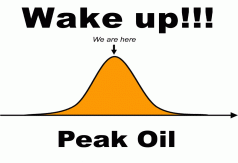

Alderman Philip Cocker has written to all 300 Tasmanian Aldermen and Councillors urging them to engage on the issue of oil vulnerability to their communities.
‘I am writing to my fellow councillors to encourage them to understand this critical issue and to look at the opportunities in their areas to take action,’ Alderman Cocker said. ‘Included with my letter is a brochure developed by a local community group which is keen to inform people on the issues. The magnitude of the vulnerability of Tasmania’s communities to rising fuel prices cannot be overstated.’
Alderman Cocker said, ‘Local Government is well placed to act in preparing their communities and ensuring they are as resilient as possible. With Tasmania spending approximately 1 billion dollars year on petroleum products, even small movements in price or demand can have a dramatic impact.
‘There will be many losers from Peak Oil. The biggest losers worst affected will be those who don’t prepare in advance by reducing their dependence on carbon-based fuels.
‘Areas such as work and family travel, industries, transport and road funding, asset replacement, operational costs and service delivery, land use planning, agriculture and food production and sourcing, and tourism are all areas that increasingly urgently need strategies to respond to increasing fuel costs.
‘Local Government is well placed to make a real difference to the impact on their communities of this issue. In fact there will be few aspects of governance and community life that will not be affected by the issues of Peak Oil.
‘There are policies and initiatives being taken by a few of the lead councils on the mainland. In 2010 the Municipal Association of Victoria Future of Local Government Conference examined the impact of peak oil on local government.
Alderman Cocker concluded, ‘The first step is for us is to understand the issues. Then we can look at the steps we can take, using the advantages of pro-active resilience building. Tasmania can only gain by moving to tackle these issues promptly and taking actions to reduce our vulnerability. The good news is that there are lots of useful resources available to assist our planning.’
Letter to councillors:
Council responses to critical energy issues
Dear Fellow Councillor,
I am writing to you as a colleague in local government on a matter of grave importance to the operations of all Tasmanian councils and particularly to the communities that we serve. The issue is oil vulnerability.
My chief concern is that despite clear warnings from highly reputable sources there is as yet an extremely low awareness amongst Australian governance bodies of the ramifications of mooted oil price inflation on Australian society on the economy and on the welfare of vulnerable communities. I believe we have a duty of care to take heed of these warnings and take appropriate responsive action with due urgency.
In recent times a number of high profile figures (such as British industrialist Richard Branson) and a number of corporate bodies (such as the US and German military) have attempted to alert politicians to acute risks to economic security that will be imposed by oil depletion. Likewise, Australia’s motoring body NRMA (NSW) has called for a national political response. The issue is being understood at the local government level in some areas and was widely discussed at the recent municipal government gathering in Victoria late last year.
The importance of this issue cannot be overstated. Nor the effects that our communities will feel as fuel prices begin to rise significantly. There is also a fantastic opportunity if we can reduce our dependence on fossil fuels and that is to release enormous sums of money in to our community. We currently spend approximately 1 billion dollars on fuel every year and nearly all this money flows out of Tasmania. For every dollar we don’t spend on importing fuels means an additional dollar kept to be spent in the Tasmanian economy.
There will be losers from Peak Oil and the continued problems from oil vulnerability across the globe and economies will suffer. Those jurisdictions best positioned to absorb the shocks from high fuel costs will be those that have observed the warning signs and have commenced the process of building resilience into their communities, reducing economic dependence on petroleum fuels.
Such measures are now being energetically pursued by a number of councils in Australia, appreciating the risks to their local economies and their way of life. Sunshine Coast and Maribyrnong Councils have taken a strong lead in incorporating Peak Oil into their deliberations and future planning.
I enclose an educational brochure prepared by a Hobart group that is attempting to raise community and political awareness of the issue. It is urgent for us, as community leaders, to change the paradigms of what we fund and to look at how we can best insulate our communities from the significant risks Peak Oil will impose. Areas such as transport and road funding, food production and sourcing, service delivery and funding, asset replacement and new assets all need to be looked at critically in the light of the Peak Oil issue and its likely effects.
I urge you to increase your knowledge of this issue and to help
foster debate in your community and council about the preparations needed. Below I have put several sources of reading and information that provide a good background.
Please call me if you want to engage in discussion or would like further information.
Download: brochure_v7_print.pdf
Tasmanian educational website:
http://peakoiltas.org
Association for the Study of Peak Oil (global academic study group): http://www.peakoil.net/
Below is the address for an excellent local government policy
http://www.maribyrnong.vic.gov.au/Page/page.asp?Page_Id=3395&h=1