Tension is rising in the Mercury newspaper’s headquarters in Hobart.
An overwhelming majority of reporters, photographers and sub-editors at the Mercury are seething at plans to export Tasmanian sub-editing jobs to Melbourne and edit the state’s major newspaper interstate.
Their Save Our Mercury campaign, utilising Facebook (HERE), Twitter (HERE) and a regularly updated blog (HERE), has gained a full head of steam and garnered support from across the political spectrum.
The primary argument mounted by the concerned journalists is that the Voice of Tasmania, as the Mercury proclaims to be each day on the front page, will lose its integrity as a part of the Tasmanian community if editing goes offshore. As one local Hobart television news report put it: the voice of Tasmania will now come with a Melbourne accent.
Tasmanian Liberal political icon Michael Hodgman, father of state Liberal leader Will Hodgman, was one of the first community leaders to come out swinging against editing of the historic 160-year-old newspaper going offshore.
“It is an attack on the parliamentary system that we inherited, the best in the world, and it cannot survive without the freedom of the press,” Mr Hodgman senior said.
“This move by News Limited is very dangerous indeed because it threatens our parliamentary democracy under the rule of law.
“We must fight it, and fight it, and not, I repeat, not, give up.”
Other high-profile Tasmanians have since joined the fight, including former justice minister and attorney-general in the Keating Labor government Duncan Kerr SC and independent federal member for Denison Andrew Wilkie, who in a 20-year military career rose to the rank of lieutenant colonel before making headlines by resigning from his role in the intelligence services over the Iraq weapons of mass destruction controversy. This support represents a broad brush across the political spectrum.
The business community is also getting involved with former Tasmanian Chamber of Commerce and Industry chief executive Damon Thomas joining the campaign. Mr Thomas, an alderman with the Hobart City Council, is a former state Crown Solicitor and Tasmanian Ombudsman. Other Hobart aldermen, including Hobart businessman Marti Zucco, have also expressed concerns. At the heart of much of this support is a concern over the Mercury’s commitment to its own community and serious misgivings about the impact on Tasmanian sovereignty.
“Tasmanian local knowledge will be lost if the Mercury sub-editing is processed interstate. Besides any job losses, I cannot see how a person sitting in an office interstate would have the knowledge of the local environment and the Tasmanian community,” Mr Zucco said.
But while voices outside the Mercury are becoming louder, those within the newspaper’s Macquarie St building are feeling an oppressive heat descending.
Since commencing the campaign, Mercury journalists have been issued two stern emails; one informing them of the company’s social media policy and the other of its electronic communications policy.
The social media policy tells staff who use a Twitter or Facebook account to communicate about the company that they “must log that account on the Register of Accounts”.
“The Register of Accounts will be held by the Human Resources Department and overseen by the Online Editor,” staff are warned in a disturbingly Orwellian tone.
Staff are also warned not to disparage the company or damage its reputation. Word quickly spread through the ranks that management had spent quite some time trawling through the comments on the Save Our Mercury Facebook page, which had attracted over 400 “likes” in a matter of days. The Save Our Mercury blog was also under scrutiny.
The electronic communications policy document advises staff that the company reserves the right to monitor anything and everything conducted on work IT systems, including voice mail and emails. The monitoring, it informs staff, can be done utilising software created to hunt down particular keywords.
These “Big Brother is watching” warnings have riled some staff. The Media, Entertainment and Arts Alliance has taken up the issue, saying any such policy has to be implemented with consultation and stands in contravention of the existing enterprise bargaining agreement.
It has also come to light that the Mercury Letters Editor has been instructed not to run any letters to the editor critical of plans to export sub-editing jobs, and was told not to pass on any such rejected letters to the union.
The Voice of Tasmania, on this issue at least, is already being gagged.
The motivations of the protesting journalists are quite simple: some are fighting for their jobs but beyond that there is a genuine concern that the integrity of the newspaper will be diminished.
A vast majority of journalists on the editorial floor believe the quality of the newspaper will plummet if Melbourne sub-editors, who may or may not have ever been to Tasmania, replace journos with 10, 20 or 30 years’ experience working in Tasmania. Highly respected retired Mercury journalist Wayne Crawford, a Walkley award winner regarded as the father figure of Tasmanian political reporting, made that very point during an interview for a news story on ABC TV last week. And he’s not the only Tasmanian journo with concerns.
Last week, at the annual Tasmanian media ball and awards night in Hobart, the master of ceremonies Mark Thomas, a former adviser to the late Jim Bacon’s Labor state government, expressed his concerns about shipping the Mercury editing offshore in his main address. Winner of the top gong for the evening, ABC radio announcer Tim Cox, made similar comments when he accepted his award. Others in the audience wore Save Our Mercury badges, including Jim Bacon’s son Scott, a current state Labor MP, and Unions Tasmania boss Kevin Harkins. These key figures do not want their news centralised and jobs exported. As one Save Our Mercury leaflet puts it: the export of editing jobs interstate “is a patronising move, harking back to British settlement when Van Diemen’s Land was administered by, and part of, the colony of New South Wales”.
The plans to ship sub-editing jobs offshore come after a dramatic two years of cutbacks and changes at the Mercury. About 40 jobs have gone from across all departments. The job shedding has affected everyone from artists to receptionists to those in classified advertising. In 2009, 15 editorial staff left, including reporters, sub-editors, clerical staff and a photographer. Sections of the Mercury have been slowly exported offshore in an incremental dismantling of the newspaper. Escape, E-Guide, Your Money and the finance and world pages, are now produced interstate. The CarsGuide, Taste and daily sport and news are next to go offshore. The Tasmanian Country, the Gazette, the Kingborough Times, Property, Style and the Sunday section of the Sunday Tasmanian are under review, expected to go offshore if and when Melbourne NewsCentral has the capacity to take them on.
Morale in the newsroom is at an all-time low. Sub-editors have worked with the Sword of Damocles hanging over them for months. One journalist who has worked at the Mercury for 20 years said last week: “It’s like everything I’ve worked for, everything I’ve learned about journalism, about being accurate and knowing your subject, is all for nothing. It’s all I have. I’m a journalist. It’s all I’ve ever wanted to be. But it’s no longer valued. We all know this is bad for the paper, everyone knows it, but they just don’t care. They don’t give a stuff about quality.”
Another far more senior journalist once made a very similar heartfelt plea. “A journalist is what I am, who I am, and what I’ll always be,” he said. “I learnt that journalism was an opportunity to make a difference. To be given the chance to represent people in a very significant way, especially those people who felt they had lost control of their lives.”
The name of this journalist was John Hartigan, News Limited chief executive. He made the comments during the Andrew Ollie Media Lecture in 2007. They are noble thoughts.
The people who have lost control of their lives at the Mercury are sub-editors within Mr Hartigan’s own group. These senior journalists have written and edited thousands of stories about others and their plights, but now find they are the story. They are the voice that is being ignored, oppressed and needs representation. And what is it they want to say? Simply that editing the Mercury offshore will destroy the brand the newspaper has built over 160 years of publication. It is already destroying the morale within the ranks. They want to say that specialised knowledge about Tasmania is essential to editing the Mercury. Local knowledge is king.
Overwhelmingly, the Mercury staff believe that if the Tasmanian community finds out about plans to take sub-editing offshore it will be outraged, insulted and resentful. So far, judging by the community support they have attracted, staff have been proven correct. There’s the rub. Their perceptive and cognisant reading of the mood of the Tasmanian public is a clear example of the power of local knowledge and the advantage of a newspaper being part of its community.
The Mercury journalists are simply doing what all good journalists should do, tell it the way it is. They are refusing to accept that because they work within the media their plight should be hushed up and they should allow the public to be hoodwinked into thinking these planned changes are in their interests. They refuse to accept that these changes should happen with incremental stealth in a climate of secrecy so as not to spook the horses. They believe the Tasmanian community has a right to know.
During Mr Hartigan’s 2007 Andrew Ollie lecture, he also said: “I believe Australians still care about their freedom and the value of great journalism. And if you do, fight like hell every inch of the way.”
The Mercury journalists value their freedom and have vowed to fight for their jobs and their community, despite an increasingly oppressive atmosphere.
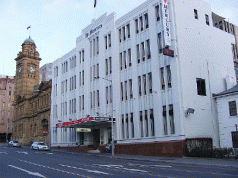
Journalists around the world have proudly fought for free speech and open debate but the Mercury staff have found that freedom appears to be confined to the world outside their Macquarie Street offices. Behind the Mercury building’s Art Deco facade information is being monitored and suppressed. Ironically, the message that staff wish to pass up the line of News Ltd command is one which is in the best interests of the group and its bottom line. It’s an opinion based on an understanding of the Tasmanian community.
It will be interesting to see what develops from the Save Our Mercury campaign’s public rally at Parliament House lawns in Hobart on Thursday, April 7, at 1pm (TT What’s On, HERE). Smart money is on local knowledge, but big money, of course, is on more centralisation of our news.
Also on Crikey: HERE
Earlier on Tasmanian Times:
Mercury jobs on the line. Art Deco Facade to be sold
Save Our Mercury
A Fly on The Wall: Behind the Art Deco Facade
Journos’ fury as Mercury, Voice of Tasmania, outsources editing to Melbourne
On Tasmanian Times 18 months ago:
…
The slick PR of another Walkley debate knocked off in the colonies.
Beautifully presented with a lovely talking head from the Guardian; who was intelligent and engaged, and funny.
But utterly, finally, useless. You could not help but feel that here was the engagement of media management and union, to provide the same truth: We’re going to be alright aren’t we?
Bullshit.
You are in more trouble than you will ever realise.
And no nice sculpted, censored presentations will make the slightest bit of difference.
Media is in the middle of revolution. As far-reaching and profound as the invention of the printing press.
And there, fundamentally, viscerally, was the problem with last night’s seminar.
It was all too touchy feely, all-too familiar media-speak, superficial, bland rolling out of cliche: how often did we hear of brand recognition, of business model?
…
What Crikey Dot Ken thinks …
Download: CDK_141.pdf