Forestry
Pulp mill effluent: The Facts

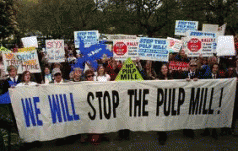

Dear Friends,
Attached is a pdf file with some of the facts concerning the marine effluent from the proposed pulp mill.
Next week Tony Burke, our Federal Minister for Sustainability, Environment, Water, Population and Communities, will be signing off on Gunns hydrodynamic modelling for the federal waters of Bass Strait.
We need to make sure he knows our concerns regarding the toxins going into the pristine waters of Bass Strait, and the effect this will have on the marine mammals and other marine life, as well as our recreational and commercial fishing in the area.
Please forward this file to him with your own message to Tony.Burke.MP@aph.gov.au
or if you want to print it and send it to him his Parliament House Office is PO BOX 6022, Parliament House Canberra 2600.
If you have time, please print out copies to distribute/letter-box in your area, and forward to your friends, family and networks.
Many thanks, Lucy Landon-Lane.
Pulp the Mill.
The proposed pulp mill will dump around 64,000 tonnes of effluent into Bass Strait each day. Over 23 billion litres of pollution will be discharged every year approximately 3 kms off Five Mile Bluff, just east of Low Head and the Tamar Estuary.
The effluent from the proposed pulp mill will contain toxins such as dioxins, furans and resin acids, and heavy metals such as mercury, cadmium and selenium. Dioxins and furans are highly toxic and are known as Persistent Organic Pollutants (POPs) because they do not readily break down, but bioaccumulate, becoming more concentrated in the food chain.
Even low concentration emissions of POPs can lead to major health problems by poisoning marine life or contaminating seafood. Humans exposed to dioxins may suffer liver disorders; damage to their immune, endocrine and reproductive systems; cancers and skin disorders. Nervous systems of developing embryos may also be damaged.
Fish caught in the outfall area will be contaminated. This may lead to harmful impacts on human health and marine life. Even a perceived contamination risk by toxins will damage Tasmania’s clean green image, and harm the commercial market for locally caught seafood.
Protected Australian fur seals and bottlenose dolphins feed in and around the proposed outfall. Australian fur seals are the world’s fourth rarest seal species and their populations are slowly recovering from over-hunting. Tenth Island holds an important seal breeding colony, where up to 500 seal pups are born every year. It is just 10km down current from the outfall. Long-lived marine mammals such as seals and dolphins are at particular risk from POPs because they can accumulate high levels of fat soluble pollutants such as dioxins in their fat and blubber.
Baby seals and dolphins fed on contaminated milk from their mothers face higher risks of developing health problems caused by pulp mill pollution.
The low flushing rate in this part of Bass Strait promotes the accumulation of POPs and other contaminants that could cause health problems both for marine mammals, and the endangered Wandering Albatross.
Unfortunately, if the mill is built, we may be unaware of a developing problem until it is too late. Baseline data on natural levels of contaminants is lacking and no truly independent monitoring system for detecting problems with mill effluent, the environment or human health is proposed. And even if problems were detected, there is no guarantee that they would be fixed. Former Environment Minister Peter Garrett removed the shut down clause from the original operating conditions, substituting it with an insignificant fine, enabling the mill to continue operating despite causing completely unacceptable levels of pollution. A monitoring process that fails to incorporate a mechanism to stop an existing problem from worsening is pointless.
Hydrodynamic modeling has now been completed for Commonwealth waters, and Federal Environment Minister Tony Burke will release his decision in early March. However, there has been no proper assessment of the effects of the effluent on Tasmanian waters and the Tamar River which are so important for recreation and marine life. And of course there has still been no proper assessment of the impacts of this proposed mill on the land environment, air quality, local economy, and so many other areas. This is appalling.
For more information see www.tapvision.info or www.ntn.org.au (national toxics network)
www.who.int/mediacentre/factsheets/fs225/en/ (World Health Organization on dioxins)