National
David Williamson: Labor’s biggest problem? Gillard’s a ham

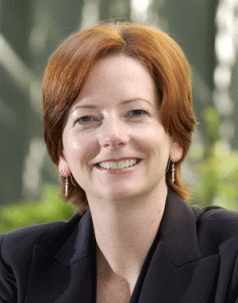

Julia Gillard and the Labor government are on the precipice, and it’s nothing to do with pink batts. It’s simply that Julia, who I like and admire, is a perfectly lousy actor.
I’ve spent a lot of my life watching actors bring my words to life. The difference between a great actor and a very good one isn’t all that great, but the difference between a good actor and a terrible actor is huge and embarrassing. And Julia as an actor, as distinct from a human being, is profoundly bad.
Of course in the best of worlds it shouldn’t matter. A politician, indeed a person, should be judged on their deeds, not their acting skills. But in the real world that’s not how it works. Humans have evolved to be incredibly sensitive to how others are really feeling. There are something over a hundred facial muscles which operate to express our emotions and survival dictated that we needed to be able to discern whether someone was hiding deep anger under that contrived smile.
When you’re faking emotion only half of those hundred muscles come into play and most people can spot the difference between fake and real. Method actors remember real emotional moments in their life as they act in order that real emotions emerge during performance.
What we really want to see in our leaders is sincerity and conviction. We want to be able to trust them. What we see in Julia is a stiff and wooden performance that gives us no idea of what she’s really feeling, if anything at all.
The Queensland floods were a turning point for her. I’m sure Anna Bligh felt genuine distress at what had happened to her state. But she also had the performance skills to convey that state of distress. Julia’s acting skills were appalling. At the height of national emotion she displayed no emotion at all. It’s possible she felt every bit as distressed as Anna but no one would have known it.
The only role Julia seems to be able to play in front of camera is that of a pedantic, emotionless, primary school headmistress lecturing slowly and carefully to a particularly dull-witted class.
As I said in a rational world it shouldn’t matter …
ABC TV’s Four Corners, tonight, January 7: Who is the real Julia? HERE
Labor’s election inquest holds dangers for Gillard
Phillip Coorey, SMH. February 7, 2011
After John Howard came from behind to win the 2001 federal election, Labor conducted a review.
Simon Crean, who took over from Kim Beazley after the loss, commissioned Bob Hawke and Neville Wran to undertake the process.
The review was made public at a news conference in August 2002, and it included 37 proposals to reform the Labor Party and its structures.
Hawke and Wran began proceedings with a long preamble in which they concluded that the September 11, 2001 terrorist attacks and Howard’s use of the MV Tampa refugee crisis were the reasons Labor lost the election.
Hawke looked displeased when then asked why Labor bothered to have a review and recommend changes when the reasons for the loss were so obvious and unrelated. ”Why shouldn’t we try and do better?” he snapped.
”It was more important because we lost, but I wouldn’t have been regarding it as irrelevant to have an inquiry to modernise the party structure even if we’d won.”
To the ultimate detriment of his leadership, Crean sapped his strength fighting internal battles to institute some of the changes. While he opposed some measures that would have increased the influence of the rank and file, Crean fought to reduce union influence inside from 60:40 to 50:50.
”The party spent 12 months cannibalising itself,” said a key player at the time. In the end, Crean was replaced by Mark Latham and the Labor tragedy gathered pace.
Late next week, the review that Julia Gillard commissioned into the election in August will be handed to Labor’s national executive.
Prima facie, it is reasonable to question why a review was needed when the reasons for what was a near disaster for Labor were blindingly obvious.
After abandoning its core policy promise on climate change and then picking and losing a fight with the miners, Labor dumped the prime minister and then declared it had lost its way, thus ensuring it could not campaign on any achievements, such as saving the economy from recession.
The new leader rushed to an election in a haste deemed both unedifying and cynical, and then two weeks into the campaign declared herself a fraud – ”fake Julia” – before promising to be genuine.
Among all this were the leaks aimed at destroying Gillard that came from either Rudd or someone close to him, and the re-entry from Planet Nasty of Latham, just to remind punters how dysfunctional Labor could be. And there were such dumb policies as the citizens assembly on climate change and the cash for clunkers car scheme, both of which have since hit the fence.
It is highly unlikely that the review, conducted by party elders John Faulkner, Steve Bracks and Bob Carr, will be anywhere near this blunt because it will embarrass the leader.
”They are just not going to write that Rudd sabotaged it and Julia made a couple of mistakes,” said one party operative.
Leaks suggest that poll-driven tactics will be criticised and, more broadly, the style of governance during the first term.
Gillard will be under pressure to undo the changes Rudd made and let the factions choose the frontbench rather than the leader.
Such a change would be perceived as a blow to Gillard’s authority, and she ruled it out yesterday. One minister said the Rudd system could work under Gillard because she was much more consultative than Rudd. Nonetheless, it is fraught.
Giving the leader ultimate authority makes the underlings less likely to tell them when they are wrong and the whole show can lurch towards disaster, as it did under Rudd. It also enables the ambitious ones who feel they are being overlooked to enter the ministry with the support of their faction rather than help depose the leader as the only means of advancing their careers.
Other recommendations of the review will include calls to reinvigorate the party by giving rank-and-file members a greater say.
On this there will be …