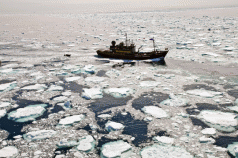
At 1330 hours (AEST), Sea Shepherd’s vessel the Gojira came up behind the Steve Irwin to receive a transfer of supplies. Seeing the fast interceptor vessel sitting dead in the water, the Yushin Maru No. 2 picked up its speed and began approaching her rapidly at a very high speed of 19 knots.
Anticipating that the whalers might attack a stationary Gojira, the Steve Irwin readied a Delta boat. Upon orders from Captain Paul Watson, the Delta crew set out to turn the approaching whaler away. The Delta crew headed towards the harpooner at full speed getting ready to deploy a prop fouler. This caused the whaling vessel to make an abrupt turn to port. The Delta pursued the fleeingYushin Maru No. 2 for 11 miles delivering a dozen stink bombs onto the deck of the whaler before returning back to the Steve Irwin.
Meanwhile, pilot Chris Aultman had landed his helicopter on the Bob Barker some 75 miles to the south along the ice edge of the Ross Sea. The Yushin Maru No. 2made a move to push through the ice to approach the Bob Barker with the objective of turning their water cannon onto the helicopter. Aultman was able to get his helicopter airborne before the harpooner closed in. The Bob Barker then turned to confront the whaler, causing the whaler to turn and flee back through the ice.It has been one week since the whaling fleet was discovered. Two of the harpoon vessels have been under constant observation and have not killed any whales. The Nisshin Maru and one other harpoon vessel the Yushin Maru No. 1 have
fled for over 1,200 miles since the discovery of the fleet on December 31st. It is doubtful they have had time to slow down to catch any whales.The Sea Shepherd Conservation Society is confident the Japanese fleet can be kept on the run and on the defensive for the entire whaling season which ends in mid to late March.

The Sea Shepherd Delta team returning to the safety of the Steve Irwin after engaging a Japanese harpoon vessel
http://www.seashepherd.org/news-and-media/news-110105-2.html
Meanwhile,
Romance in the Southern Ocean
Sea Shepherd’s crew aboard the Gojira was treated to an incredible sight when a pod of humpback whales surfaced right beside them earlier today and began to…. well, make love!

“It was incredible,” said captain of the Gojira Locky MacLean. “One of the mother humpbacks swam right up to the pontoon on the port side and extended her pectoral fin until it touched right under the wing.”
With its two pontoons, the Gojira looks a little like a humpback itself, but fortunately not attractive enough to entice the couple of excitable males close by.
Crewmember Nathan Murphy, Parliament member for Victoria, the second most populous state in Australia said, “I was inspired by their majestic beauty and amazed at the mothers and their calves, and anxious of their safety given the reason we are down here.”
Larry Routledge of South Africa added, “We all stood there in awe in front of these magnificent creatures.”
Zoe Beckett from Melbourne was also excited seeing the whales so close to the ship, “I was humbled by their size and gracious movements in the water.”
When asked if he was sure if the whales were mating, Captain MacLean said, “Oh yes, the evidence was very impressive. Let’s just say I was quite humbled as a man.”
Seeing whales swimming freely in their natural habitat in the Southern Ocean Whale Sanctuary was an incredible motivation for the crew, and the best morale booster imaginable. Although a Japanese harpoon vessel was in the vicinity, the whalers made no attempt to approach the whales with Sea Shepherd standing guard beside them.
Captain Paul Watson wrote the following about mating whales in his soon to be published epic poem Planet for the Whales:
Planet for the Whales
(excerpt)
Within the whales can be found fiery passion,
They tremble, thrust and toss with heated desire.
The immense whale penis is deeply clutched,
Held in a bold soft feminine fashion,
As their mighty strong hearts pump amorous fire,
And in the great dark depths their gentle souls are touched.
The love between the whales is a wonder of life.
Such gentleness in such gargantuan forms,
Joined together in magnificent bliss,
Lustful exchange between husband and wife,
Mated forever through long doldrums and storms,
Impregnated where the sea joins sky with a kiss.
Creating rare wee angels with wings in the sea,
The fastest growing babies in the wide world,
The largest babies born upon the Earth,
Born with majestic grace for all to see,
Into deep blue waters to be rocked and twirled,
From a mother’s love into nurtured freedom birthed.
Baby whales born to the sound of singing,
Flying from their mother’s embrace,
Gently they guide the calf to the surface,
Into the air the calves they are bringing,
Feeling the sun upon their face,
Tasting the salty, calm, topless, surface.
Blue Whale babies larger than Elephants when born
The fastest growing babies in the ocean
Rich, fat, warm, milk from the world’s largest breasts.
Upon mothers back to the surface borne
Cradled weightless, rocking with gentle motion
Tender skin feeling every sweet loving caress
Age, Saturday: Australia backed whalers in sinking
Philip Dorling
January 8, 2011
AUSTRALIAN diplomats were quick to absolve Japanese whalers of blame for the collision that sank the anti-whaling vessel Ady Gil a year ago, telling the US embassy in Canberra the Japanese would ”come away clean” from any investigation.
Leaked US embassy cables reveal the Foreign Affairs Department did not hesitate to blame anti-whaling protesters for the collision on January 6 last year between the Ady Gil and the Japanese whaler Shonan Maru No 2 .
An initial report by the US embassy on the day of the collision noted that while there were no reported casualties, the incident was ”a major escalation of the confrontation over whaling in the Southern Ocean” that would ”increase public and opposition pressure on the [Australian] government to more actively confront Japan”.
Advertisement: Story continues below
Against the backdrop of the Rudd government’s efforts to reach a settlement with Japan that would allow a limited continuation of whaling, the embassy said that ”if Japan is at fault, [the incident] will further chill Australia’s diplomatic engagement on whaling”. The embassy cables, obtained by WikiLeaks and provided exclusively to The Age, also show that New Zealand was at odds with Australia in its initial assessment of the collision.
New Zealand Foreign Ministry officials told the US embassy in Wellington that it was not clear which vessel was to blame for the incident that resulted in the Sea Shepherd Conservation Society’s Ady Gil being scuttled.
The officials said the New Zealand government was ”not making any judgment as to who was at fault for the collision, regardless of the public accusations and finger-pointing in the press that both sides in the incident are currently engaged in”.
As the Ady Gil was a New Zealand-flagged vessel, the NZ government conducted a preliminary investigation but the initial assessment was that ”it is not clear which party is at fault”.
However, in Canberra, on the day after the collision, the Foreign Affairs Department did not hesitate to attribute blame.
Following discussions with Australian diplomats, the US embassy in Canberra reported to Washington: ”The initial video evidence of the collision between a Japanese whaling ship and the Sea Shepherd Conservation Society vessel Ady Gil strongly suggests that the Ady Gil stopped or slowed significantly in the path of the Japanese whaling vessel Shonan Maru at close range and that the Japanese vessel’s actions could be consistent with trying to avoid a collision.”
Paula Watt, director of Foreign Affairs’ marine environment section, told the US embassy that while a final determination of fault would be made by maritime safety authorities, she was confident the Japanese would ”come away clean”.