Environment
The aggressive chemical push … and its long-term consequences

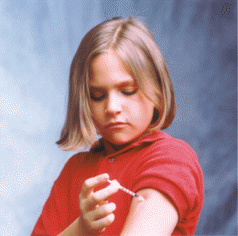

Many of these chemicals have been promoted as ‘safe’ and aggressively sold to consumers, mostly since the end of the second World War.
Preventative medicine sure seems to take a while to be implemented. Implementation of the precautionary principle and ensuring the safety of products – and in combinations – before they are released for public use is essential.
It seems it has been mostly ignored in Australia to date; it is essential these processes happen as soon as possible as a matter of urgency. – Alison Bleaney
InsideEPA.com Risk Policy Report – 11/09/2010
EPA Weighing Impacts Of Chemical Exposures On Diabetes, Obesity
Posted: November 8, 2010
First published: 2010-11-15 03:17 AM
Ed: Article removed for copyright reasons … and replaced with …
Prenatal Exposures Prompt EPA to Re-examine Chemical Regulations
By GAYATHRI VAIDYANATHAN of Greenwire
Published: November 15, 2010
U.S. EPA regulators convened with scientists last month to discuss how to design regulations for chemicals based on emerging science that connects exposures during pregnancy with disease much later in life.
More News From Greenwire
A mother exchanges with her child in the womb chemicals that have remained constant for much of human evolution. They dictate which genes will be turned on and off in the child, which proteins the child will make in his body and how much of them.
New research, in a field called epigenetics, now suggests that these changes, made during the earliest part of gestation, could spell out the child’s longer-term medical record. It could determine his propensity for mood swings, his tendency to gain weight into the realms of obesity, his risk of developing cardiovascular disease or cancer when he hits 50, and his propensity of passing on his genes to his children.
The idea is that the child adapts to environmental cues in the womb that will reflect the chemical composition of the world, thus conferring a Darwinian fitness advantage.
The mix of chemicals a fetus is exposed to has exploded in the past 200 years, heralded by the Industrial Revolution. Technology has outstripped evolution, said Robert Chapin, senior research fellow in drug safety research and development at Pfizer Inc. People were suddenly surrounded by particulate matter from cars, coal-plant emissions, metals, organic molecules from hand sanitizers, body lotions and other chemicals, some of which could cross into the placenta and merge into the child’s aqueous world.
Some, such as folic acid, were intentionally given to moms as beneficial; others such as bisphenol A became common in the modern environment and had the ability to mimic hormones that are naturally present in humans. Yet others, such as arsenic and tin, are naturally present in some places.
Scientists now suspect that the altered chemical cues during the critical windows of pregnancy — at stages when gender is still developing and the human is little more than a collection of cells — could trigger pathways that manifest as disease well into adulthood.
…
“Stan Barone, senior scientist and assistant director for Human Health Risk Assessment at the National Center for Environmental Assessment, said not making a decision about chemicals is also a decision.
“A zero value is right now evaluated at the context of no risk for many chemicals and many mixtures of chemicals,” Barone said. “That is not a real satisfactory place to be as a risk assessor, as a public health policymaker or as a person in the public or in the community.”
…
Read the full article in the New York Times HERE
And,
New Hurdle for California Condors May Be DDT From Years Ago …
BIG SUR, Calif. — Four years ago, in a musky, leaf-lined cavity halfway up a 200-foot redwood tree here, two California condors made the region’s first known nesting attempt in more than a century.
Joe Burnett, a senior wildlife biologist with the Ventana Wildlife Society and the lead biologist for the Central California condor recovery program, who had been monitoring the condor pair, was delighted with this promising development in the continuing effort to save the nation’s largest bird from extinction. When this first breeding attempt proved unsuccessful, Mr. Burnett attributed it to the young birds’ inexperience. But when he climbed the giant tree to examine the abandoned nest, he was stunned at what he uncovered: the first evidence of a potentially significant new hurdle for the condor program.
“The eggshell fragments we found appeared abnormally thin,” Mr. Burnett said. “They were so thin that we had to run tests to confirm that it was a condor egg.” The fragments reminded him of the thin-shelled eggs from birds like brown pelicans and peregrine falcons, which had been devastated by DDT but are now on the rebound.
The discovery raised a disturbing question: could DDT — the deadly pesticide that has been banned in the United States since 1972 — produce condor reproductive problems nearly four decades later?
Read the full article in the New York Times HERE
FOR IMMEDIATE RELEASE
November 16, 2010
EPA to Expand Chemicals Testing for Endocrine Disruption
WASHINGTON – The U.S. Environmental Protection Agency (EPA) has identified a list of 134 chemicals that will be screened for their potential to disrupt the endocrine system. Endocrine disruptors are chemicals that interact with and possibly disrupt the hormones produced or secreted by the human or animal endocrine system, which regulates growth, metabolism and reproduction. Administrator Lisa P. Jackson has made it a top priority to ensure the safety of chemicals, and this is another step in this process.
³Endocrine disruptors represent a serious health concern for the American people, especially children. Americans today are exposed to more chemicals in our products, our environment and our bodies than ever before, and it is essential that EPA takes every step to gather information and prevent risks,² said EPA Administrator Lisa P. Jackson.
³We are using the best available science to examine a larger list of chemicals and ensure that they are not contaminating the water we drink and exposing adults and children to potential harm.²
The list includes chemicals that have been identified as priorities under the Safe Drinking Water Act (SDWA) and may be found in sources of drinking water where a substantial number of people may be exposed. The list also includes pesticide active ingredients that are being evaluated under EPA¹s registration review program to ensure they meet current scientific and regulatory standards. The data generated from the screens will provide robust and systematic scientific information to help EPA identify whether additional testing is necessary, or whether other steps are necessary to address potential endocrine disrupting chemicals.
The chemicals listed include those used in products such as solvents, gasoline, plastics, personal care products, pesticides, and pharmaceuticals, including benzene, perchlorate, urethane, ethylene glycol, and erythromycin.
Also being announced today are draft policies and procedures that EPA will follow to order testing, minimize duplicative testing, promote equitable cost-sharing, and to address issues that are unique to chemicals regulated under the SDWA.
After public comment and review, EPA will issue test orders to pesticide registrants and the manufacturers of these chemicals to compel them to generate data to determine whether their chemicals may disrupt the estrogen, androgen and thyroid pathways of the endocrine system.
EPA is already screening an initial group of 67 pesticide chemicals. In October 2009, the agency issued orders to companies requiring endocrine disruptor screening program data for these chemicals. EPA will begin issuing orders for this second group of 134 chemicals beginning in 2011.
EPA has the most comprehensive mandated testing program for hormone effects in the world. The program is the result of a multi-year effort that includes validation of the science through a transparent scientific review process.
For more information: http://www.epa.gov/endo
Earlier on Tasmanian Times:
Bt Toxin and Imidacloprid from ‘Lethal Trees’
Imidacloprid (discussed by Forestry Tasmania as being injected into some of the trees to act as an insect ‘trap’ and also used in agriculture in Tasmania) is a neonicotinoid insecticide.
None flew over the cuckoo’s nest: A world without birds
Could we be facing a future without birds? Our reliance on pesticides has cut a swathe through their numbers. We must act now, argues Kate Ravilious
Scanning the sky with his binoculars, he searches carefully for any sign of movement: the steady beat of a blackbird’s wings, the fluttering of a flock of starlings. It has been a week now since he saw the starlings: just four of them flitting from tree to tree, feasting on the autumn berries.
Birds are a real rarity these days. In his boyhood, he recalls, he would watch the acrobatics of entire flocks as they ducked and dived after insects. But now the skies are silent, barring the hum of the odd airplane. Turning back to his fruit and vegetable patch, he continues the laborious task of pollinating the raspberry plants by hand, gently brushing pollen onto the slender stigmas inside the flowers. In the past, bees, wasps, butterflies and flies would have done this job for him; nowadays such insects are likewise a rarity. Farmers instead resort to robot bees to pollinate their crops: tiny motors, encased in fuzzy fabric, which hover from flower to flower.
Will this bleak outlook be a reality for future generations? It is nearly 50 years since Rachel Carson wrote Silent Spring, the book that warned of environmental damage the pesticide DDT was causing. Today, DDT use is banned except in exceptional circumstances, yet we still don’t seem to have taken on board Carson’s fundamental message.
According to Henk Tennekes, a researcher at the Experimental Toxicology Services in Zutphen, the Netherlands, the threat of DDT has been superseded by a relatively new class of insecticide, known as the neonicotinoids. In his book The Systemic Insecticides: A Disaster in the Making, published this month, Tennekes draws all the evidence together, to make the case that neonicotinoids are causing a catastrophe in the insect world, which is having a knock-on effect for many of our birds.
Already, in many areas, the skies are much quieter than they used to be. All over Europe, many species of bird have suffered a population crash. Spotting a house sparrow, common swift or a flock of starlings used to be unremarkable, but today they are a more of an unusual sight. Since 1977, Britain’s house-sparrow population has shrunk by 68 per cent.
The common swift has suffered a 41 per cent fall in numbers since 1994, and the starling 26 per cent. The story is similar for woodland birds (such as the spotted flycatcher, willow tit and wood warbler), and farmland birds (including the northern lapwing, snipe, curlew, redshank and song thrush).
Ornithologists have been trying desperately to work out what is behind these rapid declines. Urban development, hermetically sealed houses and barns, designer gardens and changing farming practices have all been blamed, but exactly why these birds have fallen from the skies is still largely unexplained.
However, Tennekes thinks there may be a simple reason. “The evidence shows that the bird species suffering massive decline since the 1990s rely on insects for their diet,” he says. He believes that the insect world is no longer thriving, and that birds that feed on insects are short on food.
So what has happened to all the insects? In the Nineties, a new class of insecticide – the neonicotinoids – was introduced. Beekeepers were the first people to notice a problem, as their bees began to desert their hives and die, a phenomenon known as Colony Collapse Disorder (CCD).
The first cases were in France in 1994, but the epidemic quickly fanned out across Europe, and by 2006 CCD reached the US too. Between 2006 and 2009 one third of American beekeepers reported cases of colony collapse. Aside from the loss of revenue in honey sales, this is worrying news because honey bees are one of the world’s most important pollinators, and 35 per cent of agricultural crops rely on pollinators.
As a service, pollination is worth an estimated £440m a year to the UK economy and a staggering $15bn (£9.3bn) to US farmers. And it isn’t just the Western world that is affected: in China the lack of bees has become so serious that farmers in some regions are already resorting to pollinating their crops by hand.