Media
Andrew Wilkie presents bill to protect journalists

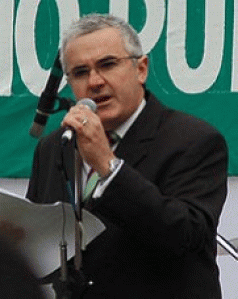

Independent Member for Denison Andrew Wilkie introduced a bill today in Parliament to protect journalists from being fined or imprisoned for refusing to reveal their sources.
It is the first piece of legislation Mr Wilkie has brought to the Parliament, and the first piece of Private Member’s Business from any of the Independents under the recent reforms to Parliamentary procedure.
Mr Wilkie said that his bill is intended to foster freedom of press and promote better access to information for the Australian public.
“The apparent freedom of speech and press many Australians take for granted is in fact on shaky ground,” Mr Wilkie said.
“Issues of public importance such as official misconduct must be reported on. For such reporting to occur, anonymity of sources is sometimes needed.”
“Many whistleblowers are good people doing their best to publicise misconduct”
Under current laws, journalists are expected to reveal confidential sources. In 2004 Michael Harvey and Gerard McManus, two senior reporters for the Herald Sun, were fined $7,000 each when they refused to disclose their source. Had they revealed this information, they would have been directly violating the Australian Journalists’ Association Code of Ethics, which states that: “Where confidences are accepted, respect them in all circumstances”.
The bill, known as the Shield Laws Bill, reforms the Evidence Act 1995, prevents journalists from being compelled to provide any information which might disclose the identity of their sources, unless a court finds such information to be in the public interest.
Andrew Wilkie’s speech:
First Reading – Evidence Amendment (Journalists’ Privilege) Bill 2010
Mr Speaker, I’m very pleased today to be in a position to present the Evidence Amendment (Journalists’ Privilege) Bill 2010.
This Bill amends the Evidence Act 1995 by strengthening the protection provided to journalists and their sources. It is intended to foster freedom of the press and better access to information for the Australian public.
The Bill provides that if a journalist has promised an informant not to disclose his or her identity, then neither the journalist nor his or her employer is compelled to answer any question, or produce any document, that would disclose the identity of the informant or enable their identity to be ascertained.
The Evidence Amendment (Journalists’ Privilege) Bill 2010 is based on the premise that every member of the community has the fundamental right to free speech, and that sometimes the exercise of that right needs to be undertaken anonymously, especially when it comes to people speaking out about official misconduct.
Moreover the Bill is based on the premise that journalists must be able to publicise such outspokenness if they are to accurately inform the Australian public about matters of interest.
In other words this Bill is to do with whistleblowers and the journalists they deal with.
Mr Speaker, people become whistleblowers for all sorts of reasons.
For example Toni Hoffman, the Queensland nurse who bravely lifted the lid on Dr Patel’s deadly transgressions at Bundaberg Base Hospital.
Lieutenant Colonel Lance Collins, who broke ranks to advise Prime Minister John Howard about the failure of institutional controls over the intelligence system.
Defence official Mike Scrafton, who blew the whistle on the Government continuing to claim asylum seekers had thrown their children overboard, even though it had been told repeatedly that no one in Defence still believed the story to be true.
UN weapons inspector Rod Barton went to the media to reveal how information on Iraqi WMD had been manipulated and how Iraqi prisoners were mistreated.
All these people served the public interest significantly by speaking up about the controversial matters that preoccupied them.
But yet all were assailed by critics keen to put troublemakers in their place and to send a strong message to other officials not to step out of line.
Toni Hoffman was ridiculed and eventually forced to go outside of the Queensland health system and raise her concerns with her local Member of Parliament, Rob Messenger. Messenger, also facing ridicule over the matter, eventually had to rely on the Courier Mail newspaper to get the Queensland Government to intervene in the Bundaberg Hospital tragedy.
Collins’s call for a Royal Commission was dismissed by the Prime Minister and he was eventually forced out of the Defence Force by what he described as the blowtorching process.
Scrafton’s evidence was criticised by the Government as implausible, irrational and evasive, and the timing of his claims as politically strategic.
Barton was reportedly marginalised at the insistence of Prime Minister Howard’s staff, and even ridiculed by the Prime Minister himself who pushed the view that “it’s quite common for people with no understanding of the process, or little understanding of the process, to misunderstand the things they see.”
Mr Speaker, in all these examples the whistleblower decided to go public. But not in all cases can they, or would they want to, which is unsurprising considering the punishment metered out publicly to those whistleblowers that do opt to out themselves.
No wonder that in some important instances whistleblowers will decide to try and keep their identities secret, preferring instead that journalists publicise their concerns while not attributing the source.
As was the case in 2004 when two senior political reporters for Melbourne’s Herald Sun newspaper, Michael Harvey and Gerard McManus, wrote stories which exposed a decision by the Howard Government to reject a $500 million increase in war veterans’ entitlements.
During the legal proceedings against the alleged source of the story the journalists refused to identify their source, thus putting them in contempt of the court and facing possible imprisonment.
This was an extraordinary situation, not least because Harvey and McManus actions were entirely consistent with the Australian Journalists Association Code of Ethics which provides that journalists should “Aim to attribute information to its source. Where a source seeks anonymity, do not agree without first considering the source’s motives and any alternative attributable source. Where confidences are accepted, respect them in all circumstances.”
As it turned out the pair were convicted of contempt of court and fined $7000 each for refusing to reveal their source behind the stories they wrote, even though this was a clear example of when journalists would not have otherwise been able to report on the actions of the Government without their source, who, had he or she been revealed, suffered harm.
The story of Harvey and McManus highlights as well as any the need for legislative reform to provide better protection for whistleblowers and the journalists who try and publicise their concerns. This Bill will go some way to rectifying the situation. Its logical counterpart will be broader whistleblower legislation and I look forward to working with Members to progress such unprecedented Federal legislation during the term of this Parliament.
Mr Speaker, whistleblowers face a hard time in Australia. They are often seen as troublemakers or misfits, people letting the team down, crazies or just do-gooders ignorant of the fact that the Government knows best. Most never enjoy any sustained media interest and instead have their say and struggle with the subsequent professional, personal and financial consequences.
In 2002 Time magazine had three American whistleblowers as their cover story People of the Year. This wouldn’t happen in Australia. Nor will it until the public understands better that many whistleblowers are good people doing their best to publicise misconduct.
And that mind shift won’t occur until politicians show leadership and pass the laws which will encourage and protect whistleblowers, and those who facilitate them, and which will show the community that whistleblowers are doing the right thing and should be supported.
Mr Speaker, I would add, however, that this Bill does recognise that there may be circumstances where the public interest in the disclosure of the identity of the source is so strong that it should be provided to the court. In such cases it will be up to those parties who want to force a journalist to reveal their source to prove that that the public interest is best served in disclosing the source, and that the public interest benefit of a disclosure genuinely outweighs the likely harm to the source.
This Bill will replace the existing provisions in Division 1A of the Evidence Act. It will include a new provision that provides clear authority for a presumption that a journalist is not required to give evidence about the identity of the source of their information. This presumption can be rebutted in circumstances where the public interest outweighs any likely adverse effect for the person who provided the information to the journalist, as well as the public interest in communication of information to the public by the media.
These amendments are based on similar provisions of the New Zealand Evidence Act 2006, modified to ensure appropriate application in the context of Australian evidence law.
Mr Speaker, Australian democracy is obviously a complex combination of many elements, for example representative bodies freely elected under universal suffrage, a balance of sorts provided by a non-elected head of state, an independent judiciary and the rule of law, the separation of church and state and so on. Central is freedom of both speech and press and this, in particular, must never be compromised.
But yet the example of Harvey and McManus shows us that the apparent freedom of speech and press many Australians take for granted is in fact on shaky ground. The Evidence Act, in its current form, rests on the premise that journalists should normally be expected to reveal their confidential sources and in doing so breach their Code of Ethics. That is wrong and this Bill will rectify the problem.
Mr Speaker I commend the Evidence Amendment (Journalists’ Privilege) Bill 2010 to the House.