ONE of the last of the listed managed investment schemes has fallen over, with receivers and managers appointed to Willmott Forests.
The board of the troubled Willmott today said that its syndicate of banks – including Commonwealth Bank and St George Bank – had appointed Mark Mentha and Bryan Webster of Korda Mentha after scrapping waivers to the $120 million they are owed.
Commonwealth Bank is also a major shareholder, with 9.75 per cent, just behind managing director Marcus Derham, who with almost 20 per cent is the largest stakeholder.
The syndicate had granted temporary waivers as Willmott undertook a business review, including the sale of land assets to repay debt, after striking trouble on lower than expected sales in full-year 2010.
“The syndicate has today advised Willmott Forrests that the temporary waiver is terminated and that all loans are immediately due and payable,” Willmott said.
Willmott had about 8000 investors that have put $400m into the company focused on establishing, managing, harvesting, processing and supplying timber products from plantation-grown resources on behalf of its growers and shareholders.
According to its website, the company employs 130-plus people and manages more than 56,000 hectares of pine, silky oak and she-oak plantations, predominantly on Australia’s east coast.
Willmott is one of the older forestry-based managed investments and is the responsible entity for a number of Woodlot investment projects.
But Willmott in July conceded that the retail investment market for forestry-based agricultural products had “severely contracted” from full-year 2009 levels.
…
The company joins Timbercorp, Great Southern, Perth-based Rewards Group and a number of other businesses associated with Tasmanian group Forest Enterprises Australia to go to corporate rescuers or liquidators.
Tasmanian Times writer John Lawrence was among the first to highlight the problems facing MIS: HERE
Meanwhile, Barry Chipman, ABC Online:
Harvesting ‘a ray of hope’ for forest contractors
Forest Contractors have begun harvesting some plantations owned by the troubled Forest Enterprises Australia (FEA) in north-east Tasmania.
FEA went into administration and partial receivership in April with debts of more than $200 million.
The Administrator, Brian Silvia announced last week he planned to start harvesting trees to provide some income for growers and work for forest contractors.
Barry Chipman from Timber Communities Australia says the harvesting provides hope that FEA will eventually return to being a profitable company.
“It’s creating work and it’s also giving renewed confidence to family investors and creditors all stakeholders that are involved with Forest Enterprises Australia,” he said.
It’s the GFC, says loss-making Forestry Tas …
Forestry Tasmania profits slashed $8m
Forestry Tasmania is blaming falling international wood products demand for a major profit slump.
The company has reported an operating loss of $8 million for the last financial year, that compares to a $9 million operating profit the previous year.
Forestry Tasmania’s chairman Adrian Kloeden has described the past year as ‘challenging’.
“It has been tough,” he said.
“The focus of the board and the senior management has been to restructure the company to survive the significant downturn in international markets brought on by the global financial crisis and exacerbated by the closure of the north-west mills and the collapse of the managed investment companies.”
Revenue fell by $21 million but Mr Kloeden says the state-owned company has emerged from the global financial crisis in better shape than others.
Forestry Tasmania says growing Chinese demand for wood products is the key to the industry’s future.
Paul Oosting, Wilderness Society:
MEDIA RELEASE September 7, 2010
FORESTRY TASMANIA STEERING TOWARDS NEW DIRECTION
Forestry Tasmania today announced a loss of $8 million for the last financial year citing the Global Financial Crisis and the loss of Gunns Japanese market. Forestry Tasmania has also importantly recognised that it cannot claim State Forest land as an asset because it doesn’t own it.
The Wilderness Society welcomed Forestry Tasmanias acknowledgment of the need for change and for making environmental credibility central to its new vision.
After years of environmental concern and campaigning about how our forests, water catchments and wildlife are managed, it is encouraging that Forestry Tasmania wants to improve its environmental standards and earn support from environment groups, said Paul Oosting spokesperson for The Wilderness Society.
This major shift now puts Forestry Tasmania in a position to improve environmental outcomes and start protecting Tasmanias irreplaceable native forests,
“However, they will not be able to earn environmental support whilst continuing to push burning native forests for power or by selling native forest wood to China. Indeed, such plans undermine the chance of a lasting agreement for both forest protection and industry security.
Any new agreements to sell or export native forest resources jeapordise any negotiated resolution of the long running Tasmanian forestry conflict.”
“In order to secure a lasting benefit to forests and to the industry, we look forward to Forestry Tasmania continuing to constructively engage in these vital negotiations said Mr Oosting.
Phill Pullinger, Environment Tasmania:
Media Release 7/9/2010
Forestry Tasmania has a bet each way on future of timber industry
In releasing their annual financial results today, Forestry Tasmania have signalled the potential for a major shift, whilst continuing to place a ‘bet each way’ on the timber industry’s future.
“There are some surprising acknowledgments today from Forestry Tasmania of the reality that the timber industry is being forced in a new direction by environment groups and the community,” said Dr Phill Pullinger, Director of Environment Tasmania.
“Acknowledging the possibility of a significant increase in forest reserves and a transition out of native forests logging, Forestry Tasmania signals the potential for a pragmatic approach to solving the forest conflict. If this transpires, it would be widely welcomed,”
“However, there continues to be major hurdles – and Forestry Tasmania are having a bet each way by pursuing the burning of native forests for power, whole-log exports, and native forests woodchip exports to China. All of these outcomes would de-rail a solution,” he continued, “You only have to look at Forestry Tasmania’s significant financial loss, the ongoing crisis within the industry, and ongoing community outrage to see that the timber industry needs to go in a completely new direction,”
Environment Tasmania is the peak body for Tasmanian environment & conservation groups – and represents over 20 Tasmanian environment groups with collective representation of over 5000 Tasmanians.
Dr Phill Pullinger
Director
Environment Tasmania
The Conservation Council
Kim Booth:
FORESTRY LOSES $8 MILLION WHILE DAMAGING BRAND AND RESOURCE
Time to End Focus on Failed Woodchip Industry and Reform Forestry Tasmania
Kim Booth MP
Greens Forests spokesperson
The Tasmanian Greens today described Forestry Tasmania’s latest loss, of nearly $8 million for the 2009-10 financial year, as an appalling indictment on a rogue Government Business Enterprise that has prioritised the profits of woodchippers while damaging Tasmania’s timber resource and brand, and losing millions of dollars of public money on a regular basis.
Greens Forests spokesperson Kim Booth MP said instead of wasting taxpayer’s money continually propping up a rogue GBE that is overseeing a failing woodchip-based industry, it is time that Labor reformed Forestry Tasmania and redirected public funds into real priorities such as hospitals, schools and public infrastructure.
Mr Booth also said that Forestry Tasmania currently appears to be seeking a social licence for its activities via megaphone diplomacy with the community, and called on the GBE to publicly abandon mooted plans to become a woodchipper in its own right, and to contact community groups and begin a process of real dialogue instead of barking out demands through the media.
“Once again Forestry Tasmania has managed to lose millions of public dollars while overseeing a huge free resource, and it is high time that Labor reformed this rogue GBE to start managing our forests for a fair return to the public purse which will allow for a the proper allocation of public funds into health, education and infrastructure,” said Mr Booth.
“It is obvious that Forestry Tasmania’s high-volume low-price export model has not only wasted hundreds of millions of taxpayer dollars, it is interfering in the market by giving away wood at rates under which no other supplier can survive.”
“This eight million dollar loss means that eight million dollars will now have to be pulled away from real priorities in order to prop-up a rogue agency that has driven Tasmania’s forestry sector to its knees.”
“If Forestry Tasmania wants social acceptance of its activities it needs to stop interfering in the market, back away from the obvious intention to become a woodchipper in its own right, and start talking to the community and stakeholders about the best way to move beyond the current failed focus on woodchipping,” said Mr Booth.
*Captions
Pete Godfrey: Conversion is still going on:
Despite all the deception and lies thrown at us from the management of Forestry Tasmania and despite reasurring us in September 2008 in the Branchline Newsletter that FT were not converting our native forests to
plantations, they are still at it.
In the three year plan for 2010 -2013 FT have a total of 130 ha of conversion coupes planned.
The list is as follows
RR186G 35 ha
CC140A 10 ha contingency coupe
ST204G 12 ha
KA006H 7 ha
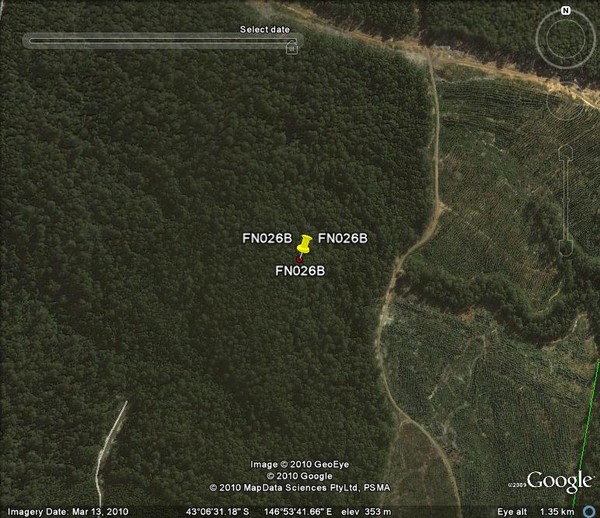
FN026B 25 ha
KD043C 6 ha
FO006C 35 ha contingency coupe.
So much for the “Maintenance of the Permanent Forest Estate Policy” that stated that FT would cease conversions at the end of 2006.
I guess that they are a little behind in their new year celebrations …
*Captions:
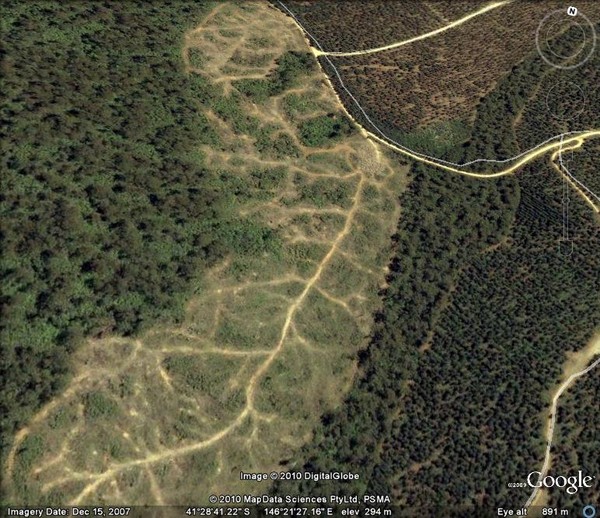
The BU135A Coupe is in the Garden of Eden area, the google image was dated December 2007 a year after FT claim to have ceased conversions. It may have been logged a year earlier but had been included to show what the clearfells look like from satellites.
The FN026B coupe is an image of a proposed conversion coupe by FT. Dated 13th March 2010 which is more than 3 years after FT claim to have stopped conversions. The coupe is 25 ha in area.
Gunns quits FIAT:
Timber giant Gunns is severing its ties with the Forest Industries Association of Tasmania.
The association represents the interests of processors of Tasmanian forest products. It gets just under half of its funding from the timber giant.
But FIAT’s Chairman Julian Amos says Gunns’ withdrawal won’t spell the end for the organisation.
“Without their presence we are still quite viable and will continue to be viable.”
It is hoped the Forest Industries Association will be a signatory to any peace deal reached between the forestry industry and environmentalists.
However Mr Amos says Gunns is now free to act alone.
“But then what meaning would such an agreement have if it wasn’t universal.”
Greg L’Estrange says the forest industry has lost the public debate on logging.
The head of timber giant Gunns Limited has spoken publicly about why the company is severing its ties with the state’s most influential forest industry lobby group.
It has been revealed Gunns is quitting the Forest Industries Association of Tasmania.
The company’s departure undermines the association’s finances and powerbase, as forestry peace talks continue with environmentalists.
Gunns chief executive Greg L’Estrange was asked about the spilt at a forest industry conference in Melbourne today.
“It’s one of those things you normally do quietly and have those conversations with the industry,” he said.
“As you would have heard today we have a certain path that we are taking our organisation on and we’ve made those decisions taking all of those things into account.”
Mr L’Estrange says the forest industry has lost the public debate on logging.
He has called for an end to the so-called war between the industry and environmentalists.
He said there had been a decline in the public demand for wood products and he reiterated Gunns’ intention to become a plantation only business, urging others to follow suit.
He told the conference that most Australians now support the environmental lobby.
“The vast support of the Australian population is with the environmental non-government organisations,” he said.
“This commands them to work with them to create a future without this conflict that moves them from being in opposition for our products and processes, to being supportive.
“This may well mean transitioning to plantation but move we must.”
Forestry Tas seeks compo:
Forestry compo claim
NICK CLARK | September 09, 2010 08.57am
FORESTRY Tasmania will expect compensation from Gunns Limited if the round-table negotiations on the future of Tasmania’s timber industry result in an end to logging in native forests.
FT and Gunns signed two major wood supply agreements in December 2007.
The 20-year pulpwood supply agreement covered 1.5 million tonnes of pulpwood a year until 2027.
The sawlog and other products supply agreement covered deals in sawlogs until 2017. The amounts are commercial-in-confidence.
Timber processor Gunns has said it wants to make a transition to a plantation-based industry, including the Bell Bay pulp mill.
It is expected an agreement between the forestry industry and conservationists would cost 3000 jobs and result in Gunns closing sawmills.
Forestry Tasmania managing director Bob Gordon said a talks agreement would likely result in the end of the pulpwood supply deal with Gunns.
“Normally when someone walks away from a contract they compensate the person selling, not buying,” he said.
Mr Gordon said FT was planning for a reduction in available native forest.
But he said FT hoped other significant customers, such as Ta Ann Tasmania, McKays Sawmill and Britton Timbers, would continue to process native forest timber.
Gunns is FT’s major customer and accounted for a significant percentage of the $114 million in forest sales revenue in 2010.
Mr Gordon would not speculate on the effect of any deal on employment at FT.
FT employed 1775 staff and contractors in 2008-09.
Analysts expect Gunns to receive up to $200 million in compensation from the Federal Government from pulling out of native forest logging and closing sawmills.
Nick Clark, Mercury story HERE
And,
Govt pressured over ‘bungled’ FEA deal
The Tasmanian Government has been accused of bungling a major forestry contract in the state’s north-east and is under pressure to make the details public.
In 2007 Forest Enterprises Australia (FEA) was awarded a tender to harvest 300,000 tonnes of radiata pine in the state’s north-east.
But FEA went into partial receivership in April with debts of $216 million.
Tasmanian Opposition Industry Spokesman Peter Gutwein is calling on the Resources Minister Bryan Green to reveal if the contract had an ‘out’ clause.
“The minister needs to explain whether or not putting this softwood resource out to tender was and option when FEA went into receivership,” he said.
“And if it was why he didn’t do that and therefore give the market and opportunity to purchase this resource again.”
Mr Gutwein says had the trees been made available to Gunns, the future of the Scottsdale sawmill could have been secured.
“The could have underpinned both the Scottsdale mill’s future but also the north-east economy,” he said.
The Liberals do not believe FEA should ever have been given the contract to harvest the trees.