A mixed silviculture strategy has been recommended for oldgrowth in Tasmania’s State forests, that includes variable retention in most tall oldgrowth wet eucalypt forests, limited clearfelling in steeper areas, single
tree/group selection in designated Special Timbers Management Units and continuation of partial/selective systems for oldgrowth dry eucalypt forest.
A couple of reports have been published on the work done to date on this project, but it remains a work in progress. The following contains links to the reports that are currently available, together with an explanation of the background to a thread that has been chugging away on tastimes, which has resulted in a new thread entitled “I’ve had enough of the secrecy” The following is my article in response to John Maddock, and should be read in conjunction to it….
John Maddock ( HERE ), the reason I emailed you with the suggestion of a phone conversation was that I felt, obviously wrongly, that we could have had an adult conversation.
Yes, it is true that I had earlier had a conversation with the Principal Research Scientist, Native Forests, of Forestry Tasmania. I wrongly thought that in an adult conversation we could have discussed the conversation I had, with a venture into the nuances, the implications, the points of detail seemingly trivial but too tedious to commit to writing, let alone submitted here, given that they would be dissected, misconstrued, misunderstood, and misrepresented by some of the more adventurous space cadets that flutter around the flame of tastimes….
What a shame. I thought you were above that. Instead, you chose to embark on a grandstanding mission of your own.
I am disappointed.

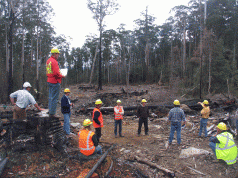
The study group in the Warra Long Term Ecological Research site, coupe 8G. Beekeeper Julian Wolfhagen is on the far left, George 3rd from the right, Ian Johnston, second from the right.
Still, I will take the opportunity to contribute some information. I have to add that the report I was provided with (on the Warra trial) was sent to me on the basis that I was one of the external contact group over a number of years.
I honestly did not know if that document was a public document, or not. Unlike some, I have a respect for such things. Also, I realize that I could not expect to get the information and co-operation that I do if I were to be too casual with information that might be unpublished, incomplete, or in a draft form, or sensitive. I have a lot of respect for intelligent, educated and committed people who are working their hearts out, and who are often subjected to ridicule, uninformed nonsense, mischief, and just plain bullshit, and worse. I am not about to get any decent people into difficult circumstances just to satisfy the grizzlers who hang around here.
The reason the report on Warra 8G has not been published is because IT HAS NOT BEEN FINISHED YET. Can you get your head around that? These scientific exercises are conducted in an area where there is international cooperation and collaboration. The scientist who is doing the economic modelling is in Denmark. He did spend some time here, and the Principal Research Scientist, Native Forests, with Forestry Tasmania, Dr. Mark Neyland, is constantly onto him to complete his analysis.
He gets promises, but no action. It is a sufficiently complicated model, and without his contribution, the local scientists are stuck at this stage. Dr. Neyland has suggested to me that a more useful document for you to look at would be the “New Silviculture Report” which can be downloaded from HEREhttp://www.forestrytas.com.au/uploads/File/pdf/pdf2009/a_new _silviculture_web_version.PDF
Another useful document is Dr. Neyland’s paper to the Old Forests New Management conference held in Hobart a couple of years ago, although it has to be noted that at the time the regen data for 8G was incomplete, as the coupe was not old enough at that stage. That document can be seen here: http://www.warra.com/documents/publications/Neyland_etal_2009.pdf
The three year regeneration surveys across the trial have now been completed, and that was only in April of this year. Dr. Neyland is working on another paper, which is a complete wrap of the Warra trial, and while it needs the economic modelling, it does have a lot of other material. However, these things take time.
What is clear, though, is that important material has emerged, and it has shaped how future logging is going to occur in sensitive but valuable areas that contribute Special Timbers to high value-adding activities and real jobs throughout the community.
This deserves proper consideration, not sniping.
First published: 2010-09-30 04:25 AM