Environment
FOXing the facts at the ABC

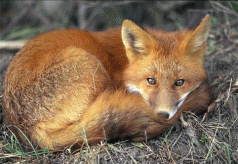

I did not intentionally organise an experiment to test the hypothesis that the media has been implicated in the three-ringed circus of confusion that surrounds the Tasmanian fox saga. But I could not have got more convincing data that my recent experience if I had done. I published an article on the strange data and their inconclusive implications concerning whether foxes are established in Tasmania ( The Fox That Wasn’t There? On Tasmanian Times: HERE).
I chose to put my full argument, analysis and conclusions on-line (lock, stock and barrel) to avoid any need for confusion. With everything there to be read, the cyber-cow to be milked at will, you might think that the rest would be easy.
But it took little more than a week for the media to hoist upon its own petard. The main problem was, they did the same to my arguments, adding to confusion when I sought to allay it.
The news media template for science reporting is well known. It seems to demand one of either broad category. There are scientific stories that offer opportunities to announce that a breakthrough or a world first is at hand – however spurious the claim. Then there are scientists who come out to slam something. The news media loves a good slamming.
I have always thought that the ABC traditions of great science journalism would filter into news reporting. I had always trusted Aunty with my research in the past and she had never failed me. Until now.
This time I had politely suggested that my arguments and circumstances were a bit too complex to suit a news bulletin. I said that I’d be happy to discuss things in a bit more depth on radio, write articles where I could report facts as I saw them. When I got back to Melbourne from working in Indonesia, sure, I would do an interview.
But would ABC news in Tasmania have any of it? Not on your nelly. Apparently someone could recognise the opportunity for a good slamming when they saw one.
Now it wasn’t so much that the ABC news incorrectly told Tasmania and the world that I now live in Indonesia that worried me much (my email to them had clearly said that I was working there). To some Tasmanians it was probably equally as bad as a mainlander making comment – but in this case it was much further away than usual. I was not even that worried that they got the important figures horribly wrong, mentioning 56 individual foxes rather than the 15 clearly stated in the original article. Oh well.
No, what pissed me off was the fact that they fabricated a new conclusion for my article. According to the ABC I was calling for a “review of the entire fox eradication program”. Read my article, and see if you can find this, I can’t. I actually call for the review of one solitary technique – that’s all – the scat DNA technique. I spend a lot of time explaining why in the online article and it is really the entire point of it. But I guess a technique that extracts DNA from a fox turd is nothing that anyone wants to be slammed with – especially when children are watching.
Who cares about small changes in words and meanings and completely altered conclusion? Me, I care a lot! I’m a scientist and getting it right is my job, even though all of us make mistakes; when we do we hopefully correct them. But after the first mistakes were pointed out the ABC posted these inaccuracies all over Australia. Disseminating known errors really sticks in my scientific craw.
In the process of being recast as a slammer, detail had got a little lost right at the start and it only got worse.
The first handful of inaccuracies had been fed into the media sausage mix and the media fed upon it, building upon them. The absolute bitter irony of it all was that my original on-line story dealt precisely with the consequences of misinterpretation, inaccuracy, poor deductions, flawed data and an inability to discern between belief and knowledge. Like a Greek tragedy, the media martyred itself to these very failings.
The bright spot was the interview with Louise Saunders on ABC radio Hobart, a medium far more suited to allowing people to explain things – in their own words. Louise had obviously done some homework and that inspired confidence.
But, the dye had been cast early on and the slamming feast was on for young and old. News-land never returns to the source (the actual article I wrote, ( On Tasmanian Times: HERE ) once it has been reported. Then, in a teaser for the story run by Radio National I surprised myself once again by offering financial advice:
Calling on the Tasmanian government to reconsider its $40 million fox eradication program, saying it’s a lot of money to spend when the existence of foxes on the island state is very much in doubt
But this was neither a quote, nor was it accurate. It is not what this unwilling slammer had said at all. It’s a lot of money, true. I most certainly lamented that it has bought very little good science down there in Tasmania – have a look at my article ( On Tasmanian Times: HERE) – all I asked for at this stage was a review of one technique and this is all I have ever called for.
Oh, and it did not stop there. The ABC decided to throw some live foxes in to boot, to make it sound even better – and confuse things even more. Very brave of them, placing a finger straight into the wound, as this is the actual controversy – just how many foxes are living and breeding in Tasmania? According to the ABC:
“Fewer than 10 have ever been shown to be alive on the island state…”
Now, I don’t know if they included Lindsay and Samantha Fox in this, as I am having difficulty making up the numbers. But fewer than 10 (ten!) live foxes is enough to make you pause to think, just what is this scientist slamming on about if fewer than 10 (9 perhaps?) live foxes have been found in Tasmania? That’s a lot! I’d think the same.
Actually, only one (“1” – pronounced “wun”) live fox has ever been confirmed to actually be alive (ie. not dead) when it turned up in Tasmania – in 1998, as it was videoed trotting off a boat in Burnie. So where did the figure of 10 come from? One is much fewer than 10 I suppose.
Now, this was the entire point of the story that the ABC has missed. Because the 4 (four) other fox bodies are the total that have turned up, in what some pathologists might say are suspicious circumstances. But one thing is not questioned; they were all dead (D-E-A-D) when they did turn up. It is interesting conjecture how they got there, the very issue, were they alive and well and living in Tasmania? Dead foxes do not breed – even in Tasmania – and especially if they were first killed on the mainland which some people think was the case. For the record, I just don’t know – and this is my point – it is inconclusive, especially given the anonymous nature of the information and convoluted circumstances. But if you add one definitely hale and hearty live fox on camera with four dead and on the nose foxes, I get a figure of five.
But perhaps the difference between live and dead foxes seems irrelevant? And if there are fewer than 10 foxes found to be alive, why not say that it is less than 1000? The statements are equally accurate. It could even mean that zero foxes are living in Tasmania, as this is also less than 10, 1000 or any other arbitrary number you may care to use.
There are 15 fox genotypes (individuals) inferred from scat DNA extracted from one turd each, and this was a major focus of my article after all. The evidence for foxes actually living and breeding in Tasmania is dubious from these results, as you would expect to find a lot more than one turd per fox – and simply just a lot more turds in general. The data seems flawed to me or very very odd. Strangely, it could also mean that there are simply masses of foxes in Tasmania. It is an interesting dichotomy, I hope you would agree!
Science-based stories demand accurate reporting because of their very complexity. One ill-advised turn and you go down a completely different track, often a blind one. For while scientists are most definitely concerned with accuracy, you would think that they would have a natural ally in journalists, whom legend has it, seek to “get it right”.
Perhaps you might cotton on to the sub-text of this issue? The decade long Tasmanian fox saga has been ridden with reporting such as this; what chance have the public got to get an objective picture? None. Confusion eventually feeds upon itself and provides fuel for a bandwagon that drives on down an uncertain road, with no one having the foggiest idea if it has the credibility to do so or even if its on the right road.
Because yesterday’s cyber news can’t even wrap up fish and chips, it has no value at all, not even the fish flavoured utility of self-respect gleaned from a job well done, unless it gets it right the first time.
When the very event that supposedly led to the introduction of foxes is described as baseless and hearsay by the Tasmanian police, it’s hard to understand what followed without some missing pieces being found. Many facts are missing in action, but there would seem to be no reason why they should be. Just why is the media not finding these pieces for the public? I’m almost as mystified by this as I am the scat DNA data.
Tasmanian politicians, government officials and people involved in the fox program have effectively told their critics that they need to shut up – in the public interest. They are told that unilateral community support is required. Maybe so. But don’t you get such support by satisfying your critics and providing evidence for your claims and justifying your urgency? Isn’t the pillar of science openness and willingness to face critical review? Or just not in Tasmania?
Overall in Tasmania, the relentless inaccuracies, poor analysis and the Jackson Pollock approach to news reporting has made the Tasmanian fox saga the intractable, fact aversive and odious saga that it is today. And people are being asked not to criticise? Really?
ABC news cannot be held responsible for all, or even a good swag of the current confusion. Not by any means. At least they were prepared to have a crack at the issue and try. Yet tabloid reporting has left everyone badly confused, and the issue has become “a sun drenched bucket of prawns” as one person so vividly described.
But after my experience, my advice to ABC management is to please call Robin Williams …
Check to see if he’s in good spirits and rude health and likely to live for many years more. Maybe offer to pay for regular health checks, throw in an assistant or three, perhaps even send him a card with “thanks for the accuracy” written on it. Does he smoke? Get him on the Quit Program if he does. Butter him up a bit and hope like hell he sticks around.
Because others in your organization have a lot to learn about science reporting – and getting it right – they need role models.