Economy
Equity and ecological sustainability rather than Corporation control

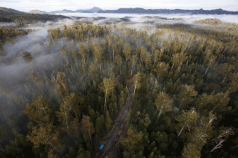

In this paper I put the case that problems about forest destruction, plantations and particularly monoculture plantations, and the search for sustainable solutions, cannot be separated from wider global problems. Wanton destruction of forests and soil fertility, and corporate power over governments and people, are not just Tasmanian issues.
We urgently need to recognize that we are part of a world now largely controlled by a few over rich and over powerful corporation chiefs. These few chiefs influence – manipulate – all too frequently eager governments and public servants to their own advantage. This manipulation, usually hidden from public view, provides substantial favors to some in high public office and disadvantages the overwhelming majority. My long held view is that focus on the accumulation of capital, into the hands of a few, needs to be replaced with a focus on equity in social and economic terms and on social and ecological sustainability.
Professor Barry Commoner, the American environmentalist who was instrumental in initiating moves to clean up the great fresh water lakes near the US Canadian border several decades ago, wrote about the effect of this form of accumulation of capital. Commoner pointed out that jobs were being eliminated, the environment was being degraded and that wealth and social power were being concentrated into ever fewer, larger corporations. Commoner suggested that this power fed on a diet of unemployment and poverty and concluded that these processes “spawned the environmental crises and the energy crises”. (1)
The English speaking world’s most celebrated economist of the 20th century makes a great deal more sense of current reality than does what we hear from most politicians and economists today. In his Presidential address to the American Economic Association on December 29th, 1972, John Kenneth Galbraith argued: “When the modern corporation acquires power over markets, power in the community, power over the state, power over belief, it is a political instrument, different in form and degree but not in kind from the state itself”. Galbraith went on to point out that to teach economics as if the power of corporations in political and cultural matters did not exist is to hide how we are actually governed. (For a clear exposition of how paper and pulp production advantages off shore controlled corporations, and the processes via which we in Tasmania are disadvantaged, see Mike Bolan “The Truth about Plantations”, Tasmanian Times, 15-06-10 HERE.)
Three to four decades ago, the response to failing Keynesian economics was to adopt economic practices designed to give private corporations more power and an even greater share of the wealth produced by the labors of working people. This approach, called variously economic rationalism, neo-liberalism or economic fundamentalism, is practised by major political parties in the ‘developed countries’ and imposed on underdeveloped countries whether they like, or want, it or not. Before commenting further on this neo-liberal approach, a much more deeply entrenched set of ideas requires recognition and rejection. These entrenched ideas have had a powerful impact on shaping world views and acceptance of the capitalist way – a way that will likely lead to our destruction as a species unless we change course.
We need to live with rather than try to conquer nature
One of Australia’s best informed and most creative thinkers and writers, Pete Hay, revealed important historical roots of the ideologies that inform current attitudes to economic issues and the natural environment. He argues that many currently accepted attitudes to economic, social and environmental issues are underpinned by the belief that: “… science and dispassionate reason can and will fuel an ever-increasing material improvement in the human estate.” (2)
Dr.Hay argues that both the political right and much of the political left base their political theories on the deeply flawed assumption that nature can be conquered and technological fixes will resolve our problems. He also argues that it is easier for the political left to jettison this assumption than it would be for the political rightwing.
I agree. The reality is that the structure of societies created and supported by the political right requires growth and ever greater exploitation of people and of natural resources to function. Capitalist markets and capital accumulation, by a few, made today’s powerful privately owned corporations possible. Capitalist markets are designed to facilitate short term profits and to increase the concentration of capital accumulation in the hands of a few rich and powerful people. Economic, social and political power of the few over the many is the inevitable consequence. Capitalism requires both growth and a reserve army of workers, the un-and under employed. The underlying driving force behind the genuine, as distinct from the pretend, left is of a very different character: the genuine left struggles for social and economic equity to enable decent conditions of life for all people.
Further, it is also clear that the approach to economic and social issues that continues to make the rich richer and the poor both poorer and more numerous is destroying scarce resources and exacerbating pollution and over-population problems. Tragically, the ‘Return of Scarcity’ pointed to by the late Nugget Coombs in his 1990 book of that title is now the grim reality for ever increasing numbers of human beings. Resource destruction and pollution are there to be seen by all but those who choose not to look. At a global level the population issue is especially complex. Ignorance, plus religious bigotry and particularly the absence of adequate, or in many instances any, social security, combine to increase family size as those in poor countries and poor economic circumstances look to families as a means of support in old age.
We have serious equity issues at home. But because of the activities of powerful global corporations vast numbers of people in so-called underdeveloped, or developing, countries are far worse off than we are. The wealth these countries are capable of producing could provide the social and economic security of which corporations based in developed countries have deprived them. Some readers, particularly those influenced by the Big Lie about ‘the white man’s burden’ and perhaps even some of us who from time to time donate to trade union, or some other form of community, aid abroad, might question my train of thought here. However the fact stands: there is extensive and highly organized plunder of developing countries by foreign governments and corporations based in the developed countries. The mechanisms for this plunder vary; see the Appendix for some examples and details
The ‘Big Fix’
We have to find a new way ahead. In a paper originally presented in Hobart in 1978, and reprinted in his 1990 book, H.C. Coombs argued that the outcomes from technological change, particularly in conditions of increasing scarcity, will include a weaker bargaining position for wage earners. He advocated government intervention to ensure that a substantial part of the unearned income extracted by proprietors “accrues to the community generally”. Coombs argued that it would not be “technically difficult” to achieve such a result. (3)
Coombs was in his life time, one of Australia’s most widely recognized and applauded public figures. Why then, given the good sense of his views, have ensuing interventions stood for the opposite to what he argued for? The answer in a nutshell: the structure of our society facilitates the capacity of the mass media and other cultural influences to twist the will and thinking of the majority of people in the direction of supporting the political, economic and social/cultural power of a few.
Equity, not guns and security fences, is the key to the search for genuine security. Striving to build a world that is no longer unfair and indecent but is peaceful and cooperative and provides genuine equal opportunity for all, along with respect for our physical environment, needs to be at the centre of our agenda. We have a long way to go but we can find a way. The stakes are high. Failure to build a fairer, more peaceful and cooperative world will cost not only many present but virtually all future citizens the opportunity we all should have for a decent lifestyle. An eminent Australian writer and creative thinker, Professor Ian Lowe, in discussing the current economic and ecological crises that we humans, whether we like to admit it or not, are now confronted with, recently wrote: “Our obsession with growth and the faith in markets are fatal flaws preventing a concerted response to environmental problems”. (4)
In his recent book, Ian Lowe summarized “the essential characteristics of a sustainable future”, including: “… a stable population and per capita consumption”; turning “resources efficiently into goods and services we need”; “… transition from fossil fuels to solar, wind and other forms of renewable energy”; “nothing is thrown away”; “protect and enhance our natural areas”; and “a more equitable society”.
Lowe advocates a more mature political system “to increase the chances that difficult decisions will be politically sustainable”. He suggests that most of these characteristics are very unlikely to be achieved by extending the traditional ways of thinking, and that they demand a re-think, a new way of looking at the world and organizing our priorities. He goes on to argue that the set of values (“individualism, consumerism and domination of nature”) “that have driven human progress over the previous century … are incompatible with the goal of a sustainable future”. Lowe also urges the need for .ecological sensitivity, an awareness of the limits of natural systems and a willingness to work within those limits. And significantly: “This sort of transition in community values may be happening now. Whether that is true or wishful thinking, it is more likely to be driven from the ground up than to come from our present leaders”. (For more detail see Ian Lowe’s “A Big Fix”)
At this point one is reminded of a comment by an eminent Canadian writer thinker with formal economic credentials, namely John Ralston Saul, in his 1995 Massey Lectures: “If economists were doctors, they would today be mired in malpractice suits”. (5)
Returning to the Tasmanian scene
One of the tragedies of our time is that politicians of the major political parties have largely failed to grasp the problems we face. It appears they are primarily influenced by the size of donations to election funds, and depend on status quo economists and the ‘Greed is Good’ affliction.
We can stop the rot and begin to change course. But as Professor Lowe says, the impetus needs to come from “the ground up” and that means from ordinary people who are informed and concerned. The minority of politicians who have grasped the reality of our situation will only grow to the extent that we develop wider public understanding of the realities we live within. In general, the corporation chiefs who currently make the important investment decisions are frequently ignorant about consequences of their decisions and are driven by and focused on what they see as the immediate bottom line.
There were, for example, several reasons why Gay had to quit as Gunns’ boss. One important reason was/is the highlighting of the fact, in the course of campaigns by ordinary people, that the pulp mill project was always, as well as being socially obnoxious, both economically and ecologically simply not viable. In his ABC promoted publicity grab called The true story of the fall of ‘Gray, Gay and Gunns’, Cousins appears as likely being either in ignorance of, or for some reason wanting to hide from, the fact that plantations to grow timber for paper pulp is a bad economic proposition and is causing social and ecological havoc.
The world market is currently over supplied with wood chips and pulp, and there are other parts of the world that can grow trees for chips and pulp both quicker and cheaper than can be done in Tasmania. This is an important part of the wisdom that guides thousands of campaigners against Gunns’ mill. Further, the ecological, social and economic issues surrounding plantations that Bob Loone, the Deputy Lord Mayor of the Meander Valley Council, has brought to public notice – plus Mike Bolan’s, above referred to, “The Truth About Plantations”, make Cousins’ highly publicized piece appear inadequate at best. The attempt to rescue wood chipping with the projected power from woodchips proposal is another looming disaster we need to avoid. (see Vica Bayley, “World Environment Day warning – Watch out for wood fired power stations” (Tasmanian Times, 06-06-10. HERE)
Yet another aspect of the pulp mill and plantations problem is the finding of Dr. Bleaney, supported by Dr. Scammell and Dr. Leaman, of toxins in water coming from areas where plantations exist. The probability, or near certainty, that toxins in the leaves of e- nitens planted in Tasmania not only kill oysters and wild life but also affect human health, places still further questions marks against monoculture plantations.
I would add to these powerful reasons to rethink monoculture plantations another emerging aspect to the entire argument that is gaining strength. Namely, that using harmful chemicals to grow timber as a source for wood pulp and even more harmful chemicals for making pulp and then paper has no future in economic let alone ecological terms. Paper was being made long before the use of harmful chemicals to make pulp from eucalypts and other timbers became a widespread practice. More recently it has been shown that paper can be made from banana tree stems with little water and no chemicals.
The whole clear felling for woodchips project is kept alive in Australia and particularly in Tasmania by massive handouts of public money and resources for projects that even so go belly up. (For some figures and other information on amounts of public money so wasted see, for example, Senator Christine Milne, Tasmanian Times 02-06-10. HERE)
An end to clear felling of both native and plantation timber and selective harvesting for building and craft use, thus preserving our forests for leatherwood and other bush honey production, is a logical way forward for Tasmania’s timber industry. Wasting public money and resources on the dinosaur circus of clear felling for wood chips has to stop. That means a radical shift to using public money to retrain workers and to help develop industries that are socially beneficial as well as being economically and ecologically sustainable. Developing new values that replace accumulation of $s by a few with concern for each other and for our natural environment is essential to the human future.
References
1. Commoner, Barry. 1977, “The Poverty of Power”, Bantam Books, New York, pp. 248-249.
2. Hay, Peter. Collected Papers 2007-08, Search Foundation, pp. 54-55, isbn 9781876300159 (pbk)
3. Coombs, H. C. 1978, “Return of Scarcity”, reprinted 1990, p. 33.
4. Lowe, Ian. 2009, “A Big Fix”, Black Inc p. 42.
5. Saul, J. R. 1997, “The Unconscious Civilisation”, Penguin Books. p 4.
Appendix
An American citizen, John Perkins, with considerable courage exposed, from the inside, the facts about how rich countries rob Governments and people in poor countries. The blurb on Perkins’ book “Confessions of an Economic Hit Man” provides a glimpse of the book: “The ‘Economic HIT MEN’ are highly paid professionals who cheat countries around the globe out of trillions of dollars. Their tools include fraudulent financial reports, rigged elections, payoffs, extortion, sex and murder. They play a game as old as Empire but one that has taken on terrifying dimensions during this time of globalization”.
Further: “John Perkins should know – he was an economic hit man for an international consulting firm that worked to convince poor countries to accept enormous development loans, and to make sure that such projects were contracted to US companies. Once these countries were saddled with huge debts, the American government would request their “pound of flesh” in favors, including access to natural resources, military cooperation and political support.”
After explaining in his Prologue (pp.xx-xx1) how economic hit men (EHM) parade themselves as Mr. nice guy and “lecture at the Harvard Business School about the miracles of macroeconomics” and how the system itself allows that the deceptions they utilize are seldom illegal, Perkins continues: “ However – and this is a very large caveat – if we fail, an even more sinister breed steps in, one we EMHs refer to as the jackals, men who trace their heritage directly to those earlier empires. The jackals are always there, lurking in the shadows. When they emerge, heads of state are overthrown or die in violent “accidents.” … When the jackals fail…, young Americans are sent in to kill and to die.” (Perkins, J. 2005, Ebury Press)
For readers not wishing to acknowledge that Perkins is actually telling it as it is, I refer you to the writing of a conservative Australian Journalist: “Armies do not need war to conquer. Right now, the most powerful army ever assembled is marching across the globe expanding an empire of greater scope and wealth than any army ever achieved by conquest. We live in an era now dominated by international corporatism, a disciplined, organised, motivated, messianic and single minded culture which is assembling enormous amounts of capital. It is largely an American phenomenon, backed, at the end of the day, by American Military power.” (Sheehan, Paul. Sydney Morning Herald, Jan. 9th, 1999)
One more source. Readers who were tuned to SBS on Tuesday, January 23rd 2007, and watched “Kidnapped by the CIA” will see Perkins’ writings as more real evidence of how it is that corporations have such power and add to the military power that supports them via the massive sums US taxpayers are conned into finding to finance CIA operations around the world. This SBS program featured claims by European Parliamentarians that the CIA had secret American prisons in Europe. This is the globalised world of which we are part. What is misnamed security results in misuse of resources both human and non human to protect the unearned income and privileges of the super rich from those whom our modern society deprives and excludes from the luxuries and, in a growing number of instances, the necessities for a decent life.