Economy
Dropped on the moon

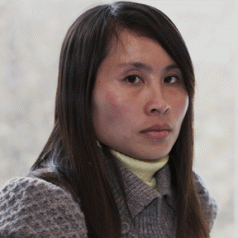

Moo Paw Wah, a recent refugee from Burma (Myanmar), is still a young woman, but the life she has lived thus far has been one that most Australians would not relate to.
When Moo was three her mother, who was still breast feeding, was jailed for one and a half years because her husband was a Karen rebel. He was also jailed by the Burmese Junta for fighting against the dictatorship.
“My father was fighting for freedom….My whole family was separated” she said. Her mother and father are still in Nu Poe, a UNHCR refugee camp in Thailand near the Thai-Burmese border where she stayed for thirteen years.
“We are given rice, chilli, oil, salt and sugar, but no meat and no vegetables…We eat bamboo shoots and wild vegetables in the rainy season, if we catch fish we will eat…if we are caught hunting we are imprisoned by the Thai authorities. Moo Paw Wah, now lives in Glenorchy Tasmania, where she says she has a “very nice neighbour, but its hard to find a job here.”
Mark a Sudanese Australian living in Hobart described life in the refugee camps in neighbouring Uganda as hard. It was difficult to get water, we all had to line up with containers and “sometimes it took so long we failed to cook.”
The camp in Kitgum district, Uganda, was attacked repeatedly by the Lords Resistance Army, a notorious militia group. “They took many people away, and we were very scared.”
Many people were forced to carry looted possessions, and refugees were killed on the spot if they admitted they were tired. “Once, five people were killed in an attack on a wedding ceremony and many people were injured.” Mark says social life here is “completely different” and very stressful. Before Good Friday his uncles car was stoned while parked inside the front yard, and rubbish bins are regularly thrown at his house, “this is the most challenging part of life here.”
Khadijeh, a 30 year old Afghan woman living in Tasmania for two years, said she has no Australian friends and has not been able to find any work for over 12 months, “even sorting cherry’s,” she said. “Sometimes I get sickness from stress because I cannot find a job [sic].” We feel like we miss something, “we feel empty here.”
The transition to living in Australian communities is often not as easy as initially expected. The recent statements by Coalition leader Tony Abbot have not made this transition any easier. Recently in a speech to the Australia Day Council in Melbourne he said, “the great prize of australian citizenship is insufficiently appreciated and given away too lightly.”
During Australia’s 2007 Federal Election the then Minister for Immigration, Kevin Andrews publicly claimed that the number of refugees from Africa would be reduced, because “Sudanese people were having trouble integrating into Australian Society.
”Evidence was not provided to prove these claims. The Department of Immigration’s October-December 2007 Community Update stated that racial attacks on African Australian’s had increased dramatically. Many racially motivated attacks followed and one Sudanese man, now a community worker living in southern Tasmania was assaulted on eight separate occasions. During September 2009, Fayia Isaiah Lahai, a Hobart taxi driver from Sierra Leone was assaulted and called a “black dog animal,” quitting his job as a result.
Al Hines, a community worker, and social activist has been assisting new arrivals for Mission Australia, Colony 47 and The Migrant Resource Centre in Hobart Tasmania for the past six years. Hines says “racism in Tasmania is worse than the mainland, and “the part people forget is that we invited them here….and we have to prepare the community to invite them in.” One new arrival described her life in Australia as like being “dropped on the moon,”and many say they would have not come if they knew it would be like this.
The issue of racism in Tasmania not only exists for new arrivals but also for international students studying at the University of Tasmania. In a press release on 11 May 2010 Acting Vice-Chancellor, David Rich said “it is distressing when any of our students are victims of violence in the community. The recent incidents involving three of our international students are disturbing.”
In 2008 the now Minister for Finance Lindsey Tanner, expressed his concern that despite formal qualifications from Australian universities, new Australian’s were not getting jobs, and were increasingly the victims of racism. Hines said a major issue for new migrants is a lack of skills recognition, and there are “doctors and lawyers driving taxis.” With most new apprenticeships requiring high levels of numeracy and literacy, many opportunities are lost. Hines says that this could be learnt in the workplace through the implementation of programs such as internships.
Christine Bennett the Coordinator of Volunteers for Centacare in Hobart said that 80 percent of Refugees are women and children, some having lived up to 18 years in refugee camps, and some having been victims of rape, and seen family members killed. Bennett explains adjusting to life in Australia is not easy because, “we are not very neighbourly, its not our nature [sic].”The communal environment that many refugees are used to living in, does not exist in Australia, and as explained by many new arrivals, lacks the openness and social inclusiveness of their former communities.
On average 400 new arrivals are settled in Tasmania every year, and while some chose to remain in Tasmania, others re-settle in areas where communities are larger offering more opportunities for employment.
Al Hines is often asked. When do I stop being a refugee? Her answer is, “the day you get here!” The use of language by media outlets and politicians regarding new arrivals, has a powerful effect on the lives of these new Australians. The recent about face of the Labour party in response to the ever present national phobia, arguably fuelled by the Coalitions “Real Action” campaign referring to asylum seekers as “illegals,” has also marginalised many existing new arrivals in the eyes of many members of the community.
The publics perception of new arrivals, whether they are asylum seekers or refugees, has a direct effect on their transition into the community. As soon as a new arrival sets foot in Australia a whole new traumatic experience begins. Sometimes separation from family members, a new language, new culture, new systems and sometimes financial hardship. New arrivals need more than social and economic support from agencies, what they need is acceptance, understanding and most of all friendship.
Steve is a BA student at UTAS and recently completed a Journalism unit.