Economy
Water policy, reality and the future


Issues related to water are fundamental to formulation of practical health, forest, farm, industry and urban policy. Thinking and reality about water is underdone globally and Australia is no exception. Tasmania is very low on the intelligence list but does not need to be.
In my three recent contributions to Tasmanian Times ( HERE ) I expressed some distress at the direction and assumptions of recent government policy which will lead inevitably to land loss, much environmental damage, social disruption,as well as economic failure and bankruptcies, and I implied that the necessary data exists whereby risk can be reduced. and policy led and framed.
Much of this information is in government hands (because I placed it there directly – incl hands of prev. minister Llewellyn) and also in the public domain (various web sites and publications). So, why is it not used, nor replicated (easy to do), nor even noted in the very few water management plans so far prepared ( a crime in itself)? Do these data expose too much ignorance or stupidity? I did not realise the nature of the tiger of reality for some time either.
My self-funded catchment research program which had evolved from my early work on the Coal River at Mines Dept between 1966-1972 began exposing some, to me as well as others, unexpected results in 1995. These included the effect of land use and forest changes, groundwater storage, gross climate changes, and implications for management. The factors are related.
A reduction in rainfall was shown to lead to losses in stream flow, groundwater storage greater than expected. The factor varied from catchment to catchment (1x ro 6x). Then, In sw WA it was noted that a 10% reduction in rainfall led to a 40+% reduction in availability and flow to storages. Similar exchanges occur in the Murray-Darling system. The new data were bang in the middle of my range. I reviewed my data.
The first publication of estimates were placed, without comment, in my book “Water” (2nd edit) in 2005. The third (and current) edition from 2007 draws stronger conclusions. and the addendum I now add is even clearer. That addendum is reproduced below.
WATER – ADDENDA (at Jun 2008)
Science of forest allocations
The book claims this can be done (see pages 126, 167) although the industry in several states suggests otherwise. Zero allocation is not, however, a realistic option: water is used in the active growth phase, whether after planting or after fire. This water is in excess of previous demand levels.
South Australia, in the limestone coast region, now sets about 1.8 ML/ha/yr as the allocation usage rate (rainfall zone ~700 mm) for both pines and eucalypts. This enables plantation operators and irrigators to be treated equally in terms of catchment water usage and balances, irrespective of whether water is paid for. References: Comaum-Caroline Prescribed Wells Area Water Allocation Plan. (adopted June 2001). SE Catchment Water Management Board, S. Aus. Review of groundwater resource conditions and management principles for the Tertiary Limestone Aquifer in the south east of South Australia. Dept. Water, Land, and Biodiversity Conservation, report 2006/02. Ministerial Statement, July 2007 (regulation of allocation).
The Penola pulp mill proposal, as presented in 2006-7, intends to use all of the available allocation for water from the deep, confined aquifer even though the exact requirements of the mill are not known. The design allows no scope for error. Review of the wood resource suggests, however, that the mill should only be about 70% of the design size to remain within the allocation limits – assuming all else is well known. This is a case where the water resource, treated conservatively, should guide what happens or what is possible. Instead, the South Australian government in mid 2007, allowed legislation to pass which provides for a doubling of the capacity of the original mill design. This is madness and must lead to over-allocation of a resource already stressed.
Industrial wood production research (e.g., CRC for Sustainable Plantation Forestry at Univ. Tasmania) indicates that the cloned eucalypts used can yield up to 3.5 g/L. Other literature offers values from as low as 0.5 g/L. These figures allow some interesting calculations.
It is claimed (Farm Forestry Toolbox) that in Tasmania in rainfall zones of 1200 mm that up to 38 tonnes can be produced per hectare per year of coupe life (12-15 years). This production requires at least 11.4 ML/ha/yr and the rainfall provides 12 ML. This seems good but note the assumptions of best possible production and the omission of losses from the water cycle (run off, infiltration, evaporation) which may account for up to 6 ML in such areas. Thus the trees (approx 1000 stems per hectare) take water from surrounding areas or groundwater. If this supply cannot be maintained to support the rapid growth of these special trees then growth stops. Perhaps this is why the historic production rate in Tasmania has averaged about 15 tonnes/ha/yr. Are tree farmers being misled? Large companies have already noted that their estimates are too great by at least 25%.
Hydrological reality needs to be inserted into the forest industry and rose-tinted investment schemes.
Need for comprehensive management
The Clyde River in central Tasmania is fed from two highland lakes (Sorell and Crescent). The entire catchment has been “managed” for more than a century, mainly to supply the town of Bothwell and (flood!!) irrigators near the town. This area is one of the driest in Tasmania and some farm practices are folly, needing complete rethinking. Carp were found in the lakes in the 1990s and schemes to remove them totally upset any water controls. The carp also cleared vegetation and the lakes are now silty and not attractive trout fishing propositions. In 2006 the State began to manage the catchment, separated the lakes from the river system, allowed a different agency (Inland Fisheries) to manage the lakes, and by 2007 (with the help of climate effects), there was chaos still not resolved. The “law” had to be broken in order to release water from the lakes, for the town. Forget the farmers who, frankly, should be forgotten since flood irrigation in this area is wasteful stupidity.
Similar problems exist in the Murray-Darling system; inefficient irrigation, inappropriate usage, over allocation and multiple jurisdictional mismanagement. The need is for integration and overview with all stages in balance with both historic patterns and the new climate reality.
The multiplier effect of rainfall change shown in Figure 15 is minor compared to that operational in the catchments of SW Western Australia where a 10% reduction in rainfall can mean a loss in yield from the catchment of 45%. The many catchments of eastern Tasmania (see pages 120-121) present different factors, ranging from 1:1 to 9:1. Each situation must be assessed independently (see also my paper, Leaman, 2008, below).
The City of Clarence water scheme (page 88) was awarded a prize for Local Government excellence in May, 2007. It was stated that the recycling of 2700 ML to 100 farmers was “diverting” 11 t of nitrogen and 3 t of phosphorus from the River Derwent (where it might not have mattered, to the Coal River where it most assuredly will).
Other problems in thinking are exposed by the concept in northern Tasmania of diverting water from the tailrace of the Poatina power station southward to the dry northern and central midlands of Tasmania. This water currently joins the Cressy-Longford irrigation scheme and, perhaps, on to Lake Trevallyn for power generation, water supply to part of Launceston, or diversion to the now-approved pulp mill. What happens if much of this water is diverted to the south? Note that in 2006-7 the South Esk river flows at Perth and Trevallyn could not have been sustained without the contribution from the tailrace which is itself a diversion from the Ouse River on the central plateau via Great Lake and its power schemes. All this overlooks another reality; that nearly all the water generation in the South Esk catchment (and the Meander its principal tributary) is now being reduced by large scale plantation forestry in the upper catchments. None of these interlocks seems to be considered. But, there is worse. Send this water south and you re-activate the salt province (back cover). Never was comprehensive management more needed.
Dams and flood plains
The issues related to dams has been examined further in two recent books; Deep Water, Jacques Leslie, Picador, 2006, and When the rivers run dry, Fred Pearce, Eden project, 2006. There are many social, political, economic issues – as well as environmental considerations.
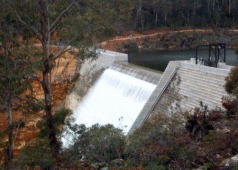
The reality of these problems may be tied to the policy idiocy of the Tasmanian government when developing concepts for large scale diversions and translocations (also dealt with in the book). The dams proposed are in-stream and large with shallow wasteful storages (high evaporation). One such scheme, now completed on the Meander River in late 2007, is to “guarantee” a flow in the river and feed local irrigators. Nothing is said about those who, downstream, had prior rights or allocations, now that less water can reach them (climate effects, forestry operations, losses from storage, diversions to others, and guaranteed ‘environmental’ flows).
Flood plain issues have been given public attention due to the experiments of Peter Andrews and his report of them in “Back from the brink” published in 2006. The issues of flood plains, retention of wet lands and marshes, are considered in various sections and he points out how much this works to increase productivity and provide drought-proofing. Criticisms, such as those on page 32 and in Section 3.2, indicate the issues related with current practices and the need to slow flow, not necessarily reduce it.
Formulation of issues and data required for initial management plans
Leaman, D. E., 2008. Comparative Assessment of Catchments in Eastern Tasmania – issues for Management. WATER DOWN UNDER 2008. Proceedings 4th International Conference on Water Resources and Environment Research, Adelaide, April. Pages 542-554. Engineers Australia.
Between 2003 and 2005 I realised that management plans needed more than climate change trends if security of supply and appropriate allocations were to be estimated and offered to users – and explained to them as well. The oral presentation of April 2008 (cited above) carried refined analysis. This paper has been circulated and was reviewed and accepted by Aust. Inst engineers. It is available on the web. Many employees of, then DPIWE, were present at the conference and attended the presentation. To ensure it was not ignored I advised all MHAs and MLCs of the paper and provided full digital copies to those interested. Minister Llewellyn got a copy but did not ask for it.
I recently updated much of this in three reports dealing with irrigation proposals which amount to cloud-cuckoo land in the absence of this basic information. These are on the web as pdf files. Dated July 2009. (Anglers Alliance Tas, Tas Greens, etc).
LESSONS FROM THE COAL RIVER ( a study in reality and requirements, July 2009)
NORTH EAST DAMS (Hydrological comments NE Tas, Dam proposals July 2009)
MIDLANDS WATER SCHEMES
(Irrigation proposals, Midlands Tasmania – rev. April 2010)
The derivation of principles and data in the three irrigation reports marks a direct linear evolution to answer the question I was trained to examine as posed in 1966: “how much water (in the Coal system) can we safely use?” From that time when knowing was important Other questions to today when ignorance seems prized is a poor trend.
Other questions which should be asked are:
Why do we include no entry in the management budget for forest land use change and plantations- broad scale or local private -? Zero is never a valid number. Such inclusion is NOT an anti-forestry matter; it is recognition of reality and then an ability to allocate fairly and safely. A usage range is available for many catchments and a fair estimate can be made for others. End of excuses, please. If S Aus can do this, so can we. Better, in fact, for many catchments.
Groundwater extraction is another factor. There remains no official pretence to knowing this, nor is there any estimate (zero again, is not a valid value).
Climate effects are becoming fashionable (they were denied to me as recently as 2004) but too many schemes still ignore this factor when even a gross estimate could be made (with refined estimates possible in many situations).
Why? Because we do not take water issues seriously. Water is our future and the control on productivity and health.
We must stop misleading users. We want and need to do many things, including forest working, productivity upgrades but the best way to do this and form valid policy is to live within the bounds of reality – what we have or can expect- and not delusion.
D E Leaman, Hobart