Economy
Bartlett’s Good Idea

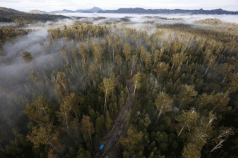

David Bartlett thinks he has had a good idea and wants to get on with it before it goes cold.
Mr Bartlett should realise that almost forty years of conflict won’t be sorted out over the weekend.
A durable process must be carefully designed and enacted into law.
It’s unfortunate that Mr Bartlett ascribes to the view that the conflict over forestry is a two-sided debate between the forestry industry and conservationists.
Nothing could be further from the truth.
It’s not difficult to see that forestry affects almost every aspect of life in Tasmania. If you drink water from a tap in Tasmania you could well ingest forestry chemicals. When you breathe you may inhale toxic wood smoke.
Driving on Tasmania’s roads can be a hazardous exercise with huge log trucks taking more than their share of the bends or failing to stop at cross-roads, even red lights.
If you go to school you may be subject to forestry propaganda and if you come for a visit you could be deeply shocked and disappointed at the scars forestry has left on what was once one of the world’s best landscapes.
If you are thinking about starting a new business venture here you might sit back and wonder why you’d put your resources into a state that is caught in the clutches of an all-pervading conflict that after thirty seven years only gets worse.
Reshaping the Tasmanian forestry industry into something socially and environmentally acceptable must involve the whole community. The vital first step towards a successful ‘roundtable’ is inclusion. Inclusion is far more meaningful than representation.
The next step is to identify the many problems around the forestry industry – if you don’t know what’s wrong you can’t fix it.
Having made an assessment of the problems it would be unproductive to dwell on them. Instead everyone should focus on solutions. Indeed it would be inappropriate to come to the negotiating table without solutions. That said some solutions could well evolve during the process.
For industry to have the social licence it wants for its operations all the problems must be identified, examined and rectified to the satisfaction of all Tasmanians.
There can be no doubt that the forestry industry in Tasmania won’t ever be the same but if Mr Bartlett’s good idea is to prove effective it must develop beyond the initial spark into an inclusive, transparent, objective, comprehensive, unbiased, logical, solution-based process that takes as long as it needs. Both the process and its outcomes will require adequate funding.
This approach has the potential to provide a durable result. Without resolution forestry would continue to be the thorn in the side of Tasmanian life to the detriment of the community, and as we can clearly see today, also to the detriment of the industry.