Economy
Asbestos silence

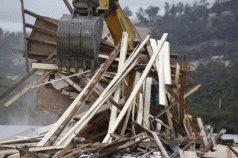

On February 26, 2009, in a dawn raid, the Huon Valley Council staged a lightning demolition of Franklin’s iconic mid-20th century football clubrooms Recorded on TT: Death in the Morning, HERE. By knock-off time that afternoon, this historic building was no more; the site on which it had stood was smooth and gravelled; and the tangled debris, its dust blowing in the wind, had been trucked away.
Considering the building was constructed in the late 1940s and early 1950s, any damned fool should have guessed there was asbestos somewhere in the structure. Did the council realise that it was highly likely that asbestos was present? Did management and the councillors who had voted for its destruction even care? These are questions concerned valley residents are still asking.
On December 7, 2009, the council made a guarded admission that asbestos was present at the demolition site in a media release that read, inter alia:
. . . Council has taken steps to allay community concerns over suggestions of an asbestos contamination at the site of the former football clubrooms at the Franklin Oval.
Following the discovery of a number of small fragments, thought to be asbestos, the council commissioned a health and safety consultant to conduct an evaluation and risk assessment of the site . . .
The consultant’s report states that:
1. . . . the risk to the public’s health is very low, due to very small concentrations of AC fragments on the surface. In addition, the asbestos fibres are fixed in a matrix of cement and are not airborne.
2. The concentration . . . is virtually negligible . . . likelihood of exposure is correspondingly low.
3. The health effects of airborne asbestos have been well documented . . . including:
— the risk of acquiring each type of disease is dose related, ie the higher the concentration of dust and the longer the exposure the greater the chance of developing an asbestos related disease.
. . . The report goes on to state that the background concentration of airborne asbestos fibre in the Main Street of Huonville would be higher than at the Franklin site.
The report recommends . . . control measure should be implemented . . .
. . . council has requested the consultant develop a management plan for the site which will determine the appropriate control measures . . .
To further allay any concerns . . . copies of the consultant’s report are being made available to both the Franklin Township Development Committee and the Franklin Progress Association.
The council has since been silent on the subject.
What is apparent is that the council’s brief to the consultant was only to test the demolition site for asbestos — and, it seems, there was evidence of pollution.
What the council did not do — if the December 7, 2009, media release told the full story — was to ask the consultant to examine the final resting place of the clubrooms debris. And what the council still has not explained is why it chose to fly in the face of all laws and regulations and bulldoze a structure that, because of its age, almost certainly contained asbestos.
It is understood that one council official told someone that post-destruction drill tests were conducted on the spot where the clubrooms once stood and that nothing had been found; it is also understood that another informed source has since said that no tests were conducted on the site. Who is to be believed?
No one I have talked to knows where the clubrooms debris went. Before the demolition, council said it would allow the building’s useable materials to be methodically extracted and put to good use. In the end, however — apart from a bit of outer cladding, the front-deck materials and a few souvenirs from the interior — the whole lot went holus-bolus (as graphically illustrated by local photographer Mike Peters’ spectacular images) to undisclosed places.
Now, more than a year later, council is still saying nothing about where the building debris went or why it acted in the way it did. If there was asbestos blowing off the cart-away trucks, there is no chance of knowing into whose lungs it might have gone. Certainly a lot of people dropped by to witness the cultural carnage and, of course, there were the workers who carried out council’s instructions.
If there was a possibility of asbestos in the building, why were not all the myriad regulations that have been imposed on the handling of this killer substance followed to the letter by council. Surely they were not ignored? Or, fearing rising local resistance to the clubrooms being demolished, was it a case of a council being panicked into precipitate action?
If asbestos regulations were not followed, logically there should be an investigation of the circumstances of an act of environmental vandalism that resulted in the demolition of a building that was a great and potentially highly valuable asset in the historic township of Franklin.
— Bob Hawkins is a Huon Valley ratepayer and an advocate for transparency in all democratic institutions. He is not a member of any political organisation.