Cartoons
Labor’s hatred of the Greens


Extract:
… Both know that, for decades now, a deep distrust of the Greens has festered away in some of the Labor Party’s darkest corners.
Some of the distrust can be traced back to the usual forest industry figures and the deeply divisive forestry debate. There will always be the segments of Labor inextricably linked to forestry interests who regard the Greens as impediments to the continuation and long-term survival of the Tasmanian logging industry.
Think Forestry Tasmania’s chief executive Bob Gordon, former Labor politician and now chairman of the Forest Industries Association of Tasmania, Julian Amos, Forestry Tasmania spin chief and former Labor media director Ken Jeffries, or Timber Communities Australia’s Barry Chipman.
This group wants the current Labor Government to have nothing to do with the Greens if for no other reason that they don’t believe anything good can ever come of it.
Interestingly, some might have once put former Labor premier Paul Lennon in this same camp, until he was one of the first to advise Mr Bartlett as the election results came in, to start talking to the Greens and thinking about Green ministers.
But there are also the Labor figures who hate the Greens for other reasons.
Some trace their enmity back to the June 1989 accord between minority Labor premier Michael Field and five Greens independent members, led by then state MP Bob Brown.
Mr Field, a mentor of Mr Bartlett’s whose brother Terry is the Premier’s chief-of-staff and political adviser, maintains to this day that he made the worst mistake of his life when he agreed to govern in minority in 1989 with the support of the Greens independents.
Without doubt Mr Field has been advising Mr Bartlett not to make the same mistake, to turn his back on governing together with the treacherous Greens.
Mr Aird was part of that short-term 30-month Labor-Green government, which is where his mistrust of the Greens has its roots.
So too was Labor Speaker Michael Polley (the 1989-92 accord government was the first time he took the Speaker’s chair) and there is little doubt his dislike of the Greens is just as great as Mr Aird’s.
Editor: There is much mythology surrounding the end of the Labor-Green Accord of 1989, with perhaps the dominant paradigm that of then Premier Michael Field being the injured party … with the Greens intransigently ending it. Informed readers may like to contribute to the revelation of a truth about this historic accord, both its achievements, and its failures, and why it so acrimoniously ended …
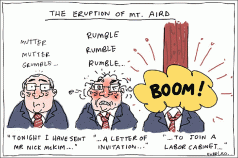
Kudelka’s Eruption of Mt Aird, first published in Mercury, Saturday Arpil 17, and: HERE on TT
Friday night’s Stateline included penetrating insight from one-time Labor adviser, Pete Hay. Here’s the transcript, from HERE
Tough path for minority government
Source: Stateline Tasmania
Published: Friday, April 16, 2010 9:45 AEST
Despite all the talk of trust, there have been two Governments involving the Greens in the past 20 years which both ended in tears.
AIRLIE WARD, PRESENTER: It would be an Australian first, a government which includes a member of the Greens. Premier David Bartlett and Greens leader Nick McKim have been deeply ensconced in talks for much of this week. It will take a massive dose of good will to make it work. Despite all the talk of trust there have been two governments involving the Greens in the past 20 years which both ended in tears. Here’s some background to how today’s events unfolded and some words of caution from those who have been there before.
DAVID BARTLETT, PREMIER: The backroom deal with the Greens is a deal with the devil.
AIRLIE WARD: What a difference a couple of weeks makes.
DAVID BARTLETT: The PLP yesterday asked the leadership team, Lara and myself, to explore opportunities, capacity and potential for the first time in Tasmania to have Ministers appointed, potentially members of Cabinet appointed, that who are not within the Parliamentary Labor party.
AIRLIE WARD: The governor, Peter Underwood, last week told David Bartlett he was obliged to form government and test its strength in Parliament. In a bid to shore up his government, Mr Bartlett extended an invitation to Greens leader Nick McKim, for a friendly bike ride and chat last Saturday.
With just a mini Cabinet sworn in to fulfil constitutional obligations, David Bartlett has this week spent many hours deep in talks with Greens leader Nick McKim, thrashing out how or if Green Ministers could form part of his government
NICK MCKIM, GREENS LEADER: Discussions are still ongoing about the model but significant progress is being made.
DAVID BARTLETT: I am coming to the conclusion after a week of or a few days of very useful discussions that we can reach a model that would certainly satisfy me that a Cabinet that contains members outside of the PLP is possible, is workable, could be stable.
AIRLIE WARD: Despite insisting he has unanimous support of the PLP, Mr Bartlett’s up against some private and not so private resistance from within.
LABOR POLITICIAN: Look I’ll be supporting Labor Ministers at this stage.
MICHAEL AIRD, TREASURER: I will not be serving in any government that has Nick McKim or Kim Booth or any other Green in it.
AIRLIE WARD: Mr Bartlett says the move is about having the best available talent in government.
DAVID BARTLETT: There will be no deal with the Greens.
There will be no backroom deals with any political party.
AIRLIE WARD: The leaders are working on a document but were reticent to label it.
NICK MCKIM: We are not working on anything that could be described as an agreement or a charter or an accord or anything like that.
AIRLIE WARD: This week’s talks have been far away from the prying eyes of the media. This morning was the first time since announcing his intentions on Tuesday that Mr Bartlett spoke on the negotiations.
DAVID BARTLETT: I believe because of the discussions and the foundations we’ve built that we can run a stable Parliament here. I’ve reached a conclusion that, with goodwill, with trust, with the right motivations, we can make this work for Tasmanians.
AIRLIE WARD: If David Bartlett recruits and they agree one or two Greens into the ministry, does that amount to a deal?
PETER HAY, UNIVERSITY OF TASMANIA: I think that’s a deal. Whether there’s a written document or not, that’s something like the accord. That is something like a Coalition.
AIRLIE WARD: Isn’t it even bigger than an accord?
PETER HAY: Yes, it is.
AIRLIE WARD: Because in the accord they weren’t members of Cabinet.
PETER HAY: No it’s more like a formal Coalition.
AIRLIE WARD: Academic Peter Hay was seconded from the University of Tasmania to be the senior private secretary to the Environment Minister during the Labor Green accord of 1989.
PETER HAY: The problem for the accord from day one was that powerful sections of the community regarded it as illegitimate. And so it had a legitimacy crisis.
AIRLIE WARD: What similarities or differences then would you draw between then and now?
PETER HAY: The legitimacy problems exist here as well. And it exists because of the idiotic commitments that the leaders of the two major parties made in the course of the election campaign. It is simply the case that we are now going to get minority government as the rule, not the exception.
And it is time the parties said there is no point in trying to scare the pants off the electorate with minority government bogey men because by doing so they paint themselves into a corner from which they can’t extract themselves under the circumstances that we find ourselves in now without confronting a crisis of legitimacy.
AIRLIE WARD: David Bartlett’s been exploring the South Australian and Western Australian models of minority Government.
PETER KENNEDY, POLITICAL REPORTER: After the last election, neither major party had the majority and the Nationals were the king makers. They were saying that they were prepared to work with either side, the side that would offer the best deal for country WA. They had talks with Labor. They had talks with the Liberal. Their traditional allies and traditional Coalition partners and in the end they decided to throw their lot in with the Liberals. Not in a traditional Coalition but in an alliance. And the alliance, according to the Nationals, gives them the right to disagree with some decisions that the Liberals might want to make. So there have been some areas of difference but generally speaking in the last 18 months they’ve got along pretty well.
AIRLIE WARD: West Australian political reporter Peter Kennedy says it’s been a boon for the Nationals who have seen their membership swell.
PETER KENNEDY: One of the great things as far as the Nationals are concerned it’s their Royalties for Regions program, which is pouring hundreds of millions of dollars of royalties from the State’s mining revenue into regional Western Australia for the first time, they say that’s where the wealth is being created. So that makes the Nationals pretty popular in the regions.
AIRLIE WARD: But it is not a formal Coalition like the Federal Liberal and National Parties.
PETER KENNEDY: If they’re decisions the Liberals want to pursue in the Cabinet that the Nationals want to disagree with, the National will withdraw from the Cabinet. The Nationals Ministers will pull out.
AIRLIE WARD: Some commentators say not too much should be drawn from the West Australian experience.
HAYDON MANNING, FLINDERS UNIVERSITY: The Nats and Libs in the west share really a common philosophy. Here in the case of Tasmania, the differences between Labor and the Greens are much more marked in a value or philosophical sense.
AIRLIE WARD: Associate Professor in the school of politics at Flinders University Haydon Manning says there’s not much similarity with South Australia either which has Independents in the Rann Government.
HAYDON MANNING: The key difference is Independents do not have a party room to answer to. They can basically call the shots as they wish. And in the case of the Rann Government the two Independents in the Ministry could walk out of the Cabinet room if it was an issue that was prickly for them. But they only had to walk down the corridor they didn’t have to go to a party room. In Tasmania, one or a number of Greens who may join this Labor ministry will face a party room and indeed a broader party membership. And that’s a much trickier proposition.
AIRLIE WARD: So if the Independents in the Rann Government were not tied to Cabinet’s solidarity, would the Greens be in Tasmania?
PETER HAY: If the Greens take ministries it is very difficult to see how they can go into this arrangement without that narrow Westminster notion of Cabinet solidarity applying. And that has important implications for the internal dynamics in the Green party because that won’t be well understood within the rank and file of the Greens.
AIRLIE WARD: Peter Hay says during the accord the Labor Party took a very narrow, conventional view of Cabinet solidarity and says that would have to change.
PETER HAY: If this arrangement that we’re about to enter into is going to work, then the Labor Party has to be much more careful about who it appoints to positions of staff, positions that are never going to see much scrutiny from the media because they are not elected positions. But the people who are appointed need to be people with good will towards this sort of arrangement.
AIRLIE WARD: He says that was one of the key failings of the accord.
PETER HAY: Most of the destablisation of the accord came from the Labor Party side on which I was.
We routinely played don’t be honest with the Greens tricks. We had meetings; staff had meetings that were presided over by the head of the Premier’s office in which we were told to do this. There were people on the Greens side who similarly had little faith in the Labor Party and allowed that to colour how they acted and I was myself on the receiving end of a couple of Green dirty tricks so it did cut both ways. But overwhelmingly the destabilisation of personal relationships in the accord came from the Labor Party.
AIRLIE WARD: The structure of the accord document itself also doomed it to failure because it was centred on policies.
PETER HAY: It crucially didn’t have any mechanism for adjudicating for mediating disputes as they arose on a day to day basis. What I hope Mr McKim and Mr Bartlett are talking about is how do we resolve conflict, not what is our policy program going to be. Time enough after it’s all set in place to talk about policy matters what is really needed now are mechanisms for negotiating a way through the minefield of misunderstanding and difficulty and personality clash and all the things that can bring this undone.
*Dr Pete Hay, BA(Hons) PhD, is Honorary Research Associate, School of Geography and Environmental Studies, UTAS
Meanwhile Dr Kate Crowley at UTAS has published extensively on the subject: Download HERE