

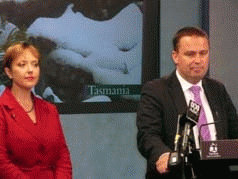
At a media conference unveiling his new Cabinet today, Labor Premier David Bartlett pledged that there would not be one ‘iota’ of change to forestry policy by his minority government.
Even though the forestry industry is in economic freefall — Gunns pulp mill remains stalled and the company is in turmoil, Forest Enterprises Australia in administration, Japanese markets are shunning Tasmanian woodchips, and Paperlinx’s pulp mill at Burnie slated for closure — Bartlett signalled that he remained committed to the same pro-forestry policies he championed in the election campaign.
Bartlett vowed that he would personally be working “very closely” with the forest industry and the newly appointed Minister for Resources, Bryan Green, to “ensure viability, sustainably and job creation in the forest industry.”
While pledging that the new ministry represented a “new era for Tasmanian politics” Bartlet made it clear that McKim and the Greens will have little influence in shaping policy on the forestry industry. “I don’t think having Greens inside the Cabinet changes our forest policy or my goals for the forest industry one iota,” he bluntly stated.
Asked why — given that in the election campaign he had pledged support for wood-fired power stations, an early extension of the RFA and the pulp mill — he would fare any better than Michael Field’s minority government, Bartlett emphasised that unlike Field he had made no policy commitments at all to the Greens. “The last Labor minority government of course had an accord in place that detailed things right down to tonnage of woodchips that could be exported. We don’t have any such agreement in place and we won’t be moving to have any such agreement in place. I believe that the Labor-Green accord was a mistake,” Bartlett said.
The Labor Green accord committed the Labor government to implement key forest policies including placing a moratorium on the logging of high conservation value forests while identifying alternatives, capping woodchip exports, scrapping the proposed Huon Forest Products woodchip mill and declaring the Douglas-Apsley National Park.
Asked a second time why his minority government wouldn’t fall over forestry, Bartlett stressed that his emphasis was on having a good working relationship with McKim. “The reason why I think this minority government has a better chance of working than those in the past is that this one has learned from the mistakes of the past. Secondly, … the crux of this arrangement will be the relationship between me and Nick McKim …that relationship and the trust we build and our ability to sustain that trust is at the … heart of making this work. As I have said before, I’m not Michael Field, as much as I admire the man, Nick McKim is not Bob Brown and that is why at the heart of it that is why this will work,” he said.
While Bartlett was keen to claim that “a strong theme” of his new ministry would be “sustainability” he also made it clear that McKim’s ministerial role would be to focus on relatively peripheral environmental policy issues away from the key economic portfolios. Bartlett described the sort of issues McKim would cover as Minister for Alternative Transport and Sustainable Energy would be “everything from cycleways, through to improved public transport through to innovative ideas that we can deliver, alternative fuels, alternative transport solutions for Tasmanians.”
While McKim will have his hands full with five portfolios spanning everything from prisons to alternative energy, forestry policy remains firmly in the hands of Labor’s traditionalists.










