Adventure and Wilderness
The Icelandic volcano overdue to erupt … A close encounter


This is the story of a close encounter with the Icelandic volcano, Katla. Katla’s much smaller near neighbour to the west, Eyjafjallajokull, has just erupted sending an ash cloud over much of Europe. Some vulcanologists believe there is a link between the two volcanoes. It makes sense that the behaviour of one volcano might influence the behaviour of its near neighbour. An eruption of Katla would dwarf the current Eyjafjallajokull eruption. The name Katla means ‘cauldron’ and the volcano has a fearsome reputation in Iceland.
What follows is a modified and condensed extract from the book, Hollow Lands and Hilly Lands by Robert McMahon, published in 2002.
Susie and I walked south from the volcanic zone of Landmannalaugar and came finally within sight of the southern coast of Iceland after crossing a pass, open for only six weeks in the year, between the ice caps of Eyjafjallajokull and Myrdalsjokull. A storm delayed our descent for two days. Had we known the maelstrom only swirled around the ice-caps, while lower down the mountain the storm was far less ferocious, we would surely have made our escape sooner than we did.
Once we had descended to Skogar near the coast we headed east to Vik and further east to the black sand beach beyond the town, where we collected driftwood and made a fire.
For six days I tended the driftwood fire, standing astride it for hours at a time, reading tattered books in English picked up at odd spots around the country. Summer was drawing to a close and for a couple of hours either side of midnight, the white light of summer in the high latitudes faded to near dark, which made the restless howling of the sea birds an even more lonesome sound. Why did we stay so long? Warmth. As simple as that. We couldn’t drag ourselves away from the fire.
It was a cold, sunny day when we left, walking in the early morning past some farmland tucked in hard against the bird cliffs that formed a long escarpment north of the road. We came to the edge of the Myrdalsandur, an absolutely flat black sand plain across which flowed the tempestuous sludge rivers from the Myrdalsjokull ice-cap. A powerful stench of sulphurous gas assailed us as we crossed the bridge over the grey mud torrent of the Mulakvisl River. The ingredients of the river were sourced from glacier and volcano. The glacier in question, Myrdalsjokull (‘jokull’ means glacier), which we had slowly circled for a couple of weeks, was a sinister white hump near at hand, a malefic Moby Dick of an ice-cap up to 1000m thick covering Katla, the volcano in question.
To the southeast was the long green mesa shaped hill of Hjorleifshofdi, lying like a ship at anchor on the black sea of the sandur. The sea itself lay a couple of kilometres south of it. The shoreline of southern Iceland has been extended successively further south by sediment deposited during floods after eruptions of Katla under the ice-cap. Hjorleifshofdi must in the recent geological past have been an island, but whether in historical times or not I do not know.
We stood on the edge of the ‘desert’ not wanting to commit ourselves to walking across it because we might well have been committing ourselves to a very hungry trek. The only town of any note across the sandur was Hofn, and that was several hundred kilometres away. We tried hitching and spent most of the day crouched behind a windbreak of our backpacks. There were no cars.
Several hundred metres south of the road a stream erupted from the base of a sand bank and flowed through a miniature Grand Canyon about 15 metres deep, gathering tributaries as it went. There seemed to be an area of moss or grass beside the stream and we made for it intending to pitch our tent. I walked in front and Susie followed about 10 metres behind.
It wasn’t a cry of alarm. More like a squeak really. I turned around. There wasn’t much of Susie visible. The ground had opened up beneath her and only her backpack had prevented her from being swallowed by the sandur, sucked into a stream beneath the earth. Iceland the hollow land.
We evaded the sandur above where we estimated the stream flowed and by a circuitous route made the bank of the stream where it exited the sand. We pitched the tent on firm mossy ground.
Late in the afternoon we struck out across the sandur towards the ‘island’ of Hjorleifshofdi. It was difficult visually to estimate the distance because of the featurelessness of the sandur and because the clear air negated perspective. The green of Hjorleifshofdi maintained its intensity at a distance. There was little distance fade to blue and grey. Nearly an hour of fast walking brought us to the base of the ‘island’. The wind was blowing strongly from the west, a tail wind, but in a most bizarre fashion a black wall of rain advanced from the opposite direction, stalking across the sandur from the east attended by twisters, fearsome black columnar spouts connecting the clouds to the ground. The universe seemed to be a metaphysical hoax like in Poe’s Narrative of Arthur Gordon Pym of Nantucket.
A stream of clear water cascaded down the green slopes of Hjorleifshofdi. Near where it disappeared into the sand we found an excellent grassy bank on which to make our camp the next day. Hoping to beat the advancing rain we raced back across the sandur to our tent pitched on a mossy bank in the miniature Grand Canyon. We had not taken our umbrellas and got soaked by the squall that shadowed us all the way. Poe could not have done better than to invent just such a malefic cloud which matched its progress to our walking pace, obscuring the hills extending west towards Vik, obscuring the ice dome of Myrdalsjokull to the north. We walked across blackness into blackness, following our outgoing footsteps. There was no other way, without a compass, to know where we were going in that bizarre inversion of a whiteout.
As soon as we arrived at our tent, the squall, its errand of harassment concluded, wandered out over the sea. The setting sun tinted the edges of Myrdalsjokull a cold yellow. Grey and white clouds hovered over the ice dome. The sight was chilling, a part of the world inimical to human existence.
Then I did a silly thing. Idly flicking through the Lonely Planet Guide to Iceland by Deanna Swaney, I read this:
“The insidious volcano Katla (‘cauldron’) snoozing beneath Myrdalsjokull just above the glacier spur Hofdabrekkajokull, is among the most destructive volcanoes in Iceland. When Katla boils over as it has done 16 times since Settlement (874), it melts enough of the glacier above it to send devastating walls of water, sand and tephra to wash away everything in their paths. In fact the liquid output of a Katla eruption is five times that at the mouth of the Amazon – up to 70,000 cubic metres per second.
“The first recorded eruption was in 894 and the mountain has exploded on an average once every 70 years since. The last recorded eruption was in 1918 and another one is expected during this century.” (This was written in the 20th Century)
And where were we camped? Right in the path of the jokulhlaulp, the flood that emanates from the ice-cap when Katla erupts. If Katla had behaved according to the law of averages it should have erupted in 1988. It was now 1992, four years overdue. That snatch of mathematics murdered sleep. It was not until later that I learned that in the opinion of vulcanologists, the 1973 eruption on Heimaey in the Westman Islands, about 65 kilometres south-west of Katla, released pressure on Katla and may have effectively delayed its inevitable eruption.
I suppose we must have slept, despite the fear of imminent engulfment, because in the early hours of the morning we were awoken by the suffocating stink of hydrogen sulphide. A cloud of it, heavier than air, had flowed into our ravine. A sure sign of volcanic activity was the increase in water and gas flow from beneath the ice-cap. Having lived all our lives in a stable and ancient land, the insecurity of the Icelandic landscape of cataclysm had us seriously spooked.
We wondered whether to pack up and head for Hjorleifshofdi to escape the gas and possibility of flood. The night was strangely warm and uncharacteristically still. Then a breeze agitated the tent and after awhile the gas dispersed. We slept then, postponing our escape to the high ground of Hjorleifshofdi until morning.
The tephra plain, or sandur, is as flat as the sea and the line of demarcation between the two is sometimes difficult to discern. It was a fine, sunny day, a rare day with heat waves rising from the black sand, as we walked towards the green ship of safety, the land dissolving in a shimmering mirage which uncertainly became the sea, which in itself was visually uncertain. A fantastic castle appeared on the water, turreted and buttressed like some castle out of Camelot the musical. I thought at first it might be a fata morgana, a phenomenon that takes its name from King Arthur’s sister, the fairy Morgana. Fata morgana are common on the east coast of Iceland, a visual illusion of islands in the ocean, mythical landscapes, cityscapes stretching along the horizon recognizable as Manhattan, Rio de Janeiro etc. As we approached Hjorleifshofdi, the vision of Camelot resolved itself into a prosaic trawler at work on a glassy sea.
I love islands, finite domains in which the essence of landscape is concentrated. Hjorleifshofdi may not be a real island, but from its 221 metre summit it felt like one. I was reminded of the Great Blasket off the Dingle Peninsula in Kerry. Both the Blasket and Hjorleifshofdi are intensely verdant. Deserted now, the dwellings of the original inhabitants are in ruins, albeit more of them on the former, testimonials to a hard life lived in isolation. The big difference is there is a wonderful body of literature about life on the Blasket, and of Hjorleifshofdi I have discovered nothing.
On both ‘islands’ I felt the past haunted silence of the green slopes, of the one plunging steeply into the North Atlantic, and of the other into the sandur.
I stayed most of the afternoon on the summit of Hjorleifshofdi. The sandur stretched heartlessly empty to the east. Even on that calm and predominantly cloudless day, there was a black sheet of rain with attendant tornado tracking erratically across the plain. Beneath the sun, high out over the sea to the south, the sky was hung like a curtain in folds of alternating pillars of bright light and dark light. I don’t know how else to describe the phenomenon.
White birds spun across the blackness beneath my eyrie. A lone Great Skua, the same colour as the sandur, flew inland until it was swallowed by distance. The souls of alienated solitaries reside in these birds. On the cliff face below I could hear the insistent squawks of the downy grey young fulmars.
Let the eruption come now, I thought, high up on my green foc’sle, confident that my ship would ride out the flood. And if it came we would be stranded there until rescued by helicopter. What a show. What a story.
There is another island of apparent safety hard against Myrdalsjokull about 15 kilometres to the north. The mountain is Hafursey, much higher than Hjorleifshofdi and just as much a jewel in a stark landscape. Now that would be a truly exciting place to be if Katla blows. I resolved to climb Hafursey the following day if the weather held. From the summit I expected to peer into the gaping maw of the beast, the point from which the flood would emanate.
But on the following day wild winds from the southwest kept us in our tents. Fine black sand covered everything. I wrote some terse comments in my notebook. It was that sort of day.
“Rationing the food. Lunch: soup and four crackers each. Dinner: soup and the remaining bread. Gathered a few sticks off the sand (where did this wood come from?) for a fire to toast our bit of stale bread. Too windy. The fire would have blown away. Stale bread it is. Hafursey obscured by squalls.”
I lay in the tent too hungry to sleep until I appropriated a pinch of the remaining sultanas. I had become famine lean. I arrived in Iceland weighing 90kg and left weighing 62kg. Forget Jenny Craig. Go walking in Iceland for a couple of months and subsist on soup, potatoes and cabbage and let your hair down occasionally with some dried fish, essentially fish flavoured balsa wood.
A fine, sunny day, promising a little warmth, propelled me across the sandur towards Hafursey. I felt exposed out there, couldn’t get the jokulhlaup out of my mind, which motivated me to race towards the apparent security of the high ground of Hafursey. I say ‘apparent’ because I was beginning to doubt one would survive a catastrophic volcanic eruption so close to its source. From a hill in the distance it grew, in a couple of hours, to be all there was to see ahead. For that rare time in my life action did not diminish anxiety. I couldn’t believe how anxious I was about that volcano. In half an hour, I thought, I’ll be on the mountain. Let the eruption come. I would be marooned on Hafursey, Susie on Hjorleifshofdi and the deluge in between. Why hadn’t Hollywood thought of this as a disaster movie?
The initial slopes of Hafursey were all lethean warmth and flowers. How tempting it was to stop and sleep the sleep of forgetfulness, sheltered from the persistent icy wind. It was a trap. The warmth would not last. Summer was fading fast. Iceland was sliding away from the sun. Soon snow and ice and winter dark would contain the land like a sarcophagus. Susie and I would leave soon, along with the birds, and the Icelanders would stay, tied to the place by the courage and obstinacy of the generations.
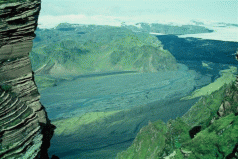
The slopes became grass cliffs, which forced me left onto a steep but easy ridge. The ascent was fast, and unaware of the imminence of revelation, I was suddenly looking down vertiginous knife edged ridges draped in moss, to the many channelled glacial outwash plain of the Mulakvisl river exiting the vast rubble snout of Hofdabrekkajokull, which sloped upwards pristinely white to the ice dome capping the volcano. I experienced landscape shock. The rawness was brutal.
I took my last three photographs and had no film left on the summit to capture the sight of the edge of the enormous Vatnajokull ice-cap 90 kilometres over the sandur to the east. Hjorleifshofdi was diminutive to the south across the sandur that looked like the surface of Mars, the thin lines of mossy water runnels imitating the canals of that planet. The pattern of moss fanning out from the base of Hafursey was fascinating.
I stayed on the summit for only a short while and munched some crackers. The air grew chill. The wind picked up. It was time to leave Hafursey. It was time to leave Iceland.
My descent was an involuntary sprint. The grass slopes were such a trick. I nearly pitched myself down a near vertical slope imagining I could move my legs fast enough to stay upright until the angle eased off 50 metres below.
Out on the sandur I walked into the cold wind blowing from the southwest. My arms grew numb. There was a sharp pain in my ears. I saw a skua sitting on the sandur away to my right, charcoal black on charcoal black. I deviated from my path, unaware that I had made the decision to do so. I did not get very close before the skua, its gaze averted, flew away on silent wings, flying so low it was soon invisible against the sandur. It might just have dematerialised. Had I really seen the skua? I looked at the spot where it had been sitting. There was nothing to differentiate that spot from any other on the sandur. The solitariness of the bird was majestic and disturbing.
I walked on trying to grab hold of words in my benumbed brain to sum up that day in Iceland, which seemed a distillation of all my days in Iceland. I thought at one point I had the perfect order and all I needed was a pen and notebook to jot them down. But I had neither and anyway my hands were so numb I would not have been able to write. I was probably hallucinating. The wind. The wind. I actually thought the wings of the skua had brushed my face. Then I thought of Bellerophon, who presumed to fly up to Olympus on the winged horse Pegasus, to transcend human limitations and become immortal with the gods. For his presumption he was thrown from the horse and condemned to wander the Aleian Plain for eternity, avoiding all contact with humans. Would Bellerophon be shunned by humans, or would he, like the skua, be compelled to avert his gaze? I had recognized Bellerophon in the skua. I had discovered the Aleian Plain. It was not in ancient Cilicia, now modern Turkey, but here in the sandur of southern Iceland, assailed by a perpetual icy wind and the stench of sulphur from the volcano.
POSTSCRIPT
Four years later, in October 1996, it wasn’t Katla that erupted but a volcano under Vatnajokull, the largest ice-cap in the country, about 90 kilometres away from where I stood on the summit of Hafursey. The resulting explosive glacial flood, or jokulhlaup, was Iceland’s most powerful flood in 60 years. Roads were washed away and bridges turned into twisted steel sculptures. Boulders and massive blocks of ice were strewn across the landscape. There was no loss of life.
Bob McMahon will be returning to Iceland at the end of May in a trip that will also take in some islands off the west coast of Ireland, St Kilda in the Outer Hebrides, Orkney and the Faroes.

Looking from the summit of Hafursey onto the black rubble snout of Hofdabrekkujokull and the glacial outflow Mulakvisl River. This is where most of the flood would emanate should Katla,lurking under the ice, erupt.


On the island of Hjorleifshofdi. The Myrdallsjokull ice-cap, under which slumbers the active Katla volcano, is in the distance. The mountain to the right of the ice cap is Hafursey.

Susie on Hjorleifshofdi. The ice dome of Myrdalsjokull is in the distance.

Hjorleifshofdi, 15 kilometres distant, viewed from the slopes of Hafursey.