Economy
Gunns tries to clear-fell a forest of speculation

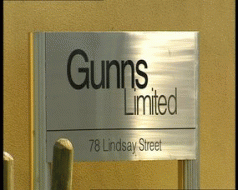

RECENT days have seen a swirl of speculation surround Gunns, Australia’s largest woodchipping company. Chairman John Gay has come out swinging as he seeks to stave off demands from institutional investors that three long-term Tasmanian directors resign, presumably with a view to constituting a new board with a strategy that doesn’t involve logging high-conservation forests or building pulp mills.
Also destabilising the company are rumours circulated by environmental interest groups claiming Gunns’ finances are in such a parlous state that ANZ is insisting on signing off on all cash outflows.
A spokesman for Gunns yesterday scotched the rumours, noting that ”we have a very good relationship with ANZ Bank and there is no truth to any of that speculation”. Gunns’ denials are believable as, despite profit in the December half falling 98 per cent, there is no indication the company has breached debt covenants. At least not yet.
Still, for anyone wondering whether the company can find it’s way through current difficulties there is one coal-mine canary that could provide an insight into how insiders are seeing the company’s prospects.
Gunns’ annual financial statements disclose an unsecured note scheme that allows company executives to deposit cash with the company, presumably offering an interest rate a little better than a bank deposit.
In June 2008, when the Gunns’ share price was $2.38 and the company was in relatively robust health, the scheme held $7.8 million. By June 2009, with the share price at $1.07, several depositors had headed for the exits and the scheme held $4.8 million.
Unfortunately the unsecured note scheme balance is published just once a year. But with the company’s share price now at 55.5¢ and with an uphill battle to keep the bank at bay looming, it would be interesting to know how the unsecured note scheme balances are now looking.
Meanwhile, in The Examiner:
GUNNS shares recovered by 3.74 per cent on the back of more than 16 million trades yesterday as Tasmanians spoke of how disappointing it would be if the timber company moved its head office away from Launceston.
Chairman John Gay has been under pressure from interstate business interests to quit the company’s board and take fellow Tasmanian directors Robin Gray and Richard Millar with him.
On the back of a 98 per cent half- year profit drop, the three men have been asked by large institutional investment groups to leave the company, with Mr Gay labelling the request a Greens-led stunt.
But shareholders have shown concern for the company’s performance, wiping more than 30 cents off its share price in recent weeks.
Gunns’ lowest recorded trade was around 50 cents back in 2000 and it looked as though the stock was headed there again before yesterday’s small rebound to 55 cents.
Mr Gay said that if he left, then Gunns’ head office would relocate to the mainland.
Financial analyst Tony Gray said that would be bad news for the Launceston economy.
“You would, over time, see few directors and highly paid executives in Launceston,” Mr Gray said.
“I can’t put a number on it but it’s not healthy for a local economy.
“At the moment, when people fly in for the AGM, they stay in Launceston, the executives use local services and buy local motor vehicles, so there are lots of flow-on effects.”
Launceston Chamber of Commerce executive officer Lou Clark said the chamber would be disappointed if Gunns chose to move its head office from Launceston.
“We are doing business in a global and connected community these days,” she said.