Economy
Let’s not experience the despair of Roelf

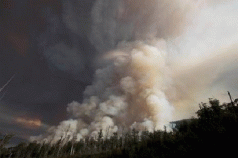

I WAS ASKED to talk at a meeting at the Hobart Town Hall today (Thursday) to talk about some of the health issues associated with the Forestry Tasmania proposal to burn, each year, around 1 million cubic meters of native forest timber to generate electricity.
The meeting was organised by The Huon Environment Centre and Environment Tasmania.
I had planned to give the usual spiel about this crazy and irresponsible plan just locking in business as usual in the setting of nothing else to do with the clearfelled timber now that the native forest wood chip market has collapsed.
I was going to say that this new business was the same-old, same-old and ignored what we really need to do in Tasmania; resolve the social divisions created by the forest industry moguls, protect our biodiversity, water catchments and food producing land and get real about reducing carbon pollution by ending the industrial scale burning of forests.
Will Mooney kicked off the session with an excellent, well researched talk which pretty much took my thunder.
I sat wondering what to say. I thought about the hope that comes at election times and I remembered a man who got his hopes up too much prior to the Federal election in 2004.
That man was Roelf Roos whom I wrote about in 2004 on Tasmanian Times.
Roos, who lived on Roses Tiers in the North East of Tasmania, was born in Berlin in the 1930s and experienced the horrors of war as a child.
The last seventeen years of his life were spent in Tasmania; he was a lover of nature and at first he thought that he and his wife, Ursula, had found heaven on Earth.
The story turned sour with the incursion of industrial scale conversion forestry into his neighborhood. The beautiful native forests he had come to love were clearfelled and burnt and military monoculture rows of E. Nitens replaced them (sustainable forestry Tasmanian style). For good measure throw in the chemicals 1080, triazines and insecticides.
Roos’ distress was known to readers of letters to The Mercury, The Examiner and this website.
Like the majority of Tasmanian people, Roos was not opposed to native forestry but he believed that something better than clearfelling, bulk woodchips, burning and poisoning was possible.
The arrival of Mark Latham on the political scene in the Federal election campaign of 2004 gave Roos hope that a positive restructure of the Tasmanian forest industry was a realistic prospect and that long suffering communities and stressed logging contractors could at last find a way out of their misery.
When Latham’s Labor failed Roos sank into despair and took his own life a few days later.
His wife gave permission for me to write his story, affirmed the accuracy of what I wrote and remarked that she wished for it to be known what had led her husband to such a terrible end.
I told the story again today.
I told the story because I fear that the one of greatest immediate health risks associated with anything that entrenches the business as usual approach to Tasmanian forestry is the extreme mental stress which it imposes on those people living in rural Tasmania who are directly exposed to the destruction of their treasured places every day.
My hope is that this coming election day will not bring such deflation as Roelf Roos experienced.
As I left the hall I was joined by a man in his late 30s or early 40s who clearly was mightily offended by what I had said. (I had been very strongly criticised in 2004 when I wrote the Roos story on Tasmanian Times and knew censure is a possibility when such events are described).
I was angrily accused of vilifying the hard working people making an honest living in the forest industry, causing them stress, showing my ignorance of forestry matters and failing to show respect to a noble profession. I was urged not to speak about matters beyond my ken and leave commentary to those who know the subject better than I.
Of course there is some validity in each of these criticisms.
I must point out that my problem has never been with forest contractors who have been very badly treated by their masters and would clearly have been much better off had Mark Latham won the 2004 election.
I do believe forestry is a noble profession. What is called forestry in Tasmania is not noble. I don’t think it really is forestry, it is really more akin to mining and it is devaluing our state and it’s future.
I feel sorry that such confrontations happen and prefer peace but it is my daughter’s future too and I do have a right and responsibility to speak up.
On Tasmanian Times, 2004, The Lament of Roelf Roos:
HERE