Economy
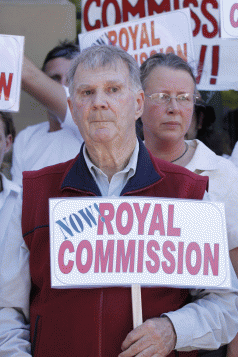
A Royal Commission, now: Peter Cundall in The Age Good Weekend (not online)


…
In the case of the mill proposal, in March 2007 the impartial body assessing it in Tasmania, the Resource Planning and Development Commission (RPDC), indicated that it was “critically non-compliant” with planning requirements. … Some days later, it withdrew from the whole RPDC process, citing “commercially unacceptable delays.” The very next day Tasmanian Premier Paul Lennon announced emergency legislation to bypass the RPDC and fast-track assessment of the proposal.
The Pulp Mill Assessment Act 2007, under which State Parliament approved the mill is, in the opinion of constitutional law expert and University of Tasmania senior law lecturer Michael Stokes “a mess. (On TT HERE)And the really bad thing about it was that is scrapped a very thorough impartial assessment and replaced it with an extremely minimalist process. The guidelines were substantially weakened and public hearings were ditched. A lot of people have said to me that is a very Third World way of doing things: where there is the appearance that a company was able to dictate to a government. That’s what you expect in the Third World, not here.”
As it stands, opponents like Cundall now believe that the act allows for the mill to go ahead even if, the consultants who assessed it are later found to be bribed. “That’s certainly a legitimate interpretation,” says Stokes.
When this extraordinary legislation was made public, all hell broke loose and Peter Cundall was right there in the middle of it. “It was this that enraged the public,” he explains. “People can see when they are being swindled. That’s why the population – and me – are absolutely appalled. And that’s why I stood outside Parliament House with other people (and was arrested) – to defend the integrity of Parliament.”
Sitting in his living room, the great galvaniser leans forward, holding up his hands, big, competent gardening hands. “I want to see a Royal Commission into the whole procedure by which this legislation was allowed to go through,” he says. Many other commentators agree with him, including both Stokes and (writer Richard) Flanagan. “There is now a very widely-help belief among Tasmanians that the Tasmanian government is corrupt,” says Flanagan. “This perception is immensely damaging for a society: it means that the necessary contract between a people and its government no longer exists.” A Royal Commission is “the only way to rebuild trust.”
“We’re dealing with the corruption that’s bleeding into Parliament from the mill”, is how Cundall puts it. He leans back, his mild brown eyes filled with the ferocious light of battle. “The stink of the mill has become the stenth of corruption.”
etc etc …
Looking around this garden – the tranquil landscape and china-blue sky and TamarRiver – it’s impossible to imagine anything spoiling Cundall’s pastoral serenity. But Gunns’ pulp mill, if it’s built, will be about 10 kilometres from the back door. Ironically it was Cundall’s own local member – parliamentary Speaker Michael Polley – who was responsible for Cundall’s arrest in November. “(That day in Hobart) he did something almost unknown in the history of Westminster government,” says Cundall as we return inside. He makes a chopping motion with his hands. “He had his own constituents arrested because he didn’t agree with them.” Chop, chop. “The police made it quite clear it wasn’t their decision (to ask Cundall and the protesters to move on, and to arrest them when they refused). They read out a statement saying, ‘We have been instructed by the Speaker of the House.’
…
“We weren’t blocking any entrance,” says (wife) Tina, who was also arrested. “We had markers down so that no-one would block the door.”