Welcome to shabby Hobart (don’t take my word for it, just read recent letters to the Mercury), and with it the decline of our old buildings (do take my word for it – I’ve been writing about the lack of preservation of our built heritage for a long time).
But has this linked situation caught the attention of our pollies as a plank of their political campaigning for the state election, particularly that built heritage neglect? Do you hear the sounds of silence in answer to that? Nothing from the Bartlett Government that I’ve seen thus far. Nothing from the hopeful replacement, the Liberals under Will Hodgman.
Hold on though, for there has been at least one indication that all is not lost. And it comes from the Greens, who may yet finish up holding the balance of political say after next month’s polling.
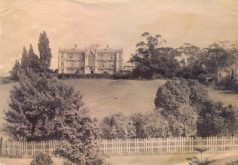
We find this indication from Wendy Heatley, Greens candidate for Franklin, in her call for the urgent rescue of Domain House, one of Hobart’s most impressive heritage buildings yet now very much in decline: disused and decaying. Rightly she says that allowing this 1840s sandstone building to rot is a disgrace. Little used for eight years, it’s damp and smelly inside, crumbling, and its Great Hall has rising damp (reported Bruce Mounster in a Mercury feature article).
It had previously been reported that the University of Tasmania wants the building back (it was the original university home and for a long tenure, 1890 to 1963, before the shift to Sandy Bay). Heatley says it would again make a fantastic city campus.
There are strong voices of support for Heatley’s cause, but negotiations with the Bartlett Government are bogged down. It seems that with other things heritage-wise this idea of building preservation doesn’t rate as a priority. They don’t seem to get the message – lose your built heritage and what do you have left to show future generations? Answer: a multitude of uninspiring present-day architecture.
Domain House is a Gothic landmark, and this fact reminds me of a link with another standout Hobart landmark from the same era: the Gothic Revival Holy Trinity Church of North Hobart. Bishop John Harrower decided the cost of repairs to its deteriorating outer sandstone wasn’t something they could tackle, so he closed and deconsecrated it.
Just as Holy Trinity is rated as one of the most important links with Australia’s early development, so does Domain House feature as one of the country’s oldest educational buildings. And here I’m reminded that there’s a significant connection between these two noble structures.
Domain House, built in 1848-49 (at the same time as Holy Trinity was completed and opened), began life as Hobart High School. Backed by local businessmen and clergymen as an independent school (non-government and non-Catholic), it filled the gap in the education system.
The man who became Hobart High’s rector was Richard Deodatus Poulett-Harris, and his achievements at the school were in keeping with such an impressive name, for his students showed the benefit of his educational expertise by winning many awards: in fact, heading the degree list nine times.
Two years ago that other website contributor, Percy From The Pews, in his fight for the cause of Holy Trinity’s preservation, wrote of the valued role provided by the Canadian-born, England-educated Poulett-Harris, for he was not only an educator but an ordained clergyman. As such he assisted with Holy Trinity services when Archdeacon Arthur Davenport was the minister, and also gave generously of his own money to the church. Proficient in German, he was able to conduct divine services in the 1870s for German migrants. And when the university came into being he became the first warden of the University Senate.
A memorial window was installed at Holy Trinity to honour his contributions. So here we have another fine example of just how close Holy Trinity was to the social history of Hobart.
As well as being the first Grand Master of Tasmania’s Masons, Poulett-Harris was a keen follower of cricket, which leads me to my next point on the preservation path.
While I might disagree with Mercury columnist Greg Barns on many of his utterances, I am in wholehearted agreement with him in his latest effort – on another part of the Domain the saving of the old TCA ground. Barns sees it as one of the most exquisitely appointed sporting venues in the world, overlooking broad vistas of the Derwent and located so handy to the city. He rightly asks that with the other improved sport facilities on the Domain – for tennis, swimming, athletics – why has the magnificent TCA ground been left to decay?
As one who enjoyed being there watching matches in its last days as an international venue, I didn’t appreciate the switch to Bellerive Oval, and still don’t, whatever certain members of the cricket establishment might think, and television commentators might say about that ground across the river.
Barns notes that a leading local sport identity in Gary Baker can’t understand why people in charge of such things are unable to see the sporting and tourism potential of the TCA ground. As Barns wrote: “It is hard to think of any other community in the world that would allow such a wonderful site to lie idle because they fail to realise the potential of a sporting facility located on the top of a hill with an extraordinary vista. But then this is Tasmania.”
He’s right on the money!