The Lamarkian implications of this are important from the point of view of basic science. And potentially important from the point of view of inheritance of acquired health problems. That is largely speculation, with some data indicating it is possible but no sense yet as to how commonly it takes place.
But these implications shouldn’t hide the profound importance of epigenetic mechanisms affecting development. Contaminants altering the epigenetic control of gene expression are key to understanding fetal origins of adult disease. This is where there are immediate opportunities to achieve health gains. We don’t have to wait to begin to capitalize upon these insights.
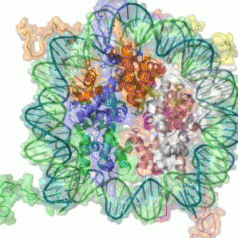
Chromatin: Change to the 3D stucture of DNA is just one epigenetic mechanism for turning genes on and off. (Picture: Zephyris, Wikimedia Commons.)
By Jade Johnston
The idea that evolutionary change occurs by the inheritance of acquired traits, as expounded by 18th-Century biologist Jean-Baptiste Lamarck, is long-thought to have been consigned to the bin of scientific oddities.
However, in a new twist on old science, faint echoes of Lamarck’s ideas can once again be heard in biologists’ laboratories – those at the cutting edge of genetic research, in the field of epigenetics.
“We now have evidence that our cells detect their environment and tag the DNA in ways that can be understood by the cells of subsequent offspring. It allows cells to adapt very rapidly to their environment and pass that adaptation on to future generations,” says Dr. Thea Edwards, a research associate at the US University of Florida’s Department of Zoology.
Epigenetics research has flourished in the last twenty years and studies how, through biochemical process, genes become switched on and off in response to changes in the environment. Organisms, in a way analagous to that originally proposed by Lamarck, pick up throughout their lives subtle changes to the way in which their genes are expressed.
This is significant for health because some of these changes can cause harm. “There are data showing that environmental contaminants can alter DNA tagging patterns. This can affect things like fertility – [and] we don’t know what it would take to get the tags back to their original form,” explains Edwards.
Research into a number of chemicals including vinclozolin, methoxychlor, and BPA are showing potential to cause epigenetic effects related to various diseases including cancer, diabetes and obesity, infertility, respiratory diseases, allergies, and neurodegenerative disorders such as Parkinson’s and Alzheimer’s disease. [EHP 115, No.9 Edwards at al.]
These effects stack up over a lifetime. Studies involving monozygotic twins have shown that although the twins begin life epigenetically identical, they accrue differences in methylation patterns as they age, with the greatest differences found between older twins living farther apart. [PNAS July 26, 2005 vol. 102 no. 30, Fraga et al.]
Given that twins who begin life genetically and epigenitally identical, something is modifying the supra-genetic mechanisms which control when their genes are turned on and off, which may result in one twin developing a disease such as cancer while the other twin does not.
“To me what’s so exciting about the field is that once we start defining these genes that are being altered genetically, you really do have the potential to prevent it and maybe even be able to go in and treat it,” says Dr. Randy Jirtle, Director of the Epigenetics and Imprinting Laboratory at Duke University, USA.
Currently, several new pharmaceuticals are coming onto the market which use epigenetic means to reactivate tumor supressor genes in cancer patients.
However, both Jirtle and Edwards insist it is much easier to use epigenetic knowledge to prevent disease rather than try to cure it. One possible application of epigenetic research in the future could be in risk assessment for chemical agents.
“In my opinion, public policy that protects us from exposure in the first place will make better medical and economic sense,” says Edwards.
And …
HERE: Open door to industry
HERE: Food packaging plastic harms babies and children