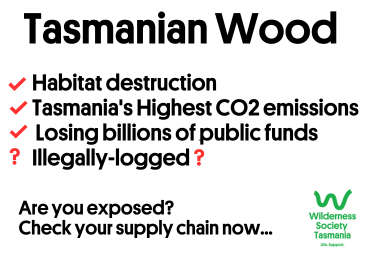
The Wilderness Society today called Gunns’ announcement that the pulp mill would be 100% plantation based at start-up a step in the right direction, but warned that the destruction of Tasmania’s native forest was set to continue unless further steps were taken. The Wilderness Society called on Gunns to commit to the protection of native forests and to renegotiate the pulp mill wood supply deal with Forestry Tasmania to exclude any native forest woodchips.
“Gunns’ announcement today is a step in the right direction however the proof we will need to see that Gunns is genuine is an end to the native forest-based wood supply deal. The wood supply deal currently locks in the annual supply of over 1 million tonnes of native forest wood for the next 20 years,” said Paul Oosting pulp mill campaigner for The Wilderness Society.
“For Gunns’ to become an environmentally and socially acceptable company and to achieve international standards, it must move existing business operations away from a dependence on logging native forests and focus entirely on the existing plantation estate.”
“So long as Gunns is responsible for the logging of native forests, including oldgrowth and rainforests, it will not be globally competitive or accepted.”
“It is encouraging to see that Gunns is now seeking to fix one of the major problems with the pulp mill and we hope they will address the other major problems such as the destruction of Tasmania’s native forests, the inappropriate site of the pulp mill and the devastating impact it would have on the marine environment, the fishing industry and local industries of the Tamar Valley.”
The Wilderness Society congratulated the community who have stood up to oppose Gunns’ pulp mill, with today’s announcement showing that their hard work is paying off.
“Public opposition to the pulp mill has led to Gunns being pressured to announce that they won’t use native forests in the mill, this is a major victory for the community, but more needs to be done,” said Mr Oosting.
“Gunns’ must now also commit to the protection of Tasmania’s irreplaceable native forests, change the location of the pulp mill and rule out the use of harmful pulp mill chemicals such as chlorine dioxide,” concluded Mr Oosting.
Paul Oosting, Wilderness Society