Economy
Welcome to the Third World, Tasmania

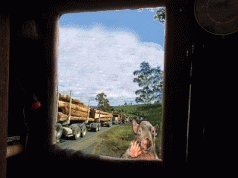

The first decade of the New Millenium saw the state of Tasmania, Australia reach third world status.
Hundreds of thousands of hectares of native forest, much of it pristine old-growth and rare temperate rainforest, were converted to a vast gigantic monoculture. A single species of tree in neat rows now spans almost the entire north of the state from the West Coast to the East Coast in a land the size of Ireland.[1]
Environment, land-occupancy, planning and zoning laws were changed to facilitate the takeover of family farms by a privileged network of heavily-taxpayer-subsidised agribusiness corporations. Bands of former Australian politicians soon joined the staff of these new ‘enterprises’ to share in the extraordinary windfall profits that flowed from this stepped-up rape and pillage. Annual reports and meetings included assurances to global investors that there were no serious impediments to profit-taking by way of environmental laws or considerations for conservation.
In a mere decade common and iconic animals such as the Tasmanian devil, the bandicoot [2] the Tasmanian quoll and four species of burrowing crayfish[3] became an endangered species. The wedge-tailed eagle is “under threat from all fronts” [4] while the local platypus were reported to display a “unique sensitivity to developing chronic skin ulcers … whereas the disease is not seen in mainland platypus” [5]. State and Federal Governments deliberately failed to incorporate scientific evidence into government decision making. [6] Nor did the Government provide adequate protection plans for these animals. [7] The abuse and neglect of our wildlife and flora was further reinforced when the Federal Environment Protection and Biodiversity Conservation Act was amended to accommodate trumped-up government notions of what constituted ‘protection’. [8]
After ten years water courses used for irrigation and domestic water supplies began to dry up[9] and became repeatedly contaminated by pesticides [10]. These chemicals have been long banned in other nations because of their toxicity and ease of movement in the environment. So, it was no surprise to read that in this state, where residents are forced to live in what amounts to a giant agribusiness industrial zone, that Tasmanians have significantly ‘poorer health outcomes compared to other Australians” [11] . In fact, three out of every four Tasmanians suffer from a chronic health condition which often “renders them unable to hold down a job and sees them struggle with simple daily tasks.” [12] Given the sheer scale of environmental and health degradation the Tasmanian Government has clearly found it a much more lucrative proposition to protect themselves over and above their constituency. Epidemiological and public health research outcomes remain long suppressed [13] as are the spray drift models for current ‘forestry’ aerial spray practices, for instance.[14]
Globally, it is hard to calculate exactly how huge the Tasmanian ‘forest’ industry’s contribution is to global warming. It must be massive, however. Hundreds of giant infernos are now lit with napalm; deliberately and routinely each year across the state as well as over the nation as a whole. Hundred of years of biomass in old growth forests have been put to the match, ancient stumps turned to charcoal and soils baked to a brick red. Now the plantations that have replaced these destroyed forests provide perfect fuel for much bigger wild fires that have begun to rage out of control with the advent of a dryer and hotter climate in South East Australia. [15]
Tasmania’s communities are struggling like they never have before. The state’s economy is quickly coming to a standstill with the biggest woodchipper, Gunns Ltd, now unable (at least for the time being) to find sufficient buyers for it ‘product’. But the story of Tasmania’s precipitous decline was foretold by many ordinary people whose clarity of thought was not polluted by heedless self-interest and bad morals. To see now that the dirty invisible hands of unfettered markets have spread their grasp into the first world makes me wonder just how little there must now be left to plunder in third world nations.
After all this, though, I can see that our forests and habitats in Tasmania have been killed – not by an enemy separate from ourselves – but by the aggregate consumption habits of a billion people on earth today. This is h-u-g-e and nothing more nor less than the enigma of people limited irrevocably to thoughts of childhood self-gratification. The state, says Tocqueville has prompted us to “dream of nothing other than being happy.”
I want to dream of a future; to dream of downed-wallets and powered-down lives. Maintenance of the huge possibility of continued human life on the planet requires our urgent change, now.
[1] “Tasmania ran up the country’s largest area of new plantation in 2008, with 27% of the total from slightly less than 0.9 of Australia’s land area”. This was all proudly reported by the Bureau of Rural Science in Tasmania’s Examiner newspaper on 23rd April 2009, notwithstanding the announced collapse of MIS giant Timbercorp, also reported on this day.
Comment by Tasmanian resident John Hayward
http://oldtt.pixelkey.biz/index.php?/weblog/comments/mckim/
[2] http://www.dpiw.tas.gov.au/inter.nsf/WebPages/SJON-58K8WK?open
http://www.tct.org.au/1080d.htm#Tasmanian
[3] Tasmania’s Freshwater Burrowing Crayfish (Engaeus sp.)
and the Mainland Yabby: Dispelling myths and informing
Students, Landowners, Fisheries Inspectors, Parks and
Wildlife Officers and Police
BUSHWATCH: 1800 00 5555
The Launceston Environment Centre: (03) 6331 8406
Threatened Species Unit at the Department of Primary
Industries, Water and Environment: (03) 62336556
Inland Fisheries Services: Launceston (03) 63365231
Hobart (03) 6233 4140
[4] *Rare eagles diving toward extinction*
By SIMON BEVILACQUA
14may06
[5] Failures in endangered species management. 10th March 2009
http://oldtt.pixelkey.biz/index.php?/weblog/article/failures-in-endangered-species-management/
[6] The insidious invasion of Bioterror
http://oldtt.pixelkey.biz/index.php/weblog/comments/the-insidious-invasion-of-bioterror/
David Obendorf and Joanne Connolly
[7] Quoll management plan released too late, trust says
http://www.abc.net.au/news/items/200509/1458178.htm?northtas
Monday, 12 September 2005. 11:34 (AEST)Monday, 12 September 2005. 11:34
[8] Protection of the environment was converted in meaning to a mere presumption of law that cannot be rebutted by evidence and must be taken to be the case whatever the evidence to the contrary. See the history of Brown v Forestry Tasmania [The Wielangta Case]
[9] “After about 10 years’ growth under intensive plantations, about one-in-eight of the streams that were in the areas that we studied had no flow for a year or more, and overall there was a 50 per cent reduction in stream flow,”
As quoted in: Plantations may do more harm than good, says CSIRO
Last Update: Sunday, January 1, 2006. 9:10am (AEDT)
http://www.abc.net.au/news/newsitems/200601/s1540198.htm
[10] Editorial: Not weak on water, 4th August 2009
www.themercury.com.au/article/2009/08/04/33155_editorial.html
[11] Lara Giddings, MP, Deputy Premier and Minister for Health and Human Services
Thursday, 29 May 2008
State of Public Health Report 2008
http://www.media.tas.gov.au/release.php?id=23855
[12] Plan to fight chronic disease. DAMIEN BROWN
December 07, 2009 09:13am
http://oldtt.pixelkey.biz/index.php?/weblog/article/plan-to-fight-chronic-disease/
The Mercury link: http://www.themercury.com.au/article/2009/12/07/114171_lifestyle.html
[13] Medical researchers angered by Govt suppression
By PM’s David Mark
http://www.abc.net.au/news/stories/2008/03/01/2177010.htm?section=justin
[14] The Australian Pesticides and Veterinary Medicines Authority (APVMA) had repeatedly failed to provide the aerial spray drift model outcomes requested by Brenda Rosser (moderator, Tasmanian Clean Water Network) for years now.
[15] The record bushfires of Victoria in February 2009 bear witness to this new and frightening development:
(i)Fire/land tenure map of the Murrindindi fire that burnt through Marysville overlaid onto the latest NASA satellite Infrared Image.25/02/2009 8:46 am
http://www.myenvironment.net.au/index.php/me/resources/bush_fire/research/fire_land_tenure_map_of_the_murrindindi_fire_that_burnt_through_marysville_overlaid_onto_the_latest_nasa_satellite_infrared_image
(ii) Links between bush fire and logging coupes
08/03/2009 1:24 pm
http://www.myenvironment.net.au/index.php/me/resources/bush_fire/research/links_between_bush_fire_and_logging_coupes
“….a logging map created from the DSEs forest explorer interactive maps. It may be more than a coincidence that the fire pattern just happens to follow coups logged over the last 30 years – hence lots of regen/regrowth, thirstier young trees, dryer undergrowth etc etc….
(iii) http://www.hancock.forests.org.au/docs/09feb.htm
Churchill Bushfire/plantation fire Feb 7 2009.
(iv) Feb 15 2009: Strzelecki Ranges/Jeeralang Creek West Branch from Jeeralang West Road. Plantations still smouldering but Hancock leave this unattended.
http://www.hancock.forests.org.au/docs/09feb.htm