Economy
No Climate Change without People Change.

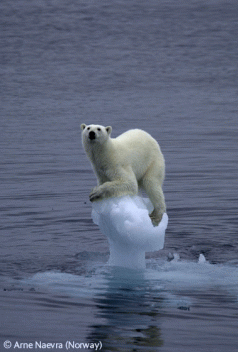

Up to 250 years ago the carbon content of the world was fairly static. There were large forests and little industry and society was basically agrarian.
Then came the invention of the steam engine followed by the Industrial Revolution, and the whole world changed. We started to mine fossil fuels and add this new source of carbon into the atmosphere. After 200 years it became noticeable that this was a bad policy as climate began to change and new weather patterns developed, but by this time, with the burgeoning population and high-living lifestyles, we were hooked on fossil fuels, just as much as an addict is on his supporting drugs. Further, the less developed nations see this ‘developed’ life-style as a desirable state and wish to catch up. Unfortunately, there are currently about five times as many have-nots as haves in the world and they are all scrambling for a piece of the action. Further, the world’s population is set to double in the next fifty years!
This is a certain recipe for disaster.
The current mantra of ‘Growth’ based on unlimited credit and debt has consumed the world’s resources, despoiled our forests, ruined our atmosphere, threatened our survival and passed this burden onto our children. This has also created an artificial situation whereby the ‘developed’ world is unwilling to give up its gains and the ‘developing’ and ‘undeveloped’ nations their aspirations of achieving these impossible standards for themselves. The resulting conflicts of culture is why a Copenhagen will ALWAYS fail and there is seemingly no practical solution to the pollution problem. No leader anywhere in the world is willing to sacrifice his political career by agreeing to any ‘accord’ that will materially impoverish his nation, which in practical terms translates into lowering the living standards and leaving the fossil fuels underground. But that, in fact, is the only way to save the planet. The current green energy solutions cannot even keep up with the increase in demand, let alone the base load.
Of course, the necessary question is, ‘is there any hope for the planet?’
There is, provided we do not reach the tipping point before it can be implemented when all solutions become meaningless. Applying the brakes at the moment of impact with the wall is a pretty useless exercise.
For any solution to succeed it has to succeed politically first. There is already a willingness on the part of many players to attempt to find a solution as demonstrated at Copenhagen. The world is waking up to the problem and there is a new awareness of the dangers, despite the denialists. Setting targets for reductions is always going to be a contentious issue as nations jockey for their own advantage. What is required is a totally different approach to the problem and a face-saving for the leaders that will allow them to sell it to their nations.
The solution.
We already know many of the factors involved and we can predict many of the others. For instance, we know what the current level of pollution is and we know what the maximum level of CO2 we can comfortably afford to stabilise the atmosphere. We know that life on this planet will be seriously impaired if the average global temperature rises above 1.5 to 2 degrees Celsius. We know the possible effects on the sea and we know many of the consequences of non-action. We also know what overall action to take to prevent this from happening, which is basically to dramatically cut our use of fossil fuels and preserve our forests. We can also work out the size of these cuts.
Copenhagen has demonstrated that this is not any one-nation problem and that ALL nations are willing to negotiate, even if they have not reached an acceptable conclusion. The people of the world have demonstrated that they are in favour of reducing emissions and it is mainly the vested interests of commerce and industry and their backers who oppose these solutions, and unfortunately, to a large extent, influence the politicians.
The solution lies in controlling the fossil fuel production throughout the world and seeing it, not as any one nation’s prerogative, but that these fossil fuels are the property of the whole world. After all, the atmosphere, which it affects, is the property of the whole world and currently the pollution by the richer nations tends to affect many of the poorer nations disproportionately more than it does themselves. This is patently unjust.
With all of the known factors, it cannot be too difficult to calculate the safe level of total emissions from fossil fuels that the atmosphere can tolerate, then using this as a base line, allocate an allowance of fossil fuel to each and every country, beyond which they may not go. This will obviously mean those countries with the current highest demands will be hit hardest, the developing nations will face cut backs and the underdeveloped will have somewhat of an advantage. What we need is the formula to make it possible.
Firstly, the initial cuts will have to be made on a sliding downward scale to prevent total chaos and hardship and give nations a short time in which to adapt to the new levels. Say 10% of the allowance by the end of the second year and increasing to the target level of 80% by 2050 and to reach the target of zero emissions by 2060. (Note that 10% of the allowance is not a 10% cut in usage if the allowance is only 50% of current levels. E.g. Normal annual usage = 1000 tonnes. Annual new allowance = 500 tonnes. 10% of 500 tonnes = 50 tonnes, so reduction by the end of the second year = 550 tonnes or 55 % of annual current fossil fuel usage. Obviously a huge target, but that maybe what is needed.)
Then the big problem; deciding on and accepting the quota system. This should have no bearing on the current economy of the nations and their present usage. It has to be a percentage of the world allowance pie in terms of population plus a distress factor. Small islands with a low population and low-lying countries will have a high ‘distress factor’ because they face total disaster, rather than discomfort or economic downturns, so some sort of weighting must be made in their allowances.
Once the formulas have been decided and the allowances allocated, the system will need policing at the bottom level of oil, coal and gas production as well as usage and forest retention. A certain amount of horse trading can emerge as the richer nations vie for any excess allowance from undeveloped nations, but on the understanding that total world production will not increase and the undeveloped nations are willingly selling their development potential. This will ensure a high price for carbon due to the small trading quantities. (To prevent corruption I would suggest that this should not be allowed to spark a new industry of ‘futures’ or carbon trading by the stock exchanges.) An alternative will be for some of the developed nations to shift their manufacturing to these nations and boost their economies in that way. There are many permutations, but one thing that should not be traded for extra carbon is forests. They should remain outside the carbon mineral trading and must nevertheless be preserved, for we cannot save the planet without their carbon dioxide absorbing capacity and they should not be used as an excuse to increase emissions. Lowering emissions does not reduce the quantity of carbon already in the atmosphere; it only turns off the tap; absorption of the existing load is the job of the world’s forests and they are currently not coping with the load. Trading in them does nothing to physically reduce the amount of carbon dioxide in the atmosphere nor does it increase their ability to absorb more CO2. Destruction of these forests should be added into the equation, as the more they are destroyed, the less we are able to contain the CO2 levels and the lower the carbon fuel allocations will have to be to compensate for this.
The net effect of this whole scheme will be to lower the living standards in the rich countries and possibly even the developing nations and to raise them somewhat in the poorer ones, but it will put the world back into survival mode. The in-fighting is going to be huge and the industrial and financial giants are going to oppose it all the way, but these are the ones that have caused the problem in the first place and must not be pandered to. It is probably better from the people’s point of view to be poorer but alive, than to be rich and dead! But the problem is not going to go away and delay is deadly, and the world cannot afford to wait for the bickering to finish before the action commences. In the final issue, money will not buy salvation!
It will also need a huge amount of political will and public willingness to accept the results but once the formula has been decided, it will of necessity have to be non-political. Simply a statement of what has to be done and how it is to be applied to all nations. Not a thing to be argued over. This is urgent and there is a strong ground swell in favour as the portents and signs of disaster are becoming stronger and more frequent.
When I was a child, I lived through the Second World War. It was a time of shortages, rationing and hardship, yet we survived. We had limited food, we did without motor cars, we had power cuts and we had none of the modern conveniences that made life easy. We willingly accepted that the only way forward was through ‘Blood, sweat, toil and tears’, but there was a tremendous sense of achievement, camaraderie and of purpose. It united the nation and gave them direction. Like never before everyone willingly embraced these hardships, and they ‘dug for victory’, reduced their spending and increased their savings, ‘made do and mended’ and ‘put their shoulders to the wheel’ and exchanged their expectations and reliance on a soft life for a more stoic existence. The eventual outcome, against the odds, was victory.
Here again the whole world faces a challenge and if we as humans wish to survive, we must meet this challenge head on. There is still a battle to be fought and it is not going to be easy, but, can we accept this challenge? Are we able to change? It needs a little inspiration and leadership, but in the words of Barack Obama, ‘Yes we can!’