The review is now is now easily available online, first go to www.gunns20.org and you will see the Steele Report on the home page.
Dr. Trevor Steele is a world authority on Legionella ecology.
He states in his review that:
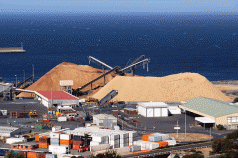
“It (the bottom layer) will undoubtedly at times contain Legionella and these could multiply there given the right conditions”. Steele goes on to say that “dispersal of dust…..containing these organisms could pose a significant health risk to susceptible persons working in, or residing in, adjacent residential or business districts, as well as susceptible workers on the Gunns site and in the port area”. Dr Steele also says that Legionella “could survive well in dust travelling long distances, even in adverse climatic conditions”. He cites distances distances up to 20 kilometers and provides the scientific papers which support this.
In his summary Steele states “Stockpiled woodchips that are undergoing partial composting over a number of weeks will support the growth of Legionella longbeachae (traditionally associated with wood products and compost), Legionella Pneumophila (traditionally associated with contaminated water in air conditioning cooling towers) and other Legionella species’.
In a concluding statement Dr Steele states that “It is also possible that dust containing Legionella pneumophila and other species that grow well in biofilms, could set up a secondary cycle of growth by contaminating air conditioning plants and thus set up another source of legionellosis in the community”. I (Frank Nicklason) have spoken to the wife of a man who worked in the Burnie CBD who developed and survived L.pneumophila infection in 2001. He had been expected to die by the Intensive Care Physicians treating him.
The infection was attributed to L.pmeumophila which was found in a water cooling tower in a building within a few hundred metres of the woodchip piles.
With respect to epidemiological evidence Steele states “The fact that none of the reported 21 cases of L. longbeachae infections in Tasmania was exposure to woodchips documented may simply mean that they were not asked of that exposure”.
I (Frank Nicklason) have spoken with a Burnie resident who lives within a few hundred metres of the woodchip piles who developed severe L.longbeachae pneumonia. I have seen the serology report confirming the infection) in mid 2001. He reports that he was not a user of compost and that his windows are often covered with dust that he believes to have come from the woodchip piles when there is an inshore wind blowing. This man required artificial ventilation in the NW general Hospital and has been left with some speech difficulties as a result of the illness.