Environment
A view from the end of the world

Peter Boyer Volunter Presenter, Al Gore’s Climate Project
Climate change became a crisis because what had seemed real — that we could go on accumulating, growing, expanding for ever — turned out to be a dream. We blocked from our minds a truth that underlies everything we do — that Planet Earth is a finite space.
And now we’re waking from our dream to find ourselves headed for a brick wall — the limits of our growth. The global warming crisis is forcing us into unfamiliar territory, where all the old, comfortable paradigms are suddenly worthless.
The warming of our planet’s atmosphere is a problem so gigantic that it promises to leave in the shade every adversity that our species has ever encountered — every natural disaster, every war and depression, every atrocity, every refugee emergency … everything.


IT seemed to come from nowhere …
Suddenly we’re all being asked to get our minds around the biggest, toughest, thorniest problem ever — the steady warming of our planet’s surface.
The media is finding a new climate story every day. Scientists, for so long ignored, are suddenly flavour of the month. The politicians are talking as if they always knew it was a problem and were just waiting for the rest of us to catch up.
Even the twin towers of big business and financial forecasting have been breached. Ignoring the climate factor is no longer a possibility.
What happened? How did climate change suddenly jump from relative obscurity to the top of the political issue pile?
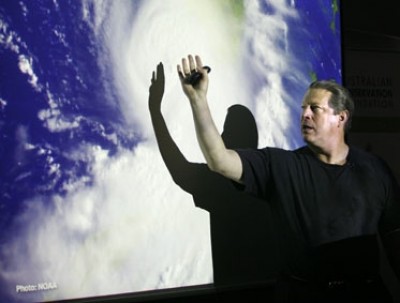
Al Gore

Al Gore’s Inconvenient Truth and Nicholas Stern’s UK economic review seem to have brought some weight and momentum to the debate, added to the spectre of a crippling drought and dwindling water.
But something else must have been lurking in the background — an underlying sense, maybe, that our government and corporate leaders didn’t really know as much about the world as they made out.
I was as surprised as anyone at how suddenly the scene changed — and I should have been prepared. In Sydney last November I was trained by Al Gore to be an Australian ‘Climate Project’ volunteer, along with one other Tasmanian (Jane Appleby, of Launceston) and around 80 others.
Since then we’ve all been preparing for the challenge of getting across to people at large what the climate change crisis is all about — why it is now demanding our urgent attention and will continue to bedevil us for decades — centuries — to come, and what we can do about it.
It’s a one-year commitment, but who knows how this is going to play out?
Planet Earth is a finite space
Climate change became a crisis because what had seemed real — that we could go on accumulating, growing, expanding for ever — turned out to be a dream. We blocked from our minds a truth that underlies everything we do — that Planet Earth is a finite space.
And now we’re waking from our dream to find ourselves headed for a brick wall — the limits of our growth. The global warming crisis is forcing us into unfamiliar territory, where all the old, comfortable paradigms are suddenly worthless.
The warming of our planet’s atmosphere is a problem so gigantic that it promises to leave in the shade every adversity that our species has ever encountered — every natural disaster, every war and depression, every atrocity, every refugee emergency … everything.
It may turn out to be not so bad. We have the capacity to limit the damage from climate change and mitigate its effects — and in the process create a better, more sustainable way of living on this planet. But we must act quickly, decisively … and together.
Transport and electricity production have to be the number one targets in any emission-reduction plan. That includes some of our truly sacred cows, notably car and air transport. Cutting back on those sorts of pleasures — while also finding low-carbon alternatives — won’t be easy.
A couple of years ago there was a collective shudder at the thought that we needed to reduce our carbon emissions by 30 per cent to stabilise carbon levels in the atmosphere. Some European governments (who are leading the world on tackling climate change) have now accepted that at least a 50 percent reduction is necessary.
The current scientific wisdom is that this is probably still well below what’s needed to stabilise carbon levels at even 150 percent of their present levels. To do this, the best estimates are that we’ll need to reduce our emissions by ninety (90) percent. Serious stuff.
Fuel-efficient cars, more use of public transport and better-insulated buildings will help, but we will still have to reduce our use of cars, air transport and electricity generated by coal or oil fuels (including diesel), while also developing low-emission, preferably renewable, energy sources.
We have some interesting times ahead.
Tasmania’s green hydro and windpower … has become part of the national mix dominated by coal
Tasmania’s high capacity to generate carbon-free electricity gives us a good start — our water and wind resources power 87 percent of our electricity needs. The remaining 13 percent is being converted from oil to relatively low-carbon natural gas.
Against that, we’re now connected to the national electricity grid, so our ‘green’ hydro and wind power becomes part of a vastly bigger national mix that’s dominated by coal.
The Roaring Forties bring us both water and wind. Our large-scale hydro power development has reached saturation, but with access to more wind than almost any other part of the inhabited planet we have scope to increase our wind-power generation many times over.
Which brings us to what Amory Lovins, the visionary American physicist, called ‘soft’ power — the power that is generated close to home in a decentralised electricity system. Like methane-driven power plants on waste disposal sites, or small hydro plants or windmills (remember them?).
The best ‘soft’ power is that generated by the user — by homes and industrial sites — and the most readily-available source is solar radiation. Tasmania receives as much sun as northern Italy or southern France. If we could successfully foster mass take-up of solar energy, it would be a very viable proposition both to heat hot water and to generate household electricity. Surplus solar power can be fed into the electricity grid to supply others.
Global warming is a deeply moral issue
Global change such as we’re now seeing calls for a global perspective, encompassing the whole of our planet in all its natural wonder, not just the artificial trappings — the home, the car, the workplace, the economy — which dominate our daily lives.
For me, living in Tasmania makes it hard not to think globally. In this southern land’s end, edging the stormiest, coldest places on the planet, nature is ever-present — in our water and our landscape, in our ever-changing weather, in our air. Nature is always intruding into our lives.
The need to consider other living things all over the planet — including people living in less fortunate circumstances than ourselves — makes global warming a deeply moral issue.
Mainly because of our hydro power system, Tasmanians are low greenhouse gas producers by Australian standards. But by world standards it’s entirely another story.
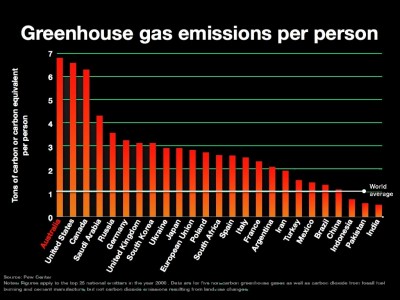
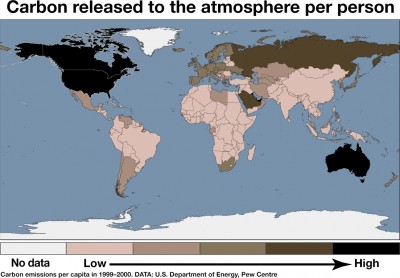
On a per-person basis, Australia is among the very top two or three greenhouse gas polluters on Earth, up there with one or two Persian Gulf states, slightly above the United States and well above Japan, China and India. On that scale, we in Tasmania can consider ourselves high-level polluters.
We owe it to others elsewhere in the world — and to those Tasmanians who come after us — to put in the effort to clean up our mess, whatever sacrifices are needed.
And at a national level, we owe it to the world to join the only regime so far negotiated to tackle the problem internationally — the Kyoto Protocol. Kyoto is not a perfect instrument, but it will get better over time, with the involvement of the whole world community.
The changes threaten everything
The changes in our climate threaten everything we value in our personal lives — the air we breathe, our water and food, our daily lives, our security and prosperity, and the future lives of our children. In the challenge ahead, all cards are on the table.
The remedies needed to meet such threats will undoubtedly come at a price, but it will be a price well worth paying. We are now forced to reconsider what our modern life is all about, but we should see it as a great opportunity to bring our communities and our personal lives more into harmony with the rest of our planet’s biosphere.
We still have a chance, but we’ve got to stop pretending all is well, get serious and get on with the job.
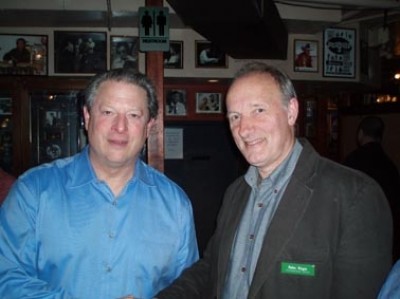
Al Gore, Peter Boyer

AL GORE’S CLIMATE PROJECT IN AUSTRALIA
The Climate Project, Al Gore’s climate change leadership program, took root in Australia late last year with the help of the Australian Conservation Foundation. The Climate Project is a US-based non-profit venture which arose out of the strong public response to Mr Gore’s hit documentary, An Inconvenient Truth.
The Australian Climate Project team includes two Tasmanians — Peter Boyer, of Hobart, and Launceston-based Jane Appleby. The Tasmanian program is being assisted by Sustainable Living Tasmania (formerly the Tasmanian Environment Centre).
In a three-day seminar in Sydney late last year, Mr Gore, the former US vice-president, guided 85 Australian trainees through the slide show that featured in An Inconvenient Truth. ‘The Climate Project in Australia aims to equip citizens with knowledge and skills to pass on to their community essential information about the science and effect of climate change, and the solutions needed to restore the health of our planet,’ Gore said.
More than 1700 Australians applied to attend the first Australian training session. The selected 85 presenters represent a diverse range of interests and come from all Australian states and territories.
‘We have been overwhelmed by community support for the program and the desire to drive real action on climate change,’ said ACF Executive Director Don Henry. The ACF is managing the Australian Climate Project and supporting the climate presenters.
Peter Boyer is a professional writer, illustrator and publisher. He is a former newspaper journalist and public sector manager in heritage and science agencies. In the latter capacity his work included writing and speaking about the climate science of Antarctica and the Southern Ocean — an interest that has continued into his freelance career and which was the basis for his selection as a Climate Project presenter.
Over the past two months Peter Boyer has been working with others in Hobart, including the city’s climate science community and people in government and non-government organisations, on how best to present the Al Gore message about climate change.
As well as visual material from the Gore film, his presentation will include new, more recent global information as well as Australian (and Tasmanian) slides.
From early March 2007, Peter Boyer and Jane Appleby are available to any audience that wants to know what climate change is all about and what they can do about it. Southern Tasmanian groups wishing to book a Climate Project presentation should contact Sustainable Living Tasmania on telephone 6234 5566 or email info@sustainablelivingtasmania.org.au.
Peter welcomes calls from anyone wanting to know more about the Climate Project. His telephone number is 6239 1181, or email peterboyer@southwind.com.au.
FINDING OUT WHAT’S HAPPENING
The Web is the ideal source of information for something as fast-moving as the climate change debate. Here’s a small sample which can be starting points — but there are many more places to go as you’ll find out.
INTERNATIONAL: You can find Al Gore’s ‘climate project’ page at Http://www.theclimateproject.org — it has good basic information on the science but is especially useful if you’re interested in taking an activist role.
For an easily-understood, comprehensive summary of the science, you can’t go past the Pew Centre at http://www.pewclimate.org. It has sections on the basics of global warming, in-depth analysis, public policy and ‘businesses leading the way’, as well as a ‘press room’ to keep people abreast of what’s happening. The Pew Centre provided an excellent analysis of the IPCC report within hours of its release — you can find that at http://www.pewclimate.org/global-warming-basics/ipcc.cfm
If you want to know more about what forward-thinking US business is doing about climate change, go to the United States Climate Action Partnership at http://www.us-cap.org
HOME: The Australian Government, which has dragged its feet on taking action on climate change, is ironically the source of some of the best practical information for individuals and households — you can find the government’s Greenhouse Office site at http://www.greenhouse.gov.au
The Australian Conservation Foundation http://www.acfonline.org.au is one of numerous ‘green’ organisations with strong climate change information and good practical advice on what you can do to help. In Tasmania, Sustainable Living Tasmania (formerly the Tasmanian Environment Centre) operates an excellent little site for practical information at http://www.up2me.com.au/
Australian business too has its climate change leaders. The Australian Business Roundtable on Climate Change can be found at http://www.businessroundtable.con.au
*From high on Greenland’s ice sheet comes this sign that the planet is heating — and a warning that our sea levels may rise much faster than we currently think. Waterfalls like this one, photographed during a recent northern summer, are increasingly frequent in Greenland. The water is heading kilometres down through the ice to the rock at the bottom. Glaciologists believe the meltwater is helping to lubricate the ice as it moves over the base rock, which would increase the rate of decay of this enormous body of land ice — and ultimately cause world sea levels to rise by several metres.